Diagnosis
Colorectal polyp
Tissue protrusions occurring in the colon lumen. May be malignant or benign based on size, growth pattern and atypia.
Also known as: Bowel polyp, Colon polyp, Colonic polyp, Gastrointestinal polyp
Etiology
Cause [mts]
Sporadic
Genetic (FAP, HNPCC)
Pathophysiology [mts]
Chronic inflammation --> Hyperproliferation --> Polyps
Non-neoplastic polyps: hyperplastic, juvenile polyps, hamartomas, and inflammatory pseudopolyps
Neoplastic polyps --> inactivation of tumor suppressor genes (APC), or mismatch repair genes (MLH1) --> adenocarcinoma
. Genetics play a significant role; familial adenomatous polyposis (FAP) is autosomal dominant, and the majority of affected patients develop colorectal cancer (CRC) by age 40. Juvenile polyposis syndrome (JPS) is also autosomal dominant. Fifty to sixty percent of patients have a mutation in the SMAD4 or BMPR1A gene.
Types of polyps [mts]
Hyperplastic (most common)
Adenomatous (tubular >80%, villous 5-15%, tubulovillous 5-15%)
Serrated (sessile or traditional)
Hamartous
Submucosal: Lymphoid, lipoma, carcinoid
Risk factors [mts]
Advancing age
Male gender
High-fat, low-fiber diet
Tobacco use
Alcohol intake
Family history of polyps
Colorectal cancer
Intestinal polyposis
Complication [mts]
95% of colon adenocarcinoma originate from polyps
Epidemiology
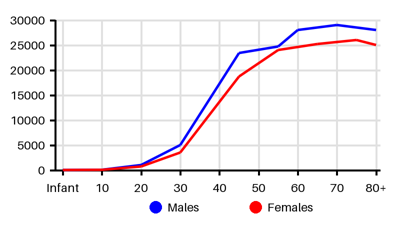
Incidence per 100.000 [tnv]
Symptoms & findings
Symptoms
Change in bowel habits, Hematochezia, Melena, Mucus
Clinical findings
None listed.
Anamneses
None listed.
Approach
Rectal exam
Rectoscopy
Sigmoideoscopy
Colonoscopy: the gold standard of colorectal cancer screening
Biopsy
Treatment
Coloscopy: Endoscopic polypectomy
Surgical removal
Differential diagnoses
Colorectal cancer, Crohn disease, Ulcerative colitis
References
[1] Meseeha M, Attia M. Colon Polyps. [Updated 2023 Aug 8]. In: StatPearls [Internet]. Treasure Island (FL): StatPearls Publishing; 2025 Jan-. Available from: https://www.ncbi.nlm.nih.gov/books/NBK430761/
[2] Valian H, Hassan Emami M, Heidari A, Amjadi E, Fahim A, Lalezarian A, Ali Ehsan Dehkordi S, Maghool F. Trend of the polyp and adenoma detection rate by sex and age in asymptomatic average-risk and high-risk individuals undergoing screening colonoscopy, 2012-2019. Prev Med Rep. 2023 Oct 10;36:102468.
[3] Conway AA, Gerry JM, Sacco F, Wren SM. High Prevalence of Adenomatous Polyps in Alaska Native People Aged 40-49 years. J Surg Res. 2019 Nov;243:524-530.
[4] Aloysius MM, Nikumbh T, Yadukumar L, Asija U, Shah NJ, Aswath G, John S, Goyal H. National Trends in the Incidence of Sporadic Malignant Colorectal Polyps in Young Patients (20-49 Years): An 18-Year SEER Database Analysis. Medicina (Kaunas). 2024 Apr 21;60(4):673.
[5] Jacobson JS, Neugut AI. Epidemiology of gastrointestinal polyps. Surg Oncol Clin N Am. 1996 Jul;5(3):531-44.