Diagnosis
Colorectal cancer
Cancer in the colon or rectum.
Also known as: Bowel cancer, Colon cancer, Rectal cancer
Etiology
Cause [cmb]
Usually sporadic [95%)
Hereditary malignancies (5%):
Lynch syndrome (hereditary nonpolyposis colon cancer - HNPCC)
Familial adenomatous polyposis (FAP)
Pathophysiology
Normal mucosa -> chronic inflammation
Hyperproliferation -> accumulation of mutation (MMR, APC, KRAS, TP53, and BRAF)
Early adenoma -> intermediate adenoma -> late adenoma
Carcinoma (-> metastatic disease)
Risk factors [cmb]
Age
Race
Diet
Inflammatory bowel disease
Family history
Inherited mutations: HNPCC, FAP, and Peutz-Jegher polyposis
Adenomas on screening colonoscopy
Lifestyle factors: Alcohol consumption, cigarette smoking, obesity, diets rich in processed red meat, insulin resistance, history of prior radiation, and immunosuppression
Protective factors [cmb]
Physical activity
Diet: Fruits, vegetables, fiber, resistant starch, and fish
Supplementations: folate, folic acid, pyridoxine, calcium, vitamin D, and magnesium
Garlic
Coffee
Aspirin, NSAIDs, hormonal replacement therapy, statins, bisphosphonates, and angiotensin inhibitors
Epidemiology
Incidence per 100.000 [dr8]
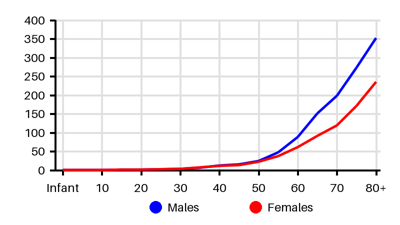
Symptoms & findings
Symptoms
Absent feces, Absent flatus, Anorexia, Change in bowel habits, Hematochezia, Ileus, Lymphadenopathy, Melena, Virchow's node, Vomiting, Weakness, Weight loss
Clinical findings
Absent distal rectal air, Air-fluid level, Anemia, Elevated CEA, Elevated Sedimentation Rate, Gastrointestinal dilatation, Gastrointestinal stenosis
Anamneses
None listed.
Localized findings
Approach
Blood test
Rectal exam
Hemofec
Colonoscopy
CT abdomen
Treatment
Surgery
The only curative modality for localized cancer (stage I-III) -> Hemicolectomy
Stage IV:
Colonic stenting
Resections of liver metastases
Partial hepatectomy + Hepatic arterial infusion of chemotherapeutic agents
Cryotherapy
Radiofrequency ablation
Liver transplantation
Adjuvant chemotherapy: 5-fluorouracil + levamisole/leucovorin or Capecitabine
Standard if stage III disease and metastatic colorectal cancer (stage IV)
Radiation therapy:
Limited to palliative therapy for selected metastatic sites such as bone or brain metastases
Biologic agents:
Bevacizumab (Avastin, Mvasi)
Cetuximab (Erbitux)
Nivolumab (Opdivo)
Panitumumab (Vectibix)
Pembrolizumab (Keytruda)
Tucatinib (Tukysa)
Fruquintinib (Fruzaqla)
Differential diagnoses
Arteriovenous malformation, Carcinoid tumor, Colorectal polyp, Crohn disease, Diverticulitis, Familial adenomatous polyposis, Gardners syndrome, Gastrointestinal lymphoma, Gastrointestinal obstruction, Hereditary nonpolyposis colon cancer syndrome, Ischemic colitis, Peutz-Jeghers syndrome, Small bowel cancer, Turcots syndrome, Ulcerative colitis, Volvulus
References
[1] Menon G, Cagir B. Colon Cancer. [Updated 2025 Feb 27]. In: StatPearls [Internet]. Treasure Island (FL): StatPearls Publishing; 2025 Jan-. Available from: https://www.ncbi.nlm.nih.gov/books/NBK470380/
[2] Voigtländer S, Hakimhashemi A, Grundmann N, Rees F, Meyer M, Algül H, Müller-Nordhorn J. Trends of colorectal cancer incidence according to age, anatomic site, and histological subgroup in Bavaria: A registry-based study. Front Oncol. 2022 Sep 20;12:904546.
[3] https://www.cancerresearchuk.org/health-professional/cancer-statistics/statistics-by-cancer-type/bowel-cancer/incidence#heading-One
[4] Siegel RL, Wagle NS, Cercek A, Smith RA, Jemal A. Colorectal cancer statistics, 2023. CA Cancer J Clin. 2023 May-Jun;73(3):233-254.
[5] Sifaki-Pistolla D, Poimenaki V, Fotopoulou I, Saloustros E, Mavroudis D, Vamvakas L, Lionis C. Significant Rise of Colorectal Cancer Incidence in Younger Adults and Strong Determinants: 30 Years Longitudinal Differences between under and over 50s. Cancers (Basel). 2022 Sep 30;14(19):4799.