Diagnosis
Melanocytic nevi
Acquired or congenital benign proliferations of melanocytes forming small collections of cells known as nests.
Also known as: Nevi
Etiology
Cause
Congenital melanocytic nevi: an error in the embryological migration (congenital malformation)
Acquired melanocytic nevi:
Ultraviolet exposure
Genetic factors (dysplastic nevus syndrome)
Blistering events (thermal burns, toxic epidermal necrolysis, epidermolysis bullosa)
Dysplastic nevi (Clark nevi): Acquired nevi that are relatively flat, thinly papular, and relatively broad. Precursors to melanoma.
Spitz nevi: Pink papules on the head of a child. Vascular ectasia display a hemangioma-like appearance.
Blue nevi: Melanocytic usually pigmented nevi. Because of the presence of deep pigmentation within a the skin, the brownish-black pigment present contributes a bluish cast to such lesions.
Pathophysiology [usz][d4l]
Melanocytes are dendritic cells derived from the neural crest present over the entire body surface.
Exogenous ultraviolet (UV) irradiation increase the density of melanocytes in normal epithelium
Melanocytic nevi represent proliferations of melanocytes that are in contact with each other, forming small collections of cells known as nests
These nevi commonly form during early childhood as a response to sun (UV) exposure
Genetic factors are also involved in the development of specific melanocytic nevi
Epidemiology
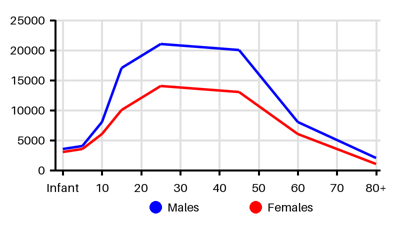
Prevalence per 100.000 [cre]
Symptoms & findings
Symptoms
None listed.
Clinical findings
None listed.
Anamneses
None listed.
Localized findings
Approach
Dermatoscopy:
Asymmetry
Borders: irregular
Color variation
Diameter > 6 mm
Evolution/elevation of lesion over time
Biopsy
Treatment
Excision
Lymph node sampling
Differential diagnoses
Basal cell carcinoma, Malignant melanoma, Pyogenic granuloma
References
[1] Bodman MA, Al Aboud AM. Melanocytic Nevi. [Updated 2023 Jul 17]. In: StatPearls [Internet]. Treasure Island (FL): StatPearls Publishing; 2025 Jan-. Available from: https://www.ncbi.nlm.nih.gov/books/NBK470451/
[2] http://emedicine.medscape.com/article/1058445; [Medscape]
[3] Valiukeviciene S, Miseviciene I, Gollnick H. The prevalence of common acquired melanocytic nevi and the relationship with skin type characteristics and sun exposure among children in Lithuania. Arch Dermatol. 2005 May;141(5):579-86.
[4] Black S, MacDonald-McMillan B, Mallett X, Rynn C, Jackson G. The incidence and position of melanocytic nevi for the purposes of forensic image comparison. Int J Legal Med. 2014 May;128(3):535-43.