Diagnosis
Omphalocele
A rare congenital abdominal wall defect with herniation of intestine (may contain liver and spleen depending on size) into the base of the umbilical cord with a protective membrane present.
Also known as: Exomphalos
Etiology
Cause/Pathophysiology [w62]
During organogenesis, the gut contents fail to rotate and return to the abdominal cavity
Failure of central fusion at the umbilical ring due to defective mesodermal growth causes incomplete closure of the abdominal wall and persistent herniation of the midgut
The abdominal viscera are contained in a translucent sac, which is composed of amnion, Wharton jelly, and peritoneum
Risk-factors [w62]
Young mothers < 20 years old
Old mothers > 40 years old
Associated anomalies: Beckwith-Wiedemann syndrome, Trisomy 13/18/21, Pentalogy of Cantrell, Shprintzen-Goldberg syndrome, Exstrophy of the bladder or cloaca, Carpenter syndrome, Charge syndrome, Marshall-Smith syndrome, Meckel-Gruber syndrome
Complications [w62]
Rupture of omphalocele --> liver injury
Pulmonary hypoplasia --> mechanical ventilation --> tracheostomy
Parenteral nutrition --> cholestasis and hepatomegaly
Feeding difficulties, failure to thrive
Inguinal hernias
Gastroesophageal reflux
Esophagitis
Epidemiology
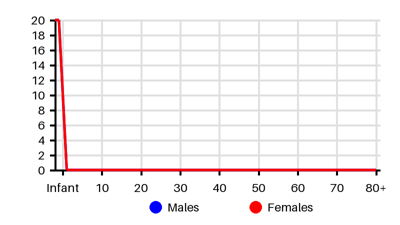
Incidence per 100.000 [3r8][6v3][2bi][pab][dei]
Symptoms & findings
Symptoms
None listed.
Clinical findings
None listed.
Anamneses
None listed.
Localized findings
Approach
Ultrasound during pregnancy
Clinical diagnosis
Treatment
Stabilization:
Airways
Sterile wrapping of the bowel to preserve heat to reduce insensible fluid loss
Orogastric tube for bowel decompression
Medications:
Intravenous fluids
Broad-spectrum antibiotics
Surgical repair [e4h][w62]
Small omphalocele --> surgical repair within 72 hours of life
Large omphalocele --> silo for progeressive reduction and then delayed closure
Differential diagnoses
Bladder exstrophy, Gastroschisis
References
[1] Zahouani T, Mendez MD. Omphalocele. Updated 2023 May 23: https://www.ncbi.nlm.nih.gov/books/NBK519010/
[2] Chen, H. (2016). Omphalocele. In: Atlas of Genetic Diagnosis and Counseling. Springer, New York, NY.
[3] Zhou GX, Liang J, Zhu J, et al: An epidemiological study on omphalocele in China during 1996 to 2000. Zhonghua Ya Fang Yi Xue Za Zhi 2004; 38:328 – 330.
[4] Rankin J, Dillon E, Wright C: Congenital anterior abdominal wall defects in the North of England, 1986 – 1996: occurrence and outcome. Prenat Diagn 1999; 19:662 − 668.
[5] Calzolari E, Bianchi F, Dolk H, et al: Omphalocele and gastroschisis in Europe: a survey of 3 million births 1980 – 1990. EUROCAT Working Group. Am J Med Gen 1995;58:187 − 194.
[6] Tiruneh C, Gebremeskel T, Necho M, Teshome Y, Teshome D, Belete A. Birth prevalence of omphalocele and gastroschisis in Sub-Saharan Africa: A systematic review and meta-analysis. SAGE Open Med. 2022 Sep 20;10:20503121221125536.
[7] Na Q, Liu C, Cui H, Zhang Z, Yin S, Li Q. Immediate repair compared with delayed repair of congenital omphalocele: short-term neonatal outcomes in China. J Int Med Res. 2011;39(6):2344-51.
[8] http://emedicine.medscape.com/article/975583 (2014-01-02); [Medscape]