Diagnosis
Gastroschisis
A congenital paraumbilical full-thickness abdominal wall defect where visceral organs herniate through without a protective membrane covering. This condition is distinct from omphalocele, where herniated organs are membrane-covered.
Also known as: Abdominoschisis, Laparoshisis, Paraomphalocele
Etiology
Cause [nv4]
Defective development of mesenchyme when the body stalk joins the abdominal wall
Elevated intra-abdominal pressure may disrupt the dysplastic abdominal wall
Pathophysiology [nv4]
The exposed organs are susceptible to damage from direct contact with amniotic fluid
May triggering immune responses and inflammatory reactions
Impaired intestinal function
External pressure on the protruding organs may cause injury and impaired peristalsis
Risk factors [nv4]
Younger maternal age
Maternal use of alcohol or tobacco during pregnancy
Complications [nv4]
Atresia
Necrosis
Perforation
Volvulus
Intestinal malformations
Short bowel syndrome
Need for total parenteral nutrition
Sepsis
Necrotizing enterocolitis
Respiratory failure
Infection
Feeding problems
Intrauterine growth restriction
Epidemiology
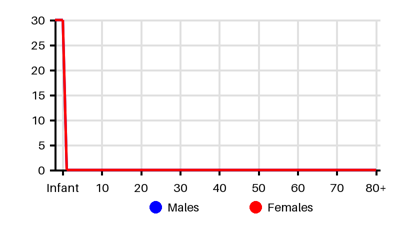
Incidence per 100.000 [osk][vqy][zsn]
Symptoms & findings
Symptoms
None listed.
Clinical findings
Anamneses
None listed.
Localized findings
Approach
Blood test: Maternal serum alpha-fetoprotein
Antenatal ultrasound --> necessitating delivery in suitable hospital with neonatal intensive care unit, and a pediatric surgeon
Blood gas analysis: hypoperfusion and/or inadequate ventilation
Treatment
If the stomach is distended (aerophagia) --> decompress with an orogastric tube [nv4]
Decompress the sigmoid colon and rectum --> facilitate reduction
Minimize loss of heat/moisture and protects the mesentery from twisting or stretching:
Cover the intestines with a moist nonadherent, semi-permeable membrane (plastic wrap)
Place baby in an incubator or a bowel bag
Hydration: 20 mL/kg lactated Ringer solution + 5% dextrose
Urine output provides the most accurate measure of the adequacy of fluid resuscitation
Broad-spectrum antibiotics
Reduction and closure: If the appearance of the intestines is normal
If the intestines are inflamed --> the intestines are placed within a silo and reduction is accomplished over the subsequent 7-10 days
Differential diagnoses
Bladder exstrophy, Omphalocele, Umbillical hernia
References
[1] http://emedicine.medscape.com/article/975583 (2014-01-02); [Medscape]
[2] Castilla EE, Mastroiacovo P, Orioli IM. Gastroschisis: international epidemiology and public health perspectives. Am J Med Genet C Semin Med Genet. 2008 Aug 15;148C(3):162-79.
[3] Calderon MG, Santos EFS, Abreu LC, Raimundo RD. Increasing prevalence, time trend and seasonality of gastroschisis in São Paulo state, Brazil, 2005-2016. Sci Rep. 2019 Oct 10;9(1):14491.
[4] Friedman AM, Ananth CV, Siddiq Z, D'Alton ME, Wright JD. Gastroschisis: epidemiology and mode of delivery, 2005-2013. Am J Obstet Gynecol. 2016 Sep;215(3):348.e1-9.
[5] Rentea RM, Gupta V. Gastroschisis. [Updated 2023 Apr 10]. In: StatPearls [Internet]. Treasure Island (FL): StatPearls Publishing; 2025 Jan-. Available from: https://www.ncbi.nlm.nih.gov/books/NBK557894/