Diagnosis
Gynecomastia
Benign proliferation of male breast glandular tissue more than 2 cm diameter in the subareolar region in axial CT images.
Etiology
Cause [916]
Physiologic: Neonatal, adoloscent, and senescent
Elevated estrogen:
Adrenal/HCG/Leydig/Seretoli-cell-tumors
Hyperthyroidism
Hypercortisolism
Liver failure
Obesity (extragonadal conversion of androgens to estrogen's by aromatase)
Decreased testosterone:
Aging
Primary testicular failure (Klinefelter's, mumps orchitis, castration)
Secondary testicular failure (hypothalamic/pituitary disease)
Renal failure
Malnutrition.
Drug side effects:
Spironolactone, cimetidine, GnRH, growth hormone, hCG, antiandrogens, 5-alpha-reductase inhibitors, antibiotics (Metronidazole, Ketoconazole, Isocyanide), chemotherapy (Methotrexate), cardiovascular (Digoxin, ACEI, calcium channel blockers, Amiodarone, Minoxidil), anxiolytic (Diazepam, tricyclic antidepressant, haloperidol, antipsychotic, alcohol, cannabis
Pathophysiology [8ff]
An imbalance in the ratio of estrogen to androgen tissue levels
Enlargement of glandular breast tissue and adipose tissue
Epidemiology
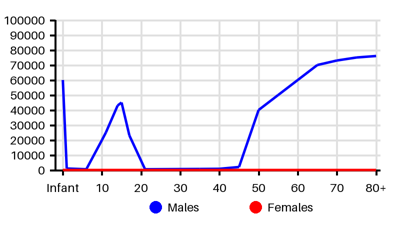
Prevalence per 100.000 [rom][5ot]
Symptoms & findings
Symptoms
None listed.
Clinical findings
Elevated Estrogen, Gynecomastia
Anamneses
None listed.
Localized findings
Approach
Blood test: liver function tests, creatinine, TSH, serum testosterone, estradiol, gonadotrophin, prolactin, LH, hCG
Mammography
Ultrasound: breast and testis
MRI of the head
CT abdomen
Biopsy
Treatment
A benign condition and is usually self-limited. Over time, fibrotic tissue replaces symptomatic proliferation of glandular tissue and tenderness resolves. Treatment of gynecomastia is geared toward its specific cause: [dp6][rom]
Observation
Drug therapy: estrogen receptor modifiers, aromatase inhibitor, anabolic steroids
Surgery (mastectomy or liposuction if only fat)
If the medical therapy is unsuccessful
If no regression after 1 year observation
If the condition worsens
If psychosocial problems rise due to gynecomastia
In patients after completing pubertal period
Differential diagnoses
Breast cancer, Cystosarcoma phyllodes, Dermoid Cyst, Drug side effects, Fat necrosis, Fibroadenoma, Fibrocyst, Hematoma, Hidradenitis suppurativa, Lipoma, Lymphoma, Mammary duct ectasia, Mastitis, Mondors disease
References
[1] http://emedicine.medscape.com/article/120858 (2014-01-02); [Medscape]
[2] Vandeven HA, Pensler JM. Gynecomastia. [Updated 2023 Aug 8]. In: StatPearls [Internet]. Treasure Island (FL): StatPearls Publishing; 2025 Jan-. Available from: https://www.ncbi.nlm.nih.gov/books/NBK430812/
[3] Johnson RE, Murad MH. Gynecomastia: pathophysiology, evaluation, and management. Mayo Clin Proc. 2009 Nov;84(11):1010-5.
[4] Aslan Ö, Bayraktaroğlu S, Çinkooğlu A, Ceylan N, Savaş R, Oktay A. Prevalence of Incidental Gynecomastia by Chest Computed Tomography in Patients with a Prediagnosis of COVID-19 Pneumonia. Eur J Breast Health. 2021 Mar 31;17(2):173-179.
[5] Abaci A, Buyukgebiz A. Gynecomastia: review. Pediatr Endocrinol Rev. 2007 Sep;5(1):489-99.