Diagnosis
Breast cancer
Cancer in the breast.
Etiology
Cause [dku]
75% ductal carcinoma
15% lobular carcinoma
5% Medullary carcinoma
4% mucinous colloid carcinoma
1% tubular carcinoma
Pathophysiology [dku]
Sporadic (90%-95%) and genetic (5%-10%)
A series of DNA mutations at critical genes
Resulting in breast epithelial cells with immortal features and uncontrolled growth
Classification [dku]
Estrogen receptor sensitivity
Progesterone receptor sensitivity
Human epidermal growth factor receptor 2 (HER2) sensitivity
TNM:
T1: <2 cm. T1a: 0.1 to 0.5 cm. T1b: 0.5 to 1.0 cm. T1c: 1.0 to 2.0 cm
T2: 2 to 5 cm
T3: >5 cm
T4: T4a: Chest wall. T4b: Skin. T4c: Both 4a and 4b. T4d: Inflammatory ca
N1: Mobile ipsilateral axillary nodes
N2: Fixed/matted ipsilateral axillary nodes
N3: N3a: Ipsilateral infraclavicular nodes. N3b: Ipsilateral mammary nodes. N3c: Ipsilateral supraclavicular nodes
M1: Distant metastases
Risk Factors [dku]
Increased exposure to estrogen
Early menarche (< 12)
Late menopause (> 55)
Nulliparity or first pregnancy > 30 years
White race
Old age
History of breast cancer in mother or sister
Genetic predisposition (BRCA1 or BRCA2 positive, Li-Fraumeni syndrome)
Postmenopausal estrogen replacement
Radiation exposure
Epidemiology
Incidence per 100.000 [dku]
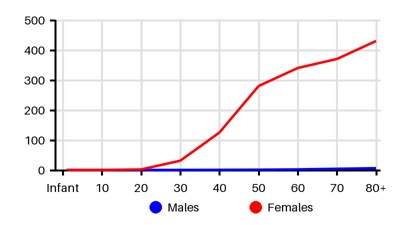
Symptoms & findings
Symptoms
Galactorrhea, Lymphadenopathy, Peau d'orange, Weight loss
Clinical findings
Anemia, Elevated Sedimentation Rate, Hypercalcemia
Anamneses
None listed.
Localized findings
Approach
Blood test [dku]
Mammography
Ultrasonography
MRI
PET
FNA
Biopsy
BRCA
Triple-negative: estrogen receptor, progesterone receptor, and HER2 receptor
Treatment
Early-stage breast cancer --> Surgery: Partial mastectomy or lumpectomy
Locally advanced breast cancer:
Preoperative (neoadjuvant) chemotherapy
Surgery (mastectomy) with axillary lymph node management
Adjuvant treatment to treat micrometastatic disease:
Radiation therapy
Chemotherapy
Hormone therapy: Anti-estrogen or aromatase inhibitor if hormone positive
Biologic agents
Metastatic breast cancer:
Hormone therapy
Chemotherapy
Differential diagnoses
Breast abscess, Cystosarcoma phyllodes, Fat necrosis, Fibroadenoma, Fibrocyst, Gynecomastia, Hidradenitis suppurativa, Intraductal papilloma, Mammary duct ectasia, Mastitis, Mondors disease, Paget's disease
References
[1] Menon G, Alkabban FM, Ferguson T. Breast Cancer. [Updated 2024 Feb 25]. In: StatPearls [Internet]. Treasure Island (FL): StatPearls Publishing; 2025 Jan-. Available from: https://www.ncbi.nlm.nih.gov/books/NBK482286/
[2] http://emedicine.medscape.com/article/1947145 (2014-01-02); [Medscape]
[3] [uptodate.com]
[4] https://www.cancerresearchuk.org/health-professional/cancer-statistics/statistics-by-cancer-type/breast-cancer/incidence-invasive#heading-One
[5] Fares et al. Breast Cancer Epidemiology among Lebanese Women: An 11-Year Analysis. Medicina 2019, 55, 463.
[6] Jemal A, Ward E, Thun MJ. Recent trends in breast cancer incidence rates by age and tumor characteristics among U.S. women. Breast Cancer Res. 2007;9(3):R28.
[7] Bertelsen et al. Age-specific incidence of breast cancer in breast cancer survivors and their first-degree relatives. Epidemiology. 2009 Mar;20(2):175-80.