Diagnosis
Umbillical hernia
Umbillical hernia is a subtype of ventral hernia (umbilical, epigastric, spigelian, and incisional) where abdominal contents herniate through a defect in the umbilicus.
Etiology
Cause [4tu]
Ascites
Obesity
Repeated pregnancies
Connective tissue disease
Congenital (10%)
Connective tissue disorders
Poor nutrition
Pathophysiology [4tu]
Obesity/ascites --> elevated intra-abdominal pressure
Stretching of the abdominal musculature --> separates muscle fibers and weaken the aponeuroses
Umbilical hernias occur at the fascial weakness in the thinned linea alba adjacent to the umbilicus where the umbilical vein penetrate the abdominal wall
In infants, umbilical hernias occur in 10% to 15% of cases and often resolve spontaneously by age 2
Clinical manifestation:
Usually asymptomatic periumbilical bulge
Pain during exercise
Complications [4tu]
65% will require surgical repair
4% require emergency intervention due to incarceration or strangulation the bowel and/or omentum
Surgical complications: surgical site infections, hematoma, early recurrence, seroma, bowel injury, foreign body reaction, mesh infection or migration
Epidemiology
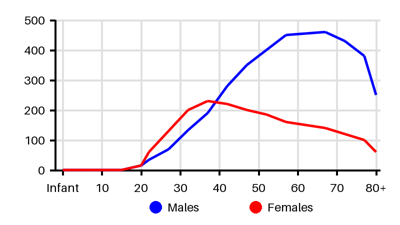
Prevalence per 100.000 [pmi][krg][4tu]
Symptoms & findings
Symptoms
Clinical findings
Anamneses
None listed.
Localized findings
Approach
Clinical diagnosis: Palpation
Blood gas
Ultrasound abdomen
CT abdomen
MRI abdomen
Treatment
Nonoperative management:
Smoking cessation
Weight reduction
Hernia belt
Surgical repair: if symptomatic or enlarging hernia larger than 2 cm in diameter [4tu]
Laparoscopic and robotic repair with mesh
Open surgery with or without mesh
Umbilical herniorrhaphy can be performed using various surgical techniques and may involve the use of synthetic or biologic mesh, depending on the size of the hernia, patient-specific factors, and the presence of contamination.
Differential diagnoses
Abdominal abscess, Desmoid, Granuloma, Hemangioma, Hematoma, Incisional hernia, Keloid, Lipoma, Lymphoma, Rectus diastasis, Rectus sheath hematoma
References
[1] Holt AC, Bamarni S, Leslie SW. Umbilical Hernia. [Updated 2024 Feb 27]. In: StatPearls [Internet]. Treasure Island (FL): StatPearls Publishing; 2025 Jan-. Available from: https://www.ncbi.nlm.nih.gov/books/NBK459312/
[2] Le, T. N., Afshar Ali, M., Gadzhanova, S., Lim, R., Bala, I., Bogale, K. N., & Gillam, M. (2024). Hernia repair prevalence by age and gender among the Australian adult population from 2017 to 2021. Critical Public Health, 34(1), 1–11.
[3] Burcharth J, Pedersen MS, Pommergaard HC, Bisgaard T, Pedersen CB, Rosenberg J. The prevalence of umbilical and epigastric hernia repair: a nationwide epidemiologic study. Hernia. 2015 Oct;19(5):815-9.
[4] [First Aid for the Surgery Clerkship]