Diagnosis
Lichen sclerosus
A chronic autoimmune dermatosis characterized by skin atrophy and hypopigmentation with genital and extragenital presentations.
Also known as: Balanitis xerotica obliterans, Kraurosis vulvae, Leukoplakia, Lichen sclerosis et atrophicus
Etiology
Cause [2qy]
Unknown cause
Multifactorial:
Genetic (association with other autoimmune diseases such as alopecia areata, vitiligo, autoimmune thyroiditis, and pernicious anemia)
Infectious trigger (spirochetes)
Sex hormone
Koebner phenomenon
Pathophysiology [2qy]
Infiltration of activated T cells releasing IL-4 and TGF-β
Activated fibroblasts producing significantly altered collagen leading to fibrosis
Vascular damage by the decrease in the number of capillaries
Complications [2qy]
Vulvar or penile squamous cell carcinoma
Loss of genital architecture:
Women: Introital stenosis, fusion, and resorption of the labia minora
Men: Phimosis, urethral stricture
Epidemiology
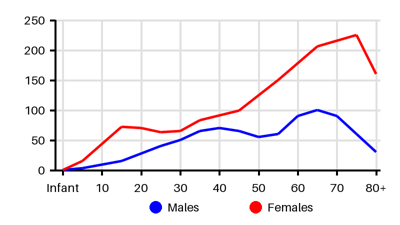
Incidence per 100.000 [zt7][ybc][4cb][v1t][avs][hor]
Symptoms & findings
Symptoms
Dyspareunia, Dysuria, Phimosis, Pruritus
Clinical findings
None listed.
Anamneses
None listed.
Localized findings
Approach
Clinical diagnosis: [2qy]
Lesion: Hypopigmentation and skin atrophy
Location: Commonly affecting the genital skin, less often the extragenital sites
Dermatoscopy [avs]
Biopsy with immunofluorescence
Treatment
Lifestyle changes: moisturizer, silk underwear, lubrication
First-line therapy:
Potent topical steroids (clobetasol ointment) once or twice daily for 3 months [zt7][jsy]
Second-line therapy:
Calcineurin inhibitors: tacrolimus and pimecrolimus
Third-line therapies: [jsy]
Topical or oral retinoids
Steroid injections
Cyclosporin
Methotrexate or hydroxyurea
Hydroxychloroquine < 6.5 mg/kg based on ideal body weight
For extragenital lichen sclerosus: phototherapy
If topical steroids fail in male patients --> circumcision [jsy]
Delayed diagnosis or steroid resistance --> genital reconstruction to restore functionality
Differential diagnoses
Acrodermatitis chronica atrophicans, Albinism, Anetoderma, Atrophoderma, Balanitis circumscripta plasmacellularis, Balanitis xerotica obliterans, Basal cell carcinoma, Candidiasis, Cutaneous T-cell lymphoma, Eczema, Graft-versus-host disease, Idiopathic guttate hypomelanosis, Leukoplakia, Lichen nitidus, Lichen planus, Morphea, Paget's disease, Pinta, Psoriasis, Scleroderma, Squamous cell carcinoma, Systemic lupus erythematosus, Tinea versicolor, Vitiligo
References
[1] Chamli A, Souissi A. Lichen Sclerosus. [Updated 2023 Jul 31]. In: StatPearls [Internet]. Treasure Island (FL): StatPearls Publishing; 2025 Jan-. Available from: https://www.ncbi.nlm.nih.gov/books/NBK538246/
[2] Jerkovic Gulin S, Lundin F, Eriksson O, Seifert O. Lichen Sclerosus-Incidence and Comorbidity: A Nationwide Swedish Register Study. J Clin Med. 2024 May 8;13(10):2761.
[3] Baandrup L, Hannibal CG, Hertzum-Larsen R, Kjær SK. Biopsy-verified vulvar lichen sclerosus: Incidence trends 1997-2022 and increased risk of vulvar squamous precancer and squamous cell carcinoma. Int J Cancer. 2024 Aug 1;155(3):501-507.
[4] Halonen P, Jakobsson M, Heikinheimo O, Gissler M, Pukkala E. Incidence of lichen sclerosus and subsequent causes of death: a nationwide Finnish register study. BJOG. 2020 Jun;127(7):814-819.
[5] Bleeker MC, Visser PJ, Overbeek LI, van Beurden M, Berkhof J. Lichen Sclerosus: Incidence and Risk of Vulvar Squamous Cell Carcinoma. Cancer Epidemiol Biomarkers Prev. 2016 Aug;25(8):1224-30.
[6] De Luca DA, Papara C, Vorobyev A, Staiger H, Bieber K, Thaçi D, Ludwig RJ. Lichen sclerosus: The 2023 update. Front Med (Lausanne). 2023 Feb 16;10:1106318.
[7] Choudhary C, Beazley R, Uppal E, Kravvas G, Bunker C. The age-related incidence of male genital lichen sclerosus is triphasic. Skin Health and Disease. 2024. e447.
[8] http://emedicine.medscape.com/article/1123316; [Medscape]
[9] [Clinical Dermatology 4.th Edition by Weller, Hunter, Savin and Dahl]