Diagnosis
Rectal prolapse
A circumferential, full-thickness intussusception of all layers of the rectal wall beyond the anal verge [654]
Also known as: Rectal procidentia
Etiology
Cause [vfs]
Congenital
Acquired: chronic constipation, weak anal sphincter
Pathophysiology [vfs]
Deficient pelvic floor
Increased intraabdominal pressure (excessive straining during to defecation)
Rectum herniates through the anal canal
Risk factors [654]
Elderly women, functional bowel disorders, chronic straining (neurological disorders, medications), multiparity, deep cul-de-sac, pregnancy, previous pelvic surgery, COPD, connective tissue disorders and hypermobility (Ehlers-Danlos syndrome), intestinal parasite infections
Epidemiology
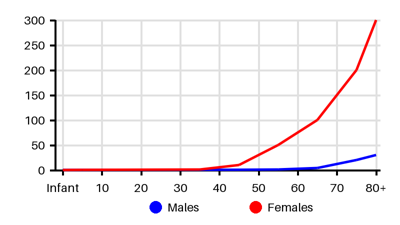
Incidence per 100.000 [uws][dgv]
Symptoms & findings
Symptoms
Constipation, Diarrhea, Fecal incontinence, Hematochezia
Clinical findings
None listed.
Anamneses
None listed.
Localized findings
Approach
Clinical examination [654]
Anoscopy/rectoscopy
Anorectal manometry
Colonoscopy: irregular bowel habits and for colorectal cancer screening
Pelvic floor imaging: defecography (MRI or fluoroscopic)
Internal prolapse
Anatomical defects: peritonealocele, enterocele, rectocele, or cystocele
Colonoscopies are typically indicated for patients
Treatment
Symptomatic: [654][zsz][vfs]
Constipation: fiber and stool softeners
Fecal Incontinence: avoid foods that accelerate gastrointestinal transit time (caffeine, lactose)
Skin breakdown: barrier ointments and absorbent pads
Pelvic floor physical therapy
Perineal procedures: preferred for elderly, frail and higher risk patients
Higher recurrence rates
Delorme procedure (mucosal sleeve resection)
Altemeier procedure (perineal proctosigmoidectomy)
Abdominal rectopexy prolapse repair:
Considered more durable than perineal operations
Rectopexy: Mobilization of the rectum and fixation to the sacral ligament
Laparoscopic ventral mesh rectopexy
Sigmoid resection + rectopexy
Wells procedure (posterior mesh repair)
Ripstein procedure (a band of mesh wrapped around the rectum)
Differential diagnoses
Colorectal polyp, Cystocele, Enterocele, Hemorrhoids, Intussusception, Proctitis, Rectocele, Urethrocele, Uterine prolapse
References
[1] Rajasingh CM, Gurland BH. Best approaches to rectal prolapse. Ann Laparosc Endosc Surg 2022;7:12.
[2] Gallo G, Martellucci J, Pellino G, Ghiselli R, Infantino A, Pucciani F, Trompetto M. Consensus Statement of the Italian Society of Colorectal Surgery (SICCR): management and treatment of complete rectal prolapse. Tech Coloproctol. 2018 Dec;22(12):919-931.
[3] Kairaluoma MV, Kellokumpu IH. Epidemiologic aspects of complete rectal prolapse. Scand J Surg 2005;94:207-10.
[4] Hatch Q, Steele SR. Rectal prolapse and intussusception. Gastroenterol Clin North Am. 2013 Dec;42(4):837-61.
[5] https://emedicine.medscape.com/article/2026460
[6] Hamel CT, Wexner SD. Rectal prolapse. In: Holzheimer RG, Mannick JA, editors. Surgical Treatment: Evidence-Based and Problem-Oriented. Munich: Zuckschwerdt; 2001. Available from: https://www.ncbi.nlm.nih.gov/books/NBK6929/