Diagnosis
Hemorrhoids
Prolapse of the submucosal veins located in the left lateral, right anterior, and right posterior quadrants of the anal canal.
Etiology
Cause/Pathophysiology [gub]
Pregnancy --> direct pressure --> decreased venous return
Low-fibre diet --> constipation --> decreased venous return
Portal hypertension --> decreased venous return
Risk factors [gub][ttg]
Lack of erect posture
Familial tendency
Higher socioeconomic status
Chronic diarrhea
Colon malignancy
Hepatic disease
Obesity
Elevated anal resting pressure
Spinal cord injury
Loss of rectal muscle tone
Rectal surgery
Episiotomy
Anal intercourse
Ulcerative colitis / Crohn disease
Classification of hemorrhoids [gub]
Internal
External
Reducible
Thrombosed
Ischemic
Complications [ttg]
Pain
Bleeding
Infection
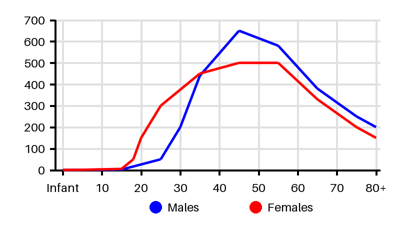
Epidemiology
Incidence per 100.000 [q44][ngn][qqs]
Symptoms & findings
Symptoms
Clinical findings
Anamneses
Localized findings
Approach
Blood test: Hb, PT-INR
Rectal exam
Anoscopy
Rectoscopy
Flexible sigmoidoscopy
Colonoscopy
Biopsy
Treatment
Only treat if symptoms. Asymptomatic hemorrhoids require no treatment.
Conservative treatment:
Diet: Increased fiber and liquid intake
Behaviour: Avoidance of straining and prolonged toilet sitting
Warm baths (twice or thrice daily)
Medical:
Stool softeners and antidiarrheal agents
Topical and systemic analgesics
Topical steroid cream
Surgery: [gub]
Internal hemorrhoids: No cutaneous innervation --> no anesthetic
Rubber band ligation: recurrence rates of 30-50% within 5-10 years
Ablation
Sclerosis
Hemorrhoidectomy: Grade III-IV or very symptomatic
External hemorrhoids (thrombosed):
Hemorrhoidectomy:
Infiltration of a local anesthetic containing epinephrine
Elliptical incision and excision of the thrombosed hemorrhoid, its accompanying vein, and overlying skin
Laser hemorrhoidectomy
Stapled hemorrhoid surgery
Doppler-guided transanal hemorrhoidal dearterialization
Differential diagnoses
Anal cancer, Anal fissure, Ascites, Cirrhosis, Colorectal cancer, Condyloma acuminatum, Constipation, Crohn disease, Portal hypertension, Pregnancy, Proctitis, Rectal prolapse, Ulcerative colitis
References
[1] https://emedicine.medscape.com/article/775407
[2] Lawrence A, McLaren ER. External Hemorrhoid. [Updated 2023 Aug 8]. In: StatPearls [Internet]. Treasure Island (FL): StatPearls Publishing; 2025 Jan-. Available from: https://www.ncbi.nlm.nih.gov/books/NBK500009/
[3] Hong J, Kim I, Song J, Ahn BK. Socio-demographic factors and lifestyle associated with symptomatic hemorrhoids: Big data analysis using the National Health insurance Service-National Health screening cohort (NHIS-HEALS) database in Korea. Asian J Surg. 2022 Jan;45(1):353-359.
[4] Xia W, Barazanchi AW, Coomarasamy C, et al. Epidemiology of haemorrhoids and publicly funded excisional haemorrhoidectomies in New Zealand (2007–2016): a population-based cross-sectional study. Colorec tal Dis. 2020;00:1–9.
[5] Johanson JF, Sonnenberg A. The prevalence of hemorrhoids and chronic constipation. An epidemiologic study. Gastroenterology. 1990 Feb;98(2):380-6.