Diagnosis
Seborrheic keratosis
A common benign epidermal tumor made up of immature keratinocytes.
Etiology
Cause [4mn]
Unknown
Genetic component
Pathophysiology [4mn]
Mutation --> A benign clonal proliferation of a immature epidermal keratinocyte
Paraneoplastic syndrome: The sign of Lesser-Trélat is the association of multiple eruptive seborrheic keratoses with internal malignancy (usually gastrointestinal adenocarcinoma)
Risk factors [4mn]
Age > 50 years
Sunlight
Irritation/skin friction
White skin
Epidemiology
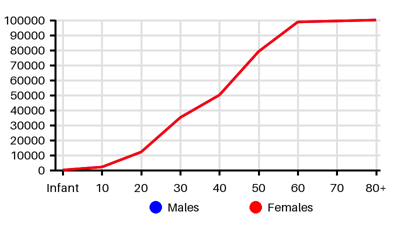
Prevalence per 100.000 [zwq][zs1][yza][efw]
Symptoms & findings
Symptoms
None listed.
Clinical findings
None listed.
Anamneses
None listed.
Localized findings
Approach
Dermatoscopy: multiple stuck-on, well-demarcated warty plaque
Biopsy
Treatment
Benign tumor --> Treatment is not mandatory
Often removed due to itchy, cosmetic reasons [4mn]
Ammonium lactate and alpha hydroxy acids [4ib]
Chemical peel (trichloracetic acid)
Tazarotene cream 0.1% applied twice daily
Eskata: hydrogen peroxide 40% solution
Crytherapy (for thinner lesions) [4mn][efw]
Curettage
Electrocautery
Ablative laser surgery
Shave biopsy
Differential diagnoses
Acanthosis nigricans, Acrochordon, Acrokeratosis verruciformis of Hopf, Actinic keratosis, Arsenical keratosis, Basal cell carcinoma, Bowenoid papulosis, Condyloma acuminatum, Confluent and Reticulated Papillomatosis, Cutaneous horn, Dermatosis papulosa nigra, Epidermal nevus, Epidermodysplasia verruciformis, Fibroepithelial polyp, Lentigo, Malignant melanoma, Melanocytic nevi, Nevus sebaceus, Pemphigus erythematosus, Premalignant fibroepithelial tumor, Prurigo nodularis, Psoriasis, Squamous cell carcinoma, Stucco keratosis, Verruca vulgaris
References
[1] Greco MJ, Bhutta BS. Seborrheic Keratosis. Updated 2024 May 6: https://www.ncbi.nlm.nih.gov/books/NBK545285/
[2] Yeatman JM, Kilkenny M, Marks R. The prevalence of seborrhoeic keratoses in an Australian population: does exposure to sunlight play a part in their frequency? Br J Dermatol. 1997 Sep;137(3):411-4.
[3] Huang J, Zhang L, Shi L, Wu M, Lv T, Zhang Y, Lai Y, Tu Q, Wang X, Wang H. An epidemiological study on skin tumors of the elderly in a community in Shanghai, China. Sci Rep. 2023 Mar 17;13(1):4441.
[4] Gill D, Dorevitch A, Marks R. The prevalence of seborrheic keratoses in people aged 15 to 30 years: is the term senile keratosis redundant? Arch Dermatol. 2000 Jun;136(6):759-62.
[5] Kwon OS, Hwang EJ, Bae JH, Park HE, Lee JC, Youn JI, Chung JH. Seborrheic keratosis in the Korean males: causative role of sunlight. Photodermatol Photoimmunol Photomed. 2003 Apr;19(2):73-80.
[6] http://emedicine.medscape.com/article/1059477; [Medscape]
[7] Jackson JM, Alexis A, Berman B, Berson DS, Taylor S, Weiss JS. Current Understanding of Seborrheic Keratosis: Prevalence, Etiology, Clinical Presentation, Diagnosis, and Management. J Drugs Dermatol. 2015 Oct;14(10):1119-25.