Diagnosis
Condyloma acuminatum
Benign proliferations of skin and mucosa caused by the human papillomavirus (HPV).
Also known as: Anogenital warts, Genital warts, Venereal warts, Verruca acuminata
Etiology
Cause [7e4]
HPV infection
Pathophysiology [7e4]
Primarily spread through sexual contact
Infection of squamous epithelial cells --> virus can remain in a latent
HPV contains an oncogene --> proteins that stimulate cell proliferation
The number of infected squamous epithelial cells grows --> the epidermis thicken --> acanthosis/warts
Risk factors [7e4]
Age
Number of lifetime sexual partner
History of chlamydia and gonorrhea infections
Smoking
HIV
Complications [7e4]
Some HPV subtypes (16 and 18) can cause malignancy (anal/cervical/vaginal/oropharyngeal)
Warts may recur after treatment because of activation of latent virus present in healthy skin adjacent to the lesion
Epidemiology
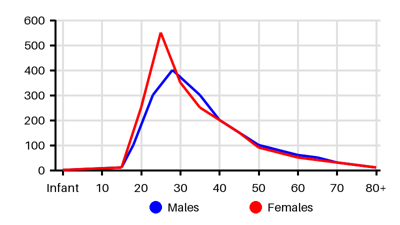
Incidence per 100.000 [rv2][du2]
Symptoms & findings
Symptoms
None listed.
Clinical findings
None listed.
Anamneses
None listed.
Localized findings
Approach
Cytology (Pap test)
PCR
Acetic Acid Test
Biopsy
Treatment
Prophylaxis --> Vaccine [uao]
Non-surgical treatment options:
Cytotoxic / antiproliferative drugs: podofilox, podophyllin, 5-FU, salicylic acid, trichloroacetic acid, and bichloracetic acid
Immune response modifiers (imiquimod and interferon alfa)
Sinecatechins ointment
Trichloroacetic acid solution
Isotretinoin
Surgical eradication or reduction of symptoms [rio]
Surgical excision
Chemical ablation
Cryotherapy (Liquid nitrogen)
Laser surgery
Electrocauterization
Photodynamic therapy
Squamous intraepithelial dysplastic lesions
Elimination --> Surgical excision
Differential diagnoses
Acquired digital fibrokeratoma, Acrochordon, Actinic keratosis, Anal cancer, Arsenical keratosis, Basal cell carcinoma, Cervical cancer, Cutaneous horn, Fibroepithelial polyp, Hemorrhoids, Herpes simplex, Hidradenitis suppurativa, Keloid, Keratoacanthoma, Lichen nitidus, Lichen planus, Molluscum contagiosum, Neurofibromatosis, Nevus, Penile cancer, Pityriasis versicolor, Prurigo nodularis, Psoriasis, Rectal cancer, Seborrheic keratosis, Squamous cell carcinoma, Syphilis
References
[1] Pennycook KB, McCready TA. Condyloma Acuminata. [Updated 2023 Jun 21]. In: StatPearls [Internet]. Treasure Island (FL): StatPearls Publishing; 2025 Jan-. Available from: https://www.ncbi.nlm.nih.gov/books/NBK547667/
[2] Tampubolon, Rio & Purwoko, M. & Devi, Mutia. (2022). Human Papillomavirus High-risk Type Infection on Perianal Giant Condyloma Acuminatum. Bioscientia Medicina : Journal of Biomedicine and Translational Research. 6. 1812-1818.
[3] Patel H, Wagner M, Singhal P, Kothari S. Systematic review of the incidence and prevalence of genital warts. BMC Infect Dis. 2013 Jan 25;13:39.
[4] http://emedicine.medscape.com/article/1133317; [Medscape]
[5] http://emedicine.medscape.com/article/219110; [Medscape]
[6] Marra F, Ogilvie G, Colley L, Kliewer E, Marra CA. Epidemiology and costs associated with genital warts in Canada. Sex Transm Infect. 2009 Apr;85(2):111-5.