Diagnosis
Incisional hernia
Abdominal wall hernia at the site of a previous surgical incision. A subtype of ventral hernia (umbilical, epigastric, spigelian, and incisional).
Etiology
Cause [vtt]
Decreased wound healing: hematoma, seroma, infection
Elevated intra-abdominal pressure: chronic cough, COPD, constipation, urinary retention, BPH, pregnancy, ascites
Poor surgical technique
Pathophysiology [vtt]
Intimate edge to edge fascial adaption is necessary for optimal healing
Chronically increased intraabdominal pressure --> risk of dehiscence
The presence of gaps between the two healing edges --> weak scar tissue
Risk of incomplete patency of the abdominal wall
Risk factors [bem][vtt]
BMI (obesity)
Age
DM
Renal failure
Smoking
Malnutrition
Steroids and immunosuppressants
Complication [vtt]
Obstruction
Strangulation
Incarceration
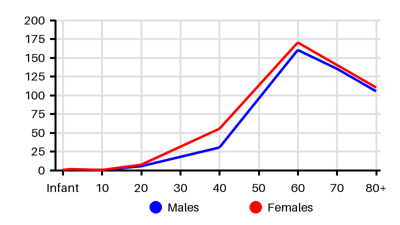
Epidemiology
Incidence per 100.000 [vtt][bem][syi][g4k][ypw][nfu][t6b]
Symptoms & findings
Symptoms
Absent feces, Absent flatus, Carnett's sign, Fever, Ileus, Nausea, Obstipation, Oliguria, Tachycardia, Vomiting
Clinical findings
None listed.
Anamneses
Localized findings
Approach
Blood test
Blood gas
Ultrasound abdomen
CT abdomen
Treatment
Nonoperative management: [vtt]
Reduction of hernia
Hernia belt
Weight reduction
Watchful waiting if small hernia/asymptomatic patient/frail patient
Surgical repair: open or laparoscopic
Prosthetic mesh reduce tension, increase repair strength and reduce hernia recurrence rates [bem][vtt]
Differential diagnoses
Abdominal abscess, Abdominal aortic aneurysm, Ascites, Cholecystitis, Colorectal cancer, Constipation, Crohn disease, Diastasis recti, Gastric cancer, Gastrointestinal obstruction, Hepatocellular carcinoma, Hepatomegaly, Lipoma, Neuroblastoma, Rectus diastasis, Rectus sheath hematoma, Renal cell carcinoma, Ruptured ovarian cyst, Splenomegaly, Urinary retention, Uterine leiomyoma, Volvulus
References
[1] Hope WW, Tuma F. Incisional Hernia. Updated 2023 Jun 12: https://www.ncbi.nlm.nih.gov/books/NBK435995/
[2] Gillies M, Anthony L, Al-Roubaie A, et al. (March 03, 2023) Trends in Incisional and Ventral Hernia Repair: A Population Analysis From 2001 to 2021. Cureus 15(3): e35744.
[3] Le, T. N., Afshar Ali, M., Gadzhanova, S., Lim, R., Bala, I., Bogale, K. N., & Gillam, M. (2024). Hernia repair prevalence by age and gender among the Australian adult population from 2017 to 2021. Critical Public Health, 34(1), 1–11.
[4] K Itatsu, Y Yokoyama, G Sugawara, H Kubota, Y Tojima, Y Kurumiya, H Kono, H Yamamoto, M Ando, M Nagino, Incidence of and risk factors for incisional hernia after abdominal surgery, British Journal of Surgery, Volume 101, Issue 11, October 2014, Pages 1439–1447.
[5] Ortega-Deballon P, Renard Y, de Launay J, Lafon T, Roset Q, Passot G. Incidence, risk factors, and burden of incisional hernia repair after abdominal surgery in France: a nationwide study. Hernia. 2023 Aug;27(4):861-871.
[6] Dai F, Cai Y, Luo H, Shu R, Zhang T, Dai Y. Spatiotemporal trends in hernia disease burden and health workforce correlations in aging populations: a global analysis with projections to 2050. BMC Gastroenterol. 2025 Apr 25;25(1):296.
[7] Zhang J, Wang J, Han X, Fan J, Huang C, Dong Y. Global burden and future trends of inguinal, femoral, and abdominal hernia in older adults: A systematic analysis from the Global Burden of Disease Study 2021. PLoS One. 2025 Jun 6;20(6):e0323790.
[8] http://emedicine.medscape.com/article/189563 (2014-01-02); [Medscape]