Diagnosis
Benign neoplasm of the small intestine
A neoplasm that arises from the small intestine and is characterized by the absence of atypical or malignant cytological and architectural features, and absence of invasive features or metastatic potential.
Also known as: Benign small bowel tumor, Benign tumor of the small intestine
Etiology
Causes [zts][ige][u7o][r1h]
Adenoma (malignant predisposition): arise from glandular epithelium. Three types:
simple villous
tubular
Brunner's gland adenoma
Gastrointestinal stromal tumor/GIST: mesenchymal tumor that arise from the interstitial cells of Cajal (malignant predisposition)
Leiomyoma/hemangioma: originate from smooth muscle cells
Lymphangioma
Neurofibroma
Lipoma: arise from either submucosal adipose tissue or serosal fat
Hamartoma
Fibroma
Desmoid tumor (risk factor: familial adenomatous polyposis)
Pathophysiology [r1h]
Unknown
Lower tumor rate in small intestines compared to colon due to: alkaline environment, liquid intestinal content, rapid transit time, fast turnover rate of small intestinal epithelium, lower load of carcinogen-producing bacteria, and presence of IgA
Risk factors for epithelial tumors (adenoma) [fut][r1h]
Lifestyle: Dietary factors (refined carbohydrates, red meat), alcohol/tobacco?
Medical conditions: Crohn's disease, celiac disease, peptic ulcer disease, familial adenomatous polyposis, cystic fibrosis
Epidemiology
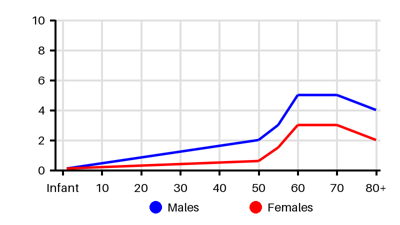
Incidence per 100.000 [y9p][qhu]
Symptoms & findings
Symptoms
Absent feces, Absent flatus, Hematochezia, Icterus, Ileus, Melena, Nausea, Vomiting, Weight loss
Clinical findings
Absent distal rectal air, Air-fluid level, Anemia, Gastrointestinal dilatation, Jaundice
Anamneses
None listed.
Localized findings
Approach
Gastroscopy
CT abdomen
Enteroclysis
Treatment
Symptomatic or precancerous benign small bowel tumour --> resection:
Small tumors: observation
Endoscopically (dependant on size and location)
Surgical resection
Differential diagnoses
Abdominal abscess, Appendicitis, Celiac disease, Colorectal cancer, Diverticulitis, Gastrointestinal obstruction, Infectious colitis, Intussusception, Ischemic colitis, Meckels diverticulum, Ovarian torsion, Peutz-Jeghers syndrome, Ruptured ectopic pregnancy, Small bowel cancer, Volvulus
References
[1] https://emedicine.medscape.com/article/191675
[2] Ocasio Quinones GA, Khan Suheb MZ, Woolf A. Small Bowel Neoplasms. [Updated 2023 Jun 1]. In: StatPearls [Internet]. Treasure Island (FL): StatPearls Publishing; 2025 Jan-. Available from: https://www.ncbi.nlm.nih.gov/books/NBK560725/
[3] O'Riordan BG, Vilor M, Herrera L. Small bowel tumors: an overview. Dig Dis. 1996 Jul-Aug;14(4):245-57.
[4] Emmy Ludwig, Robert C. Kurtz. Chapter 121 - Tumors of the Small Intestine. Sleisenger and Fordtran's Gastrointestinal and Liver Disease (9th Edition), W.B. Saunders, 2010.
[5] David Lewin and Klaus J. Lewin. Modern Surgical Pathology, 2nd Edition, 2009. Chapter 22 - Small Intestine.
[6] Gourtsoyianni S, Papanikolaou N. Small Bowel Benign Neoplasms and Polyposis. In: Hamm B, Ros PR, eds. Abdominal Imaging. Berlin, Germany: Springer, 2013; 593–602.
[7] https://emedicine.medscape.com/article/189390
[8] Dufay et al. Mesenteric tumors: diagnosis and treatment. J Visc Surg. 2012 Aug;149(4):e239-51.
[9] Barsouk et al. Epidemiology of Cancers of the Small Intestine: Trends, Risk Factors, and Prevention. Med Sci (Basel). 2019;7(3):46.
[10] Chen-Shuan Chung et al. Small bowel tumors: A digestive endoscopy society of Taiwan (DEST) multicenter enteroscopy-based epidemiologic study. Journal of the Formosan Medical Association, Volume 117, Issue 8, 2018, Pages 705-710.