Diagnosis
Congenital cystic adenomatoid malformation
Congenital pulmonary malformation involving abnormal cystic lung tissue where normal lung should exist.
Also known as: Congenital pulmonary airway malformation
Etiology
Cause [quk]
Congenital pulmonary airway malformation (95%)
Rarely sporadic with no genetic predisposition
Pathophysiology [quk]
Mutations in genes influencing cell proliferation or apoptosis
Abdnormal embryogenesis --> anomalous bronchial morphogenesis
Arrest in lung development during various stages of embryogenesis
Stocker classification:
Type 0: originates in the trachea or bronchi (incompatible with life)
Type 1: originates in the bronchi (70% all cases)
Type 2: originates in the bronchiolar regions (cysts)
Type 3: originates in the bronchiolar regions (solid)
Type 4: originates in the acinar structures
Complications [dfn]
Prenatal:
Fetal hydrops
Pleural effusion
Polyhydramnios secondary to failure of normal fetal swallowing because of esophageal compression
Postnatal:
Infections
Bleeding
Air embolism
Cardiac failure due to shunting
Pneumothorax
Malignant changes
Other anomalies: renal agenesis, cardiovascular defects, diaphragmatic hernia, skeletal defects, esophageal atresia
Epidemiology
Incidence per 100.000 [azh][hwz][zrg]
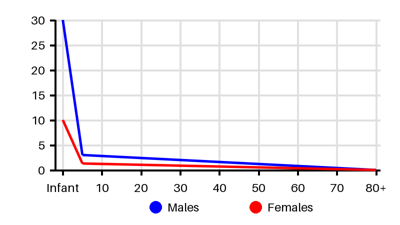
Symptoms & findings
Symptoms
Cough, Dyspnea, Intercostal retraction, Respiratory distress, Respiratory failure, Wheezing
Clinical findings
Heart failure, Mediastinal shift, Pleural effusion, Pneumothorax, Polyhydramnios, Pulmonary cysts
Anamneses
None listed.
Approach
Prenatal ultrasound: Most are detected prior to birth
Clinical presentation:
Most are asymptomatic (>75%)
Recurrent infections
Chronic cough or recurrent wheeze
Chest x-ray
CT thorax
MRI thorax
Echocardiography
Bronchoscopy
Treatment
Antenatal complications: [dfn][5e9]
Thoracocentesis, pleuro-amniotic shunt placement, percutaneous ultrasound-guided sclerotherapy, or radiofrequency/laser ablation, fetal bronchoscopy, and rarely open fetal surgery
Postnatal treatment: [dfn][5e9]
Elective surgery within the 1st year of life in cases with large and medium-sized cyst
Resection with minimally invasive video-assisted thoracoscopy (VATS)
Open thoracotomy
Conservative approach in cases with small-sized asymptomatic cysts unchanged during radiologic followup
Differential diagnoses
Bronchomalacia, Congenital diaphragmatic hernia, Emphysema, Pneumonia, Pneumothorax, Pulmonary sequestration
References
[1] Mehta PA, Sharma G. Congenital Pulmonary Airway Malformation. [Updated 2023 Aug 7]. In: StatPearls [Internet]. Treasure Island (FL): StatPearls Publishing; 2025 Jan-. Available from: https://www.ncbi.nlm.nih.gov/books/NBK551664/
[2] Annunziata et al. Congenital Lung Malformations: Unresolved Issues and Unanswered Questions. Front Pediatr. 2019 Jun 13;7:239.
[3] Laberge JM, Flageole H, Pugash D, Khalife S, Blair G, Filiatrault D, Russo P, Lees G, Wilson RD. Outcome of the prenatally diagnosed congenital cystic adenomatoid lung malformation: a Canadian experience. Fetal Diagn Ther. 2001 May-Jun;16(3):178-86.
[4] Guo XL, Wang Q, Liu ZP, Suo DM, Zeng M, Huang Y, Feng JP. Clinical analysis on prevalence and pregnancy outcome of fetal congenital cystic adenomatoid malformation in Foshan from 2007 to 2012. MCHCC. 2012;2014:4927–4931.
[5] Fan D, Xia Q, Wu S, Liu L, Yu Z, Wang W, Wu S, Guo X, Liu Z. Prevalence of prenatally diagnosed congenital cystic adenomatoid malformation among fetuses in China. Oncotarget. 2017 Jun 20;8(45):79587-79593.
[6] http://emedicine.medscape.com/article/1001488 (2014-01-02); [Medscape]
[7] Costa Júnior Ada S, Perfeito JA, Forte V. Surgical treatment of 60 patients with pulmonary malformations: what have we learned? J Bras Pneumol. 2008 Sep;34(9):661-6.
[8] Saleh, M.E., Beshir, H., Awad, G. et al. Surgical outcomes for pediatric congenital lung malformation: 13 years’ experience. Indian J Thorac Cardiovasc Surg 36, 608–618 (2020).
[9] Abbey, P., Narula, M.K. & Anand, R. Congenital Malformations and Developmental Anomalies of the Lung. Curr Radiol Rep 2, 71 (2014).