Diagnosis
Congenital diaphragmatic hernia
Patent pleuroperitoneal canal through the diaphragm leading to protrusion of abdominal contents into the thoracic cavity:
Bochdalek (70-75%): Posterolateral hernia [h3d][qpe]
Morgagni (20-25%): Anterior retrosternal hernia [h3d]
Central hernia (2-5%) [qpe]
Etiology
Cause [qpe]
Congenital developmental defect in the diaphragm
Genetic, environmental, and/or nutritional factors
Isolated anomaly or associated with other anomalies
Pathophysiology [qpe]
Disturbance in the formation of the pleuroperitoneal membranes
Diaphragmatic discontinuity --> congenital diaphragmatic hernia
Hernia --> pulmonary hyperplasia of the restricted ipsilateral lung
Respiratory distress/failure --> may result in pulmonary hypertension
Risk factors [fku]
Male gender
Maternal age beyond 40
Caucasian ethnicity
Smoking
Alcohol use during pregnancy
CDH complications [fku][qpe]
Prenatal:
Preterm birth
Intrauterine growth restriction
Stillbirth
Infant death (1-year mortality 45.9%)
Postnatal:
Chronic lung disease
Home oxygen requirement
Aspiration pneumonia
Pulmonary hypertension
Obstructive airway disease
Oral feeding aversion
Gastroesophageal reflux
Growth failure
Neurocognitive delay
Sensorineural hearing loss
Asymmetry of the chest wall
Scoliosis
Epidemiology
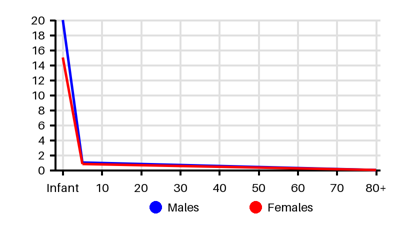
Incidence per 100.000 [gsh][wey][fku][g7v][nmi][ekq]
Symptoms & findings
Symptoms
Cyanosis, Dyspnea, Intercostal retraction, Nasal flaring, Respiratory distress, Respiratory failure
Clinical findings
Acidosis, Elevated Lactate, Hypoxemia, Pulmonary hypertension, Respiratory acidosis
Anamneses
None listed.
Localized findings
Approach
Blood gas
Ultrasound abdomen
Chest x-ray
ECG
Echocardiography
Treatment
Antenatal diagnosis is the optimal care [h3d]
Determine whether the defect is isolated or associated with other anomalies
Birth at a tertiary care center with pediatric surgery and neonatology services
After delivery: [h3d][qpe]
Intubation
Avoid non-invasive ventilation (gastric distension)
Placement of orogastric tube connected to suction
Gentle ventilation to avoid overdistention of hypoplastic lungs (risk of pneumothorax)
ECMO if severe respiratory failure
preductal oxygen saturations < 75% to 85%
postductal PaO2 < 30 mm Hg
peak inspiratory pressures < 30cmH2O
mean airway pressure < 15cmH2O
hypotension that is resistant to fluid and/or inotropic support
inadequate oxygen delivery with persistent metabolic acidosis
Echocardiographic assessment
Delayed surgical repair --> reduction of intrathoracic intestine and closure of the diaphragmatic defect.
Differential diagnoses
Congenital cystic adenomatoid malformation, Emphysema, Pneumothorax, Pulmonary hypertension, Pulmonary sequestration, Teratoma
References
[1] Hartnett KS. Congenital diaphragmatic hernia: advanced physiology and care concepts. Adv Neonatal Care. 2008 Apr;8(2):107-15.
[2] Dumpa V, Chandrasekharan P. Congenital Diaphragmatic Hernia. [Updated 2023 Aug 8]. In: StatPearls [Internet]. Treasure Island (FL): StatPearls Publishing; 2025 Jan-. Available from: https://www.ncbi.nlm.nih.gov/books/NBK556076/
[3] Balayla J, Abenhaim HA. Incidence, predictors and outcomes of congenital diaphragmatic hernia: a population-based study of 32 million births in the United States. J Matern Fetal Neonatal Med. 2014 Sep;27(14):1438-44.
[4] Chen ZY, Tao J, Xu WL, Gao YY, Li WY, Liu Z, Zhou JY, Dai L. Epidemiology of congenital diaphragmatic hernia among 24 million Chinese births: a hospital-based surveillance study. World J Pediatr. 2023 Dec 9.
[5] Yang W, Carmichael SL, Harris JA, Shaw GM. Epidemiologic characteristics of congenital diaphragmatic hernia among 2.5 million California births, 1989-1997. Birth Defects Res A Clin Mol Teratol. 2006 Mar;76(3):170-4.
[6] Dehdashtian M, Bashirnejad S, Malekian A, Aramesh MR, Aletayeb MH. Seasonality, Epidemiology and Outcome of Congenital Diaphragmatic Hernia in South West of Iran. J Neonatal Surg. 2017 Apr 15;6(2):28.
[7] http://emedicine.medscape.com/article/978118 (2014-01-02); [Medscape]
[8] Wright JC, Budd JL, Field DJ, Draper ES. Epidemiology and outcome of congenital diaphragmatic hernia: a 9-year experience. Paediatr Perinat Epidemiol. 2011 Mar;25(2):144-9.