Diagnosis
Anal fissure
Painful linear tears in the anal mucosa below the dentate line:
Acute: lasting < 6 weeks
Chronic (recurring): lasting > 6 weeks
Also known as: Anal ulcer, Anorectal fissure, Fissure in ano
Etiology
Cause [n4r]
Constipation
Chronic diarrhea
Sexually transmitted diseases
Tuberculosis
Inflammatory bowel disease
HIV
Anal cancer
Childbearing
Anal surgery
Anal intercourse
Pathophysiology [n4r]
Direct trauma: either the posterior or anterior midline
The passage of hard stools against an elevated anal sphincter tone
The classic "unstoppable force meets immovable object" scenario
Hard bowel movement --> pain --> worsening constipation
High sphincter pressure --> reduced blood perfusion --> delayed healing
Lateral fissure --> underlying etiology (HIV, tuberculosis, IBD)
Risk factors [mn3]
Constipation
Hypothyroidism
Obesity
Complications [n4r]
Infection
Incontinence
Fistula formation
Epidemiology
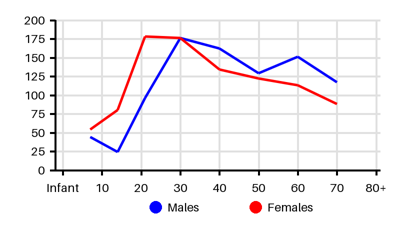
Incidence per 100.000
Symptoms & findings
Symptoms
Clinical findings
None listed.
Anamneses
None listed.
Localized findings
Approach
Rectal exam
Anoscopy
Rectoscopy
Treatment
Exclude other underlying conditions [n4r]
Treat the constipation: Break the cycle (hard bowels -> pain -> constipation)
Fiber supplementation
Adequate fluid intake
Stool softeners: Laxatives, Mineral oil
Pain relief:
Sitz bath
Xylocain gel
Topical anti-inflammatory ointment (Scheriproct)
Sphincter relaxing procedures:
Intra-anal application of nitroglycerin
Botulinum toxin
Sphincter dilatation
Lateral internal sphincterotomy
Differential diagnoses
Anal cancer, Anorectal abscess, Anorectal fistula, Colorectal cancer, Crohn disease, Hemorrhoids, Tuberculosis, Ulcerative colitis
References
[1] Jahnny B, Ashurst JV. Anal Fissures. [Updated 2022 Nov 14]. In: StatPearls [Internet]. Treasure Island (FL): StatPearls Publishing; 2025 Jan-. Available from: https://www.ncbi.nlm.nih.gov/books/NBK526063/
[2] Mapel et al. The epidemiology and treatment of anal fissures in a population-based cohort. BMC Gastroenterol. 2014 Jul 16;14:129.