Diagnosis
Anorectal abscess
Infection arising in the cryptoglandular epithelium lining the anal canal. The infection may extend to the:
Intersphincteric space: Perianal abscess (superficial, 60%) [cqi][4c7]
Ischiorectal space: Ischiorectal abscess (deeper, 20%) [4c7]
Supralevator space (5%) [4c7]
Also known as: Anal abscess, Ischiorectal abscess, Perianal abscess, Perirectal abscess, Rectal abscess
Etiology
Etiology [kh4][cqi]
Anaerobes: Bacteroides fragilis, Peptostreptococcus, Prevotella, Fusobacterium, Porphyromonas, and Clostridium,
Aerobes: Staphylococcus aureus, Streptococcus, and Escherichia coli
Other underlying conditions - 10%: inflammatory bowel disease, trauma, HIV, malignancy, tuberculosis, hidradenitis suppurativa, sexually transmitted diseases, radiation therapy, foreign bodies, perforated diverticular disease
Pathophysiology [kh4]
Abscess formation due to obstruction of anal crypts (90%) [cqi]
Other underlying causes (10%)
The abscess forms initially in the intersphincteric space and then spreads along adjacent spaces
Risk factors
Surgery
Fistula
Trauma
Complications [4c7]
Bacteremia/sepsis
Fistula formation
Fecal incontinence
Urinary retention
Constipation
Epidemiology
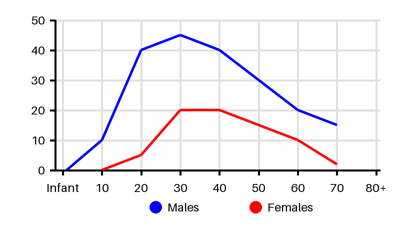
Incidence per 100.000 [swq][w1f]
Symptoms & findings
Symptoms
Chills, Dyschezia, Fever, Malaise
Clinical findings
Elevated CRP, Elevated Sedimentation Rate, Leukocytosis
Anamneses
None listed.
Localized findings
Approach
Blood test
Wound culture
Rectal exam
Anoscopy
Rectoscopy
Sigmoideoscopy
Colonoscopy
Biopsy
Treatment
Incision and surgical drainage [kh4]
Antibiotics if immunosuppression, diabetic, sepsis
Antibiotics alone is inadequate and inappropriate
Differential diagnoses
Anal cancer, Anal fissure, Anorectal fistula, Bartholins abscess, Cellulitis, Colorectal cancer, Constipation, Crohn disease, Diarrhea, Hemorrhoids, Hidradenitis suppurativa, HIV, Immunodeficiency, Necrotizing fasciitis, Periurethral abscess, Pilonidal disease, Proctitis, Prostatic abscess, Rectal prolapse, Ulcerative colitis
References
[1] Sigmon DF, Emmanuel B, Tuma F. Perianal Abscess. [Updated 2023 Jun 12]. In: StatPearls [Internet]. Treasure Island (FL): StatPearls Publishing; 2025 Jan-. Available from: https://www.ncbi.nlm.nih.gov/books/NBK459167/
[2] Turner SV, Singh J. Perirectal Abscess. [Updated 2023 Aug 7]. In: StatPearls [Internet]. Treasure Island (FL): StatPearls Publishing; 2025 Jan-. Available from: https://www.ncbi.nlm.nih.gov/books/NBK507895/
[3] https://emedicine.medscape.com/article/191975
[4] Hsieh et al. Epidemiology and outcomes of anal abscess in patients on chronic dialysis: a 14-year retrospective study. Clinics (Sao Paulo). 2019 Mar 21;74:e638.
[5] Abcarian H. Anorectal infection: abscess-fistula. Clin Colon Rectal Surg. 2011 Mar;24(1):14-21. doi: 10.1055/s-0031-1272819.
[6] Sainio P. Fistula-in-ano in a defined population. Incidence and epidemiological aspects. Ann Chir Gynaecol. 1984;73(4):219-24.