Diagnosis
Benign paroxysmal positional vertigo
Acute vertigo that occurs when the head is in a specific position. Vertigo classically lasts < 2 minutes.
Also known as: Benign postural vertigo, BPPV
Etiology
Causes
Idiopathic, Trauma, Ear diseases, Otitis media, Vestibular neuritis, Menieres disease, Otosclerosis, CNS disease, Vertebral basilar insufficiency, Acoustic neuroma, Cervical vertigo
Pathophysiology
Displacement of otolith crystals from the crista of the posterior semicircular canal.
Epidemiology
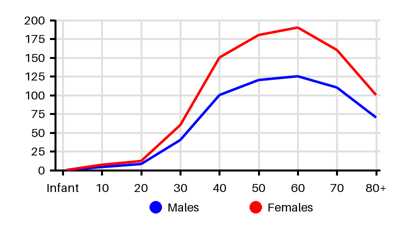
Incidence per 100.000 [zz7][qbu][zhk]
Symptoms & findings
Symptoms
Dizziness, Nausea, Nystagmus, Vertigo
Clinical findings
None listed.
Anamneses
None listed.
Approach
Neurology
Dix-Hallpike test
Epley maneuver
Otologic examination
Electronystagmography
MRI caput
Audiometry
Electronystagmography
Caloric testing
Diagnostic criteria: A–D have to be fulfilled [5gf]
(A) Vestibular vertigo: (spontaneous rotational or positional vertigo)
(B) Duration of an attack always <1 min
(C) Symptoms invariably provoked by the following changes of head position:
(D) Not attributable to another disorder
Treatment
Usually resolves without treatment in weeks to months
Vestibulosuppressant medication provide minimal relief
Canalith repositioning: noninvasive treatment with 95% success rate (expert)
Epley maneuver
Semont maneuver
Yacovino maneuver
Differential diagnoses
Acoustic neuroma, Central positional vertigo, Labyrinthitis, Meniere disease, Migraine, Orthostatic hypotension, Vestibular neuronitis
References
[1] Froehling et al. Benign positional vertigo: incidence and prognosis in a population-based study in Olmsted County, Minnesota. Mayo Clin Proc. 1991 Jun;66(6):596-601.
[2] Hyo Geun Choi et al. How rare is benign paroxysmal positional vertigo in children? A review of 20 cases and their epidemiology. International Journal of Pediatric Otorhinolaryngology, Volume 132, 2020.
[3] http://emedicine.medscape.com/article/884261 (2014-01-02); [Medscape]
[4] von Brevern et al. Epidemiology of benign paroxysmal positional vertigo: a population based study. J Neurol Neurosurg Psychiatry. 2007 Jul;78(7):710-5.