Diagnosis
Migraine
A syndrome of recurring headache:
Pulsating pain
Unilateral
Frontotemporal and ocular region
Moderate-to-severe intensity
Period: 4–72 hours
Neurological symptoms:
Nausea
Vomiting
Aura (20%) [fbw]
Horner syndrome
Sensory hypersensitivity: light, sound, or movement [bfk]
Resistant migraine:
Failed at least 3 classes of migraine preventatives
≥8 debilitating headache days per month for ≥3 consecutive months
Refractory migraine:
Failed all of the available preventatives
≥8 debilitating headache days per month for ≥6 consecutive months
Etiology
Cause [fbw]
Not exactly known, many unconfirmed theories
Vascular theory: Intracranial vasoconstriction followed by rebound vasodilation
Vessels dilate during a migraine attack
Stimulation of intracranial vessels induces headache
Vasoconstrictors (ergots) improve the headache
Vasodilators (nitroglycerin) provoke an attack
Do not explain the efficacy of some drugs that have no effect on blood vessels
Neurovascular theory:
Primarily a neurogenic process with secondary changes in cerebral perfusion
Biochemical theory: Vasoactive substances and neurotransmitters
Anatomical: A potential "migraine center" in the brainstem
Genetic factor: 70% of patients have a first-degree relative with a history of migraine
Environmental/behavioral factors: persons with a predisposition
Magnesium deficiency
Endothelial dysfunction
Serotonin: An important receptor in the headache pathway
Pathophysiology [9vo]
A premonitory phase:
Yawning, mood changes, lethargy, neck stiffness, sensitivity to light and sound, restlessness, difficulty focusing vision, feeling cold, cravings, sweating, increased energy, thirst, and edema
Transient neurological symptoms (migraine aura)
Positive symptoms (scintillating scotoma, bright lines or shapes, tinnitus, noises, paresthesias, allodynia, or rhythmic movements)
Negative symptoms (visual field defects, hearing, sensation, or movement)
Headache lasting from hours to days:
Unilateral, pulsating pain with nausea, vomiting, photophobia, phonophobia, rhinorrhea, lachrymation, allodynia, and osmophobia
Postdrome phase: movement-vulnerable headache, exhaustion, dizziness, difficulty concentrating, and euphoria
Risk factor [bfk][fbw]
Advanced age
Head trauma
Lower socioeconomic status
Stress
Sleep problems
Obesity
Pain syndrome
Pro-inflammatory states (increased CRP, TNF-alpha )
Pro-thrombotic states
Hormonal imbalances: pregnancy, ovulation, estrogen, cortisol, thyroid
Psychological factors
High blood pressure
Hypercholesterolemia
Impaired insulin sensitivity
High homocysteine levels
Stroke
Coronary heart disease
Medications (vasodilators, oral contraceptives)
Smoking
Caffeine
Citrus fruits
Aged cheese
Alcohol (red wine)
Fasting or skipping meals
Strong odors (perfumes, colognes, petroleum distillates)
Epidemiology
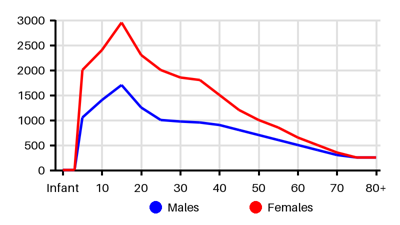
Incidence per 100.000 [bfk][s9o][9os][cgo][gai][2vq][vt9]
Symptoms & findings
Symptoms
Agitation, Anopsia, Anorexia, Aphasia, Bilateral hemianopsia, Confusion, Depression, Dizziness, Dysarthria, Headache, Lethargy, Miosis, Muscle weakness, Osmophobia, Paresthesia, Phonophobia, Photophobia, Ptosis, Scotoma, Vertigo, Vomiting
Clinical findings
Anamneses
None listed.
Localized findings
Approach
Migraine is a clinical diagnosis [fbw]
Exclude structural and metabolic causes of headache
Rule out comorbid diseases that could complicate headache
Screening tool: ID-CM (sensitivity of 82% and a specificity of 87%)
Blood test: CRP/ESR to rule out temporal arteritis
Lumbar Puncture and CT/MRI caput if: [fbw]
First or worst severe headache
Abnormal neurologic examination
Change in the pattern of previous migraine
Headache with fever
Migraine and epilepsy
New daily, persistent headache
Escalation of headache frequency/intensity
Posteriorly located headaches
Treatment
Non-pharmacological: [fbw]
Reduction of triggers: lack of sleep, fatigue, stress, certain foods (alcohol, caffein, chocolate, aspartame, citrus fruits, bananas, avocados, dried fruit, nuts and soy
Cognitive-behavioral therapy
Acute phase: [fbw]
Selective serotonin receptor agonists (triptans)
Serotonin agonists (ditans, lasmiditan)
Calcitonin gene-related peptide receptor antagonists (rimegepant, ubrogepant)
Ergot alkaloids (ergotamine, dihydroergotamine)
Analgesics
NSAIDs
Antiemetics
Prophylactic treatment if >2 attacks per month or duration of attacks >24 hours or symptomatic medications are ineffective: [fbw]
Antiepileptic drugs
Beta blockers
Tricyclic antidepressants
Calcium channel blockers
SSRIs
NSAIDs
Serotonin antagonists
Botulinum toxin
CGRP inhibitors
Differential diagnoses
Benign paroxysmal positional vertigo, Brain abscess, Brain tumor, Carotid artery dissection, Cerebral aneurysm, Cerebral venous sinus thrombosis, Cluster headache, Encephalitis, Intracerebral hemorrhage, Labyrinthitis, Medication-overuse headache, Meniere disease, Meningitis, Subarachnoid hemorrhage, Temporal arteritis, Tension headache
References
[1] https://emedicine.medscape.com/article/1142556
[2] Amiri P, Kazeminasab S, Nejadghaderi SA, Mohammadinasab R, Pourfathi H, Araj-Khodaei M, Sullman MJM, Kolahi AA, Safiri S. Migraine: A Review on Its History, Global Epidemiology, Risk Factors, and Comorbidities. Front Neurol. 2022 Feb 23;12:800605.
[3] Pescador Ruschel MA, De Jesus O. Migraine Headache. [Updated 2024 Jul 5]: https://www.ncbi.nlm.nih.gov/books/NBK560787/
[4] Safiri S, Pourfathi H, Eagan A, Mansournia MA, Khodayari MT, Sullman MJM, Kaufman J, Collins G, Dai H, Bragazzi NL, Kolahi AA. Global, regional, and national burden of migraine in 204 countries and territories, 1990 to 2019. Pain. 2022 Feb 1;163(2):e293-e309.
[5] Fan, L., Wu, Y., Wei, J. et al. Global, regional, and national time trends in incidence for migraine, from 1990 to 2019: an age-period-cohort analysis for the GBD 2019. J Headache Pain 24, 79 (2023).
[6] Stovner, Lars Jacob et al. Global, regional, and national burden of migraine and tension-type headache, 1990–2016: a systematic analysis for the Global Burden of Disease Study 2016. The Lancet Neurology, Volume 17, Issue 11, 954 - 976.
[7] Yang Y, Cao Y. Rising trends in the burden of migraine and tension-type headache among adolescents and young adults globally, 1990 to 2019. J Headache Pain. 2023 Jul 27;24(1):94.
[8] Fan Z, Kang J, Li W, Wang Z, Qiao H, Xu F. Trends in migraine incidence among women of childbearing age from 1990 to 2019 and the prediction for 2030: an analysis of national data in China. J Headache Pain. 2023 Nov 27;24(1):158.
[9] Stang PE, Yanagihara PA, Swanson JW, Beard CM, O'Fallon WM, Guess HA, Melton LJ 3rd. Incidence of migraine headache: a population-based study in Olmsted County, Minnesota. Neurology. 1992 Sep;42(9):1657-62.
[10] Wang, Y., Huang, X., Yue, S., Liu, J., Li, S., Ma, H., … Wu, J. (2022). Secular Trends in the Incidence of Migraine in China from 1990 to 2019: A Joinpoint and Age–Period–Cohort Analysis. Journal of Pain Research, 15, 137–146.