Diagnosis
Syphilis
Infectious disease caused by the spirochete Treponema pallidum.
Etiology
Cause [ckb]
Treponema pallidum is a spiral-shaped bacteria (spirochete)
Incubation period: 3 to 4 weeks
Slow metabolic rate, taking an average of 30 hours to multiply
Pathophysiology [qzt][ckb]
Transmitted by:
Intimate contact with infectious lesions (most common)
Blood transfusion
Transplacentally from an infected mother to fetus in utero (congenital)
Treponema pallidum rapidly penetrates intact mucous membranes within a few hours and enters the lymphatics and blood to produce systemic infection.
If untreated, it progresses through 4 stages: primary, secondary, latent, and tertiary.
Primary syphilis:
Development of a highly infectious painless chancre at the site of transmission
Localization: Genitals, digits, nipples, tonsils, and oral mucosa
Chancre consists of mononuclear leukocytes, macrophages, and lymphocytes
Healing occurs within 3-12 weeks with considerable residual fibrosis
Resolve without treatment and 25% may go to secondary phase if untreated
Secondary syphilis: 4-10 weeks after the appearance of the primary lesion
The spirochetes multiply and spread throughout the body
Systemic manifestations: Headache, malaise, fever, myalgia, arthralgia, lymphadenopathy, pharyngitis, hepatosplenomegaly, alopecia, and maculopapular rash involving the palms and soles
Resolve without treatment and the patient may enter latent phase if untreated
Latent syphilis: secondary syphilis have resolved, but patients remain seroreactive
1/3 of untreated latent syphilis patients go on to develop tertiary syphilis
Tertiary syphilis (rare): slow inflammatory damage over months to years
Gummatous syphilis:
Necrotizing granulomas (gummas) in the liver, bones, testes or any organ
Cardiovascular syphilis (80-85%)
Aortitis
Aneurysm in the ascending aorta due to chronic inflammatory destruction
Aortic valve insufficiency may result
Neurosyphilis (5-10%)
CSF: high protein, low glucose, high lymphocytes, positive syphilis serology
Damage to the blood vessels of the meninges, brain, and spinal cord
Parenchymal neurosyphilis: Meningitis, hemiplegia, stroke, aphasia, seizures, spinal neuroarthropathy, tabes dorsalis (demyelination of dorsal medulla spinalis)
Paresis, areflexia and impaired vibration/proprioceptive/pain/temperature sensation leading to a wide-based gait
Congenital syphilis (infection of the fetus in utero):
A high rate of spontaneous abortion and stillbirth
Widespread condylomata lata and rash, and mucopurulent rhinitis
Bone/teeth deformities (saddle nose, saber shins, Cluttons joints, Hutchinsons teeth, mulberry molars), general paresis, deafness and blindness
Complications [ckb]
Neurological complications: meningitis, stroke, cranial nerve palsies, tabes dorsalis, dementia, and general paresis
Cardiovascular complications: aortitis, aortic regurgitation, carotid ostial stenosis
Granulomatosis lesions (gummas) in various body organs
Neonatal infections --> congenital syphilis --> adverse pregnancy outcomes
Epidemiology
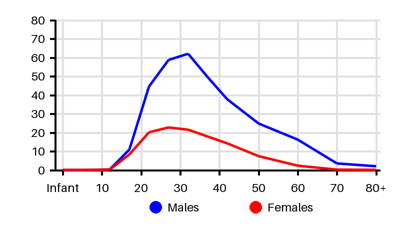
Incidence per 100.000 [vsr][69w][qzt][9fa]
Symptoms & findings
Symptoms
Agitation, Alopecia, Anorexia, Aphasia, Areflexia, Arthralgia, Arthritis, Ataxia, Blindness, Dementia, Diastolic murmur, Epistaxis, Fatigue, Fever, Headache, Hearing loss, Hepatomegaly, Lymphadenopathy, Malaise, Myalgia, Nausea, Neck stiffness, Paresis, Paresthesia, Photophobia, Psychosis, Rhinorrhea, Splenomegaly, Urinary incontinence, Weakness
Clinical findings
Chorioretinitis, Glomerulonephritis, Hemoglobinuria, Hepatitis, Hydrops, Iritis, Keratitis, Optic neuritis, Pericardial effusion, Periostitis, Pharyngitis, Proctitis, Renal failure, Thrombocytopenia
Anamneses
None listed.
Localized findings
Approach
Blood test
Serelogy
Polymerase chain reaction
Microscopy (darkfield)
Biopsy
Lumbar tap
CT abdomen
CT thorax
CT caput
MR caput
Ultrasonography of the fetus when the disease has been diagnosed during the second half of the mother's pregnancy
Treatment
Penicillin is the preferred bacteriocidal antibiotic for all stages of syphilis [ckb]
Primary, secondary, and early latent syphilis: Single dose Penicillin G 2.4 million units
Tertiary/late latent syphilis: Penicillin G 2.4 million units intramuscular (for 3 weeks)
Neurosyphilis: Penicillin G 3 to 4 million units IV every 4 hours daily for 10 to 14 days
Alternatives:
Doxycycline 100 mg orally (PO) twice daily for 14 days
Ceftriaxone 1 to 2 gm IM or intravenously (IV) daily for 10 to 14 days
Tetracycline 100 mg PO 4 times daily for 14 days
Congenital Syphilis:
Penicillin G 50,000 units/kg body weight/dose IV every 12 hours during the first 7 days after birth, then every 8 hours for 10 days
Differential diagnoses
Behcet's disease, Brain tumor, Candidiasis, Chancroid, Chlamydia, Contact dermatitis, Dementia, Eczema, Encephalitis, Erythema multiforme, Fungal infection, Granuloma inguinale, Heart failure, Herpes simplex, Herpes zoster, HIV, Human papillomavirus, Lymphogranuloma venereum, Lymphoma, Meningitis, Mononucleosis, Pityriasis rosea, Psychosis, Rocky mountain spotted fever, Sarcoidosis, Stroke, Urinary tract infection, Uveitis, Yaws
References
[1] Tudor ME, Al Aboud AM, Leslie SW, et al. Syphilis. [Updated 2024 Aug 17]. In: StatPearls [Internet]. Treasure Island (FL): StatPearls Publishing; 2025 Jan-. Available from: https://www.ncbi.nlm.nih.gov/books/NBK534780/
[2] Kojima N, Klausner JD. An Update on the Global Epidemiology of Syphilis. Curr Epidemiol Rep. 2018 Mar;5(1):24-38.
[3] Rates of reported cases of syphilis in the United States in 2023, by age and gender. John Elflein: https://www.statista.com/statistics/622816/syphilis-rate-in-the-us-by-age-and-gender/
[4] Gregory ECW, Ely DM. Trends and Characteristics in Maternal Syphilis Rates During Pregnancy: United States, 2016-2022. NCHS Data Brief. 2024 Feb;(496):1-8.
[5] Yu W, You X, Luo W. Global, regional, and national burden of syphilis, 1990-2021 and predictions by Bayesian age-period-cohort analysis: a systematic analysis for the global burden of disease study 2021. Front Med (Lausanne). 2024 Aug 15;11:1448841.
[6] http://emedicine.medscape.com/article/157325 (2014-01-21); [Medscape]
[7] http://emedicine.medscape.com/article/229461 (2014-01-02); [Medscape]