Diagnosis
Fracture
An injury involving fractured bone tissue.
Etiology
Cause
Usually trauma
Pathologic fracture: when inadequate trauma
Osteoporosis
Carcinoma (primary or metastatic)
Cyst
Enchondroma
Giant cell tumor
Osteomalacia
Osteogenesis imperfecta
Scurvy
Rickets
Pagets disease
Pathophysiology [bzc]
Traumatic injury
Bones and soft tissue absorb the imposed energy
When the absorption of energy exceeds the threshold of the bone --> fracture
The bone fragments are usually not attached to any anchoring structures --> displaced --> risk of soft tissue and neurovascular structure damage
Foreign material can be deposited into deep intramuscular and bone cortex --> osteomyelitis
Classification
Anatomical location
Direction of fracture line (transverse, oblique, spiral)
Simple or comminuted
Open or closed.
Complications [bzc]
Infection
Failure to heal
Non-union
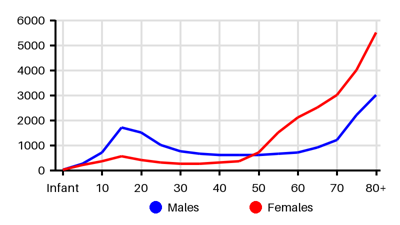
Epidemiology
Incidence per 100.000 [ng7][s6y]
Symptoms & findings
Symptoms
Paralysis, Paresis, Paresthesia, Pulselessness
Clinical findings
None listed.
Anamneses
Localized findings
Approach
Arterial blood gas: hemoglobin, hematocrit, platelet count, metabolic panel, serum lactate, and toxicology screens
X-ray
CT
MRI
Treatment
Treatment goals:
Prevent infection
Allow the fracture to heal
Restore function in the injured limb
Considerations:
Unstable (open) fracture: not maintained in a reduced position
Displaced intra-articular fractures
Fractures known to heal poorly (femoral neck fracture)
Disrupted ligamentous function (patella fracture)
Pathologic fractures
Multiple traumatic fractures
Individuals who poorly tolerate prolonged immobilization
Fractures in growth areas --> risk for growth arrest
Contraindication for surgery:
Active infection: local, systemic, osteomyelitis
Compromised soft tissue overlying fracture (injury, burns, infection)
Medical conditions
Treatment:
Nonoperative Therapy:
Control hemorrhage
Pain relief
Prevent ischemia injury
Remove contamination (foreign body and nonviable tissues)
Reduce fracture and maintain reduction with immobilisation (splints, plaster cast, traction)
Surgery:
External fixation
Open Reduction and Internal Fixation (ORIF):
Kirschner wires
Plates and screws
Intramedullary nails
Differential diagnoses
Acute extremity ischemia, Compartment syndrome, Deep venous thrombosis, Erysipelas, Gout, Pseudogout, Rheumatoid arthritis, Septic arthritis, Thrombophlebitis
References
[1] Sop JL, Sop A. Open Fracture Management. [Updated 2023 Aug 8]. In: StatPearls [Internet]. Treasure Island (FL): StatPearls Publishing; 2025 Jan-. Available from: https://www.ncbi.nlm.nih.gov/books/NBK448083/
[2] Ando J, Takahashi T, Ae R, Ajiki T, Matsumura T, Sasao W, Abe M, Takeshita K. Epidemiology of distal radius fracture: a regional population-based study in Japan. BMC Musculoskelet Disord. 2023 Jun 13;24(1):478.
[3] Bergh C, Wennergren D, Möller M, Brisby H. Fracture incidence in adults in relation to age and gender: A study of 27,169 fractures in the Swedish Fracture Register in a well-defined catchment area. PLoS One. 2020 Dec 21;15(12):e0244291.
[4] https://emedicine.medscape.com/article/1270717