Diagnosis
Acute extremity ischemia
Arterial occlusion resulting in sudden and severe decrease in blood supply to an extremity which may progress to irreversible ischemia in 6-8 hours, depending on collateral circulation.
Also known as: Acute arterial occlusion, Acute limb ischemia, Critical limb ischemia
Etiology
Cause [iom][ghw][nvp]
Embolization (30%) from proximal artery or heart with atrial fibrillation, myocardial infarction, valvular disease, septic embolization
Trauma (5%): knee dislocation, long-bone fracture, penetrating trauma, iatrogenic (catheter)
Thrombosis: Atherosclerosis (40%), stenosis, aneurysm (5%), postoperative bypass graft thrombosis (20%)
Upper extremity: vasospasm, arteritis, subclavian steal syndrome, septic embolization
Pathophysiology
Sudden Arterial Occlusion
Impaired Blood Flow
Metabolic Imbalance: anaerobic metabolism --> lactic acid --> metabolic waste -->
Inflammatory response --> Tissue damage
Eventual necrosis (gangrene)
Reperfusion injury: swelling, severe pain and hyperesthesia [ghw]
Risk factors [vic]
Age
Smoking
Diabetes
Obesity
Sedentary lifestyle
Family history of vascular disease
High cholesterol
High blood pressure
Epidemiology
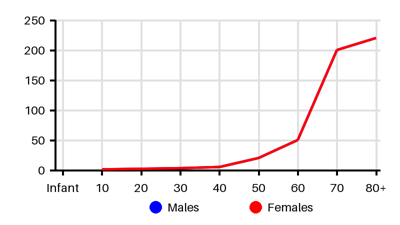
Incidence per 100.000 [zfb][esh][iom][nb9][nvp][vic]
Symptoms & findings
Symptoms
Foot drop, Muscle hypertonia, Pallor, Paralysis, Paresis, Paresthesia, Poikilothermia, Pulselessness
Clinical findings
Anamneses
None listed.
Localized findings
Approach
Clinical diagnosis: [ghw]
the “6 Ps”: pain, pallor, paralysis, pulse deficit, paresthesia and poikilothermia
Rutherford classification for acute limb ischemia: [kig]
I. Viable:
Sensory Loss: No. Weakness: No. Arterial signal: Yes. Venous signal: Yes.
IIa. Marginally Threatened - Salvageable if promptly treated
Sensory Loss: Minimal. Weakness: No. Arterial signal: No. Venous signal: Yes.
IIb. Immediately Threatened - Salvageable with immediate revascularization
Sensory Loss: Some. Weakness: Some. Arterial signal: No. Venous signal: Yes.
III. Irreversible - Major tissue loss or permanent nerve damage
Sensory Loss: Yes. Weakness: Yes. Arterial signal: No. Venous signal: No.
Blood test
Blood gas
Ankle-brachial index
CT angiography
MR angiography
Treatment
The therapeutic strategy will depend on: type of occlusion (thrombus or embolus), location, type of conduit (artery of graft), Rutherford class, duration of ischemia, comorbidities and therapy-related risks and outcomes [ghw]
Endovascular techniques: [ghw][nvp]
Percutaneous catheter-directed thrombolysis
Percutaneous thromboaspiration with or without thrombolytic therapy
Percutaneous mechanical thrombectomy
Open surgery:
Thromboembolectomy with a balloon catheter (Fogarty) [iom]
Bypass surgery
Endarterectomy and patch angioplasty
Amputation
Postprocedural pharmacotherapy: [ghw]
Vasodilators if there is evidence of vasospasm
Cardiac thromboembolism --> Anticoagulation: warfarin, dabigatran, apixaban, rivaroxaban
Atherosclerotic thrombosis or after stent --> statin and anti-platelet therapy (aspirin and clopidogrel)
Differential diagnoses
Aortic dissection, Cellulitis, Compartment syndrome, Deep venous thrombosis, Erysipelas, Gout, Necrotizing fasciitis, Shock, Spinal disc herniation, Spinal stenosis, Thromboangiitis obliterans, Trauma
References
[1] Baril DT, Ghosh K, Rosen AB. Trends in the incidence, treatment, and outcomes of acute lower extremity ischemia in the United States Medicare population. J Vasc Surg. 2014 Sep;60(3):669-77.e2.
[2] Olinic DM, Stanek A, Tătaru DA, Homorodean C, Olinic M. Acute Limb Ischemia: An Update on Diagnosis and Management. J Clin Med. 2019 Aug 14;8(8):1215.
[3] Natarajan B, Patel P, Mukherjee A. Acute Lower Limb Ischemia-Etiology, Pathology, and Management. Int J Angiol. 2020 Sep;29(3):168-174.
[4] Smith DA, Lilie CJ. Acute Arterial Occlusion. 2023 Jan 2. In: StatPearls [Internet]. Treasure Island (FL): StatPearls Publishing; 2024 Jan–. PMID: 28722881.
[5] Biancari F. Meta-analysis of the prevalence, incidence and natural history of critical limb ischemia. J Cardiovasc Surg (Torino). 2013 Dec;54(6):663-9. PMID: 24126504.
[6] Dormandy J, Heeck L, Vig S. Acute limb ischemia. Semin Vasc Surg. 1999 Jun;12(2):148-53.
[7] Dryjski M, Swedenborg J. Acute ischemia of the extremities in a metropolitan area during one year. J Cardiovasc Surg (Torino). 1984 Nov-Dec;25(6):518-22.
[8] Rutherford RB, Baker JD, Ernst C, Johnston KW, Porter JM, Ahn S, Jones DN. Recommended standards for reports dealing with lower extremity ischemia: revised version. J Vasc Surg. 1997 Sep;26(3):517-38.
[9] http://emedicine.medscape.com/article/460178 (2014-01-02); [Medscape]