Diagnosis
Compartment syndrome
Increased pressure within a closed osteofascial compartment, resulting in impaired local circulation.
Also known as: Acute compartment syndrome
Etiology
Cause [3kq][fbe]
Orthopedic:
Fracture (69-75%)
Blunt or Penetrating Trauma
Total knee arthroplasty
Vascular:
Reperfusion therapy
Arterial puncture or injury
Hemorrhage
Deep Vein Thrombosis
Soft Tissue:
Crush injury
Contusion
Burn
Envenomation (Snake Bite)
Iatrogenic
Drugs (Anticoagulants)
Bleeding Disorders (Sickle cell)
Casts or Splints
Constrictive Dressings
Extravasation of drugs and fluids
Prolonged lithotomy positioning
Viral myositis
Diabetic muscle infarction
Pathophysiology [4za]
The muscle fascia is thin, inelastic and surrounds muscle compartments --> limits the capacity for rapid expansion
Injury --> edema and/or blood accumulation --> increased pressure within a compartment --> compresssion of draining veins --> reduced venous outflow
Perfusion pressure = systolic pressure - compartment pressure
Delta pressure = diastolic pressure - measured intracompartmental pressure
Disequilibrium between venous outflow and arterial inflow
Impaired local circulation --> ischemia --> necrosis
Anterior compartment of the leg is the most common location --> drop fot
Other locations: forearm, thigh, buttock, shoulder, hand, and foot
Risk factors [4za]
Male
Trauma
Peripheral vascular disease
Bleeding disorder: hemophilia, leukemia
Complications
Contractures
Rhabdomyolysis
Nerve damage and associated numbness and/or weakness
Infection
Renal failure
Epidemiology
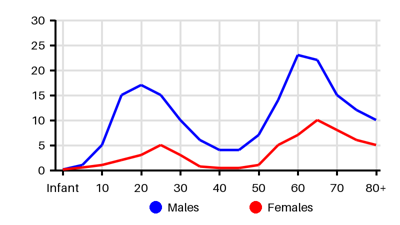
Incidence per 100.000 [3kq][93p]
Symptoms & findings
Symptoms
Muscle hypertonia, Pallor, Paralysis, Paresthesia, Pulselessness
Clinical findings
None listed.
Anamneses
Localized findings
Approach
Clinical diagnosis: [4za]
Pain (severe)
Pulselessness
Paresthesia
Paralysis are found in the late stage
Measurement of Intra-Compartmental Pressure (pathological > 30 mmHg)
Creatinine kinase
Urine myoglobin
Ultrasound: look for occlusion or thrombus
Treatment
Immediate surgical fasciotomy (sooner than later) [4za]
Treat underlying cause
Renal protection
Rhabdomyolysis --> IV fluid + bicarbonate --> keep urine output at 1-2 mL/kg/hr
Differential diagnoses
Acute extremity ischemia, Cellulitis, Deep venous thrombosis, Erysipelas, Fracture, Necrotizing fasciitis, Rhabdomyolysis
References
[1] Herrmann P, Eidmann A, Hochberger FF, Heinz T, Rak D, Weißenberger M, Rudert M, Stratos I. Epidemiological Analysis of Traumatic Compartment Syndromes in Germany. J Clin Med. 2024 Mar 14;13(6):1678.
[2] Pechar J, Lyons MM. Acute Compartment Syndrome of the Lower Leg: A Review. J Nurse Pract. 2016 Apr;12(4):265-270.
[3] Torlincasi AM, Lopez RA, Waseem M. Acute Compartment Syndrome. [Updated 2023 Jan 16]. In: StatPearls [Internet]. Treasure Island (FL): StatPearls Publishing; 2025 Jan-. Available from: https://www.ncbi.nlm.nih.gov/books/NBK448124/
[4] McQueen MM, Gaston P, Court-Brown CM. Acute compartment syndrome. Who is at risk? J Bone Joint Surg Br. 2000 Mar;82(2):200-3.
[5] http://emedicine.medscape.com/article/307668 (2014-01-02); [Medscape]