Diagnosis
Liver injury
Traumatic liver injury resulting in subcapsular hematoma or laceration.
Also known as: Liver trauma, Traumatic liver injury
Etiology
Cause [ums]
Trauma:
Blunt 91% (57% traffic accidents)
Penetrating
Iatrogenic
Pathophysiology [ums]
Blunt injury: Locally fixed under the diaphragm --> susceptible to shear forces from deceleration injuries
Penetrating injury: anterior location and relative large size (gunshot or stab wounds)
Highly vascular parenchyma with thin-walled vessels and high blood flow
American Association for the Surgery of Trauma Liver injury classification:
Grade 1: minor injuries represent 80-90% of all injuries, require observation
Hematoma: Subcapsular, non-expanding, <10% of surface area
Laceration: Capsular tear, non-bleeding, <1 cm parenchymal depth
Grade 2:
Hematoma: Subcapsular, non-expanding, 10-50% of surface area
or intraparenchymal non-expanding, less than 2 cm in diameter
Laceration: Capsular tear, active bleeding, 1-3 cm parenchymal depth, <10cm in length
Grade 3:
Hematoma: Subcapsular, >50% of surface area or expanding, ruptured subcapsular hematoma with active bleeding, intraparenchymal hematoma >2 cm
Laceration: Capsular tear >3 cm parenchymal depth
Grade 4:
Hematoma: Ruptured intraparenchymal hematoma with active bleeding
Laceration: Parenchymal rupture with bleeding involving 25-50% of the lobe
Grade 5:
Laceration: Parenchymal rupture with bleeding involving >50% of the lobe
Vascular: Juxtahepatic venous injuries (retrohepatic vena cava/hepatic veins)
Grade 6: Hepatic avulsion
Complications [ums]
Liver abscess
Bile leak/fistula
Hemobilia
Bilihemia
Bile duct stricture
Liver necrosis
Liver failure
Epidemiology
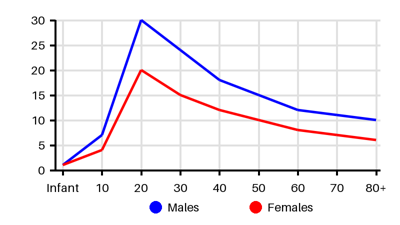
Incidence per 100.000 [ums][8eq][ypa]
Symptoms & findings
Symptoms
Hypotension, Tachycardia, Tachypnea
Clinical findings
Anamneses
Localized findings
Approach
Ultrasound abdomen
CT abdomen (if hemodynamic stable patient)
Diagnostic celiac angiography
Treatment
Treatment strategy: [8eq][ums]
Nonoperative management: hemodynamic stable, no active bleeding
Therapeutic transcatheter arterial embolism: Grade 1-3 injury and fluid demand <2L/h
Surgery: If hemodynamic unstable patient
Perihepatic packing
Mesh rapping
Resection debridement
Anatomical resection
Complete vascular isolation with veno-venous bypass and portocaval shunt
Liver transplantation
Differential diagnoses
Hypovolemia, Internal hemorrhage, Ruptured ectopic pregnancy, Sepsis, Shock
References
[1] Taghavi S, Askari R. Liver Trauma. [Updated 2023 Jul 17]. In: StatPearls [Internet]. Treasure Island (FL): StatPearls Publishing; 2025 Jan-. Available from: https://www.ncbi.nlm.nih.gov/books/NBK513236/
[2] Chien LC, Lo SS, Yeh SY. Incidence of liver trauma and relative risk factors for mortality: a population-based study. J Chin Med Assoc. 2013 Oct;76(10):576-82.
[3] Wiik Larsen J, Søreide K, Søreide JA, Tjosevik K, Kvaløy JT, Thorsen K. Epidemiology of abdominal trauma: An age- and sex-adjusted incidence analysis with mortality patterns. Injury. 2022 Oct;53(10):3130-3138.