Diagnosis
Rosacea
A chronic skin disease that causes transient facial flushing, erythema, papules, pustules and telangiectasias with central face distribution.
Etiology
Cause [szn]
Unknown
Genetics (family history, HLA association)
Immune reaction
Microorganisms (Demodex folliculorum mites, Helicobacter pylori)
UV exposure
Triggering factors [znn]
Hot or cold temperatures
Wind
Hot drinks
Caffeine
Exercise
Spicy food
Alcohol
Emotions
Topical products
Medications: potent corticosteroids, flushing drugs
Pathophysiology [r3a][szn]
Neurovascular dysregulation:
Dilation of lymphatic and blood vessels --> erythema and flushing
Inflammatory activation:
Chronic low-grade dermatitis --> neoangiogenesis
Dermal matrix degeneration
Pilosebaceous unit abnormalities
Reactive oxygen species
Subtypes: [znn][szn]
Erythematotelangiectatic: Persistent erythema with intermittent flushing
Papulopustular: Papules and pustules ("adult acne" without comedones)
Phymatous: Fibrosis and hypertrophy of sebaceous glands (male nose)
Ocular affection (50-75%): Redness, tearing, dry eye, tingling/burning, foreign-body sensation, light sensitivity, blurred vision, gritty sensation, pruritus, hordeola, and blepharitis
Epidemiology
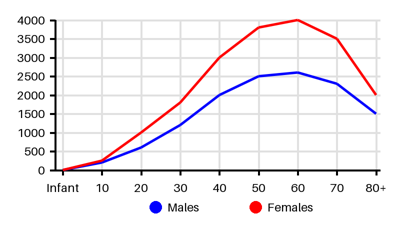
Prevalence per 100.000 [mgd][qzu][edf][f3p]
Symptoms & findings
Symptoms
Blepharitis, Conjunctivitis, Xerophthalmia
Clinical findings
None listed.
Anamneses
None listed.
Localized findings
Approach
Clinical diagnosis
Skin biopsy to exclude differential diagnosis
Diagnostic criteria [znn]
Diagnostic phenotypes (≥1 required):
Fixed centrofacial erythema that may periodically intensify
Phymatous changes
Major phenotypes (≥2 required)
Papules and pustules
Flushing
Telangiectasia
Ocular manifestations
Secondary signs and symptoms that may appear
Burning and stinging
Edema (facial edema)
Dry-appearing skin
Ocular rosacea:
Lid margin telangiectasia
Interpalpebral conjunctival injection
Spade-shaped infiltrates in the cornea
Scleritis and sclerokeratitis
"Honey crust" and collarette accumulation at the base of the lashes
Irregularity of the lid margin
Evaporative tear dysfunction
Treatment
Rosacea is treatable but not curable [s2t][edf][szn]
Topical rosacea:
Avoid local irritation (UV light, hot/cold temperatures, wind, hot drinks, caffeine, exercise, spicy food, alcohol, soaps, alcoholic cleansers, tinctures, astrigents, abrasives and peeling agents. Only very mild soaps and diluted detergents are advised.
Color-correcting powders (make-up)
Sunscreen with SPF>30
Anti-inflammatory antibiotics: Tetracyclines, clindamycin, erythromycin, metronidazole gel
Imidazole
Ketoconazole cream (anti-inflammatory and immonusuppressive)
Drying lotions (sulphur lotion)
Topical retinoids (Isotretinoin)
Azelaic acid
Ivermectin cream
Brimonidine tartrate gel (alpha-2 agonist)
Oxymetazoline (topical alpha agonist)
Dapsone (severe, refractory rosacea)
Corticosteroids only used in rosacea fulminans
Systemic rosacea:
Antibiotics: Tetracyclin 1-1.5g/day (alternative: Doxycycline/Erythromycin)
Isotretinoin 0.1-1.0mg/kg/day (side effects: dry eyes/blepharitis)
Rosacea fulminans:
Oral corticosteroids: Prednisolon 1mg/kg/day for one week
Then Isotretinoin 0.2-0.5mg/kg/day with slow tapering of Prednisolon
Ocular rosacea:
Lid hygiene
Lubricating eye drops: Fusidic acid gel (daily 1 to 2 times application on eyelids)
Topical antibiotics: Metronidazole 0.75% gel
Cyclosporine 0.05% eyedrops
Remove telangiectasia:
Laser treatment
Surgical resection
Electrosurgery
Differential diagnoses
Acne, Carcinoid syndrome, Dermatomyositis, Drug side effects, Eczema, Mastocytosis, Mixed connective tissue disease, Perioral dermatitis, Photosensitivity, Polycythemia vera, Polymorphic light eruption, Sarcoidosis, Seborrheic dermatitis, Systemic lupus erythematosus
References
[1] Farshchian M, Daveluy S. Rosacea. [Updated 2023 Aug 8]. In: StatPearls [Internet]. Treasure Island (FL): StatPearls Publishing; 2025 Jan-. Available from: https://www.ncbi.nlm.nih.gov/books/NBK557574/
[2] http://emedicine.medscape.com/article/1071429; [Medscape]
[3] Cribier B. Pathophysiology of rosacea: redness, telangiectasia, and rosacea. Ann Dermatol Venereol. 2011 Nov;138 Suppl 3:S184-91.
[4] Gether L, Overgaard LK, Egeberg A, Thyssen JP. Incidence and prevalence of rosacea: a systematic review and meta-analysis. Br J Dermatol. 2018 Aug;179(2):282-289.
[5] Saurat JH, Halioua B, Baissac C, Cullell NP, Ben Hayoun Y, Aroman MS, Taieb C, Skayem C. Epidemiology of acne and rosacea: A worldwide global study. J Am Acad Dermatol. 2024 May;90(5):1016-1018.
[6] Rainer BM, Kang S, Chien AL. Rosacea: Epidemiology, pathogenesis, and treatment. Dermatoendocrinol. 2017 Oct 4;9(1):e1361574.
[7] Abram K, Silm H, Oona M. Prevalence of rosacea in an Estonian working population using a standard classification. Acta Derm Venereol. 2010 May;90(3):269-73.
[8] Jansen T, Plewig G. Rosacea: classification and treatment. J R Soc Med. 1997 Mar;90(3):144-50.
[9] [Clinical Dermatology 4.th Edition by Weller, Hunter, Savin and Dahl]