Diagnosis
Otitis externa
Inflammation involving the external auditory canal and auricle.
Also known as: Swimmer’s ear, Tropical ear
Etiology
Cause [m9u][vhv][gd7][ccv]
Infection (98%): Pseudomonas (20-60%), Staphylococcus aureus (10-70%), Streptococcus, Candida
Allergy/eczema: Neomycin eardrops, topical antimicrobials, topical steroids, topical anesthetics, preservatives in topical otic medications: propylene glycol, thimerosal, benzalkonium chloride, benzethonium chloride, and methyl-p-oxybenzoate
Dermatological disease: dermatitis (atopic, seborrheic, or contact), psoriasis, dermatomycosis, or acne
Pathophysiology [vhv]
The external auditory canal is covered by hair follicles and cerumen-producing glands
Cerumen provides an acidic protective barrier that inhibits bacterial and fungal growth
Disruption of the normal pH and protective factors within the auditory canal:
Disrupted skin integrity (trauma, excessive or aggressive cleaning)
Insufficient protective acidic cerumen production --> Risk of infection
Blockage of the ear canal due to cerumen
Persistent water in the ear canal (moisture and higher pH) --> Risk of infection
Risk factors [ccv]
Swimming
Humidity
Trauma or external devices (cotton swabs, earplugs, hearing aids)
Dermatologic conditions such as eczema and psoriasis
Narrow external ear canals
Ear canal obstruction (cerumen obstruction, foreign body)
Radiotherapy or chemotherapy
Stress
Immunocompromised patients
Complications [fac][wap][ccv]
Periauricular cellulitis
Malignant exernal otitis/necrotizing external otitis (diabetes, immunocompromised)
Chronic otitis externa --> canal stenosis and hearing loss
Myringitis
Perichondritis
Facial cellulitis
Osteomyelitis of the temporal bone
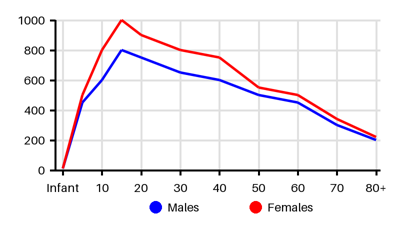
Epidemiology
Incidence per 100.000 [vhv][sf9][gd7]
Symptoms & findings
Symptoms
Hearing loss, Otalgia, Otorrhea, Pruritus
Clinical findings
Elevated CRP, Elevated Sedimentation Rate, Leukocytosis
Anamneses
None listed.
Localized findings
Approach
Otoscopy
Pneumatic otoscopy
Otomicroscopy
Tympanometry
Acoustic reflectometry
Culture
Imaging studies: CT, scintigraphy
Audiometry
Treatment
Prophylaxis: [vhv]
Maintain a healthy skin barrier
Limit water accumulation/moisture in the external auditory canal
Addressing allergy and underlying dermatitis
Dry aural toilet (suction, dry mopping, removal of obstructing cerumen or foreign object)
Non-antibiotic (antiseptic or acidifying) drops
Topical antibiotic three times daily for 7 days: Ciprofloxacin 0.3%
Steroid drops: Dexamethasone 0.05% + ramycetin 0.5% + gramicidin 0.005%
Fungal infection: three times daily for 7 days
Triamcinolone acetonide 0.1% + neomycin sulfate 0.25% + gramicidin 0.025% + nystatin 100,000 units/mL
Analgesics
Differential diagnoses
Bacterial tonsillitis, Cerumen, Cholesteatoma, Eczema, Foreign body, Furunculosis, Herpes zoster, Mastoiditis, Otitis media, Peritonsillar abscess, Psoriasis, Retropharyngeal abscess, Squamous cell carcinoma, Temporomandibular syndrome
References
[1] Stone KE. Otitis externa. Pediatr Rev. 2007;28(2):77.
[2] Rosenfeld RM, Schwartz SR, Cannon CR, Roland PS, Simon GR, Kumar KA, Huang WW, Haskell HW, Robertson PJ. Clinical practice guideline: acute otitis externa. Otolaryngol Head Neck Surg. 2014 Feb;150(1 Suppl):S1-S24.
[3] Roland PS, Stroman DW. Microbiology of acute otitis externa. Laryngoscope. 2002 Jul;112(7 Pt 1):1166-77.
[4] Medina-Blasini Y, Sharman T. Otitis Externa. [Updated 2023 Jul 31]. In: StatPearls [Internet]. Treasure Island (FL): StatPearls Publishing; 2025 Jan-. Available from: https://www.ncbi.nlm.nih.gov/books/NBK556055/
[5] Rubin Grandis J, Branstetter BF 4th, Yu VL. The changing face of malignant (necrotising) external otitis: clinical, radiological, and anatomic correlations. Lancet Infect Dis. 2004 Jan;4(1):34-9.
[6] Schwarz GA, Blumenkrantz MJ, Sundmäker WL. Neurologic complications of malignant external otitis. Neurology. 1971 Nov;21(11):1077-84.
[7] Rowlands S, Devalia H, Smith C, Hubbard R, Dean A. Otitis externa in UK general practice: a survey using the UK General Practice Research Database. Br J Gen Pract. 2001 Jul;51(468):533-8.
[8] Al Aaraj MS, Kelley C. Necrotizing (Malignant) Otitis Externa. Updated 2023 Oct 29: https://www.ncbi.nlm.nih.gov/books/NBK556138/