Diagnosis
Peritonsillar abscess
Collections of pus in peritonsillar space.
Also known as: Quinsy
Etiology
Cause [5rb][15m][cku][fbu]
Acute tonsillitis (complication)
Group A streptococcus, Staphylococcus, Corynebacterium, Streptococcus milleri
Anaerobes: Bacteroides, Fusobacterium, Peptostreptococcus, Prevotella
Infectious mononucleosis
Chronic periodontal disease
Pathophysiology [fbu]
Infection develops in crypta magna
Spreads beyond the confines of the tonsillar capsule --> peritonsillitis
Necrosis and pus formation in the capsular area --> peritonsillar abscess
Complications [71s][fbu]
Parapharyngeal abscess
Retropharyngeal abscess
Airway obstruction
Aspiration pneumonitis
Pneumonia/Lung abscess
Mediastinitis
Erosion into carotid sheath
Poststreptococcal glomerulonephritis
Sepsis
Epidemiology
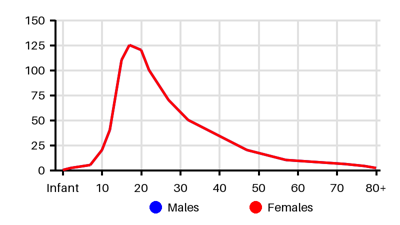
Incidence per 100.000 [e27][to9][w58][9yn]
Symptoms & findings
Symptoms
Drooling, Dysphagia, Fever, Halitosis, Hot potato voice, Lymphadenopathy, Malaise, Odynophagia, Otalgia, Sore throat, Trismus, Uvula deviation
Clinical findings
Anamneses
None listed.
Localized findings
Approach
Clinical examination
Blood test: Complete blood count, electrolytes, CRP, EBV-antibody test (Monospot test)
Intraoral ultrasonography
CT
Needle aspiration for culture
Treatment
Supportive therapy:
Hydration
Pain control
Corticosteroids to treat edema and inflammation (little evidence)
Antibiotic therapy: group A streptococcus and oral anaerobes [71s][5rb][5g9][ivs][syn]
Penicillin G 10 million units every 6 hours + Metronidazole 500mg every 6 hours
3rd generation cephalosporin (Ceftriaxone) 1g every 12 hours
Piperacillin/tazobactam 4g every 6 hours
If penicillin allergy: Clindamycin 900mg every 8 hours
If MRSA; Vancomycin 1g every 12 hours + Metronidazole 500mg every 6 hours
Surgery: [cbd][m1t]
Needle aspiration only
Incision and drainage
Quincy tonsillectomy
If recurrent problem --> Tonsillectomy after the abscess has resolved
Differential diagnoses
Bacterial tonsillitis, Cellulitis, Dental infection, Epiglottitis, Lymphoma, Mononucleosis, Parapharyngeal abscess, Pharyngitis, Retropharyngeal abscess
References
[1] Powell EL, Powell J, Samuel JR, Wilson JA. A review of the pathogenesis of adult peritonsillar abscess: time for a re-evaluation. J Antimicrob Chemother. 2013;68(9):1941-1950.
[2] Klug TE. Incidence and microbiology of peritonsillar abscess: the influence of season, age, and gender. Eur J Clin Microbiol Infect Dis. 2014;33(7):1163-1167.
[3] Gavriel H, Vaiman M, Kessler A, Eviatar E. Microbiology of peritonsillar abscess as an indication for tonsillectomy. Medicine (Baltimore). 2008 Jan;87(1):33-36.
[4] Gupta G, McDowell RH. Peritonsillar Abscess. [Updated 2023 Jul 17]. In: StatPearls [Internet]. Treasure Island (FL): StatPearls Publishing; 2025 Jan-. Available from: https://www.ncbi.nlm.nih.gov/books/NBK519520/
[5] Powell J, Wilson JA. An evidence-based review of peritonsillar abscess. Clin Otolaryngol. 2012;37(2):136-145.
[6] Risberg S, Engfeldt P, Hugosson S. Incidence of peritonsillar abscess and relationship to age and gender: retrospective study. Scand J Infect Dis. 2008;40(10):792-6.
[7] Herzon FS. Harris P. Mosher Award thesis. Peritonsillar abscess: incidence, current management practices, and a proposal for treatment guidelines. Laryngoscope. 1995 Aug;105(8 Pt 3 Suppl 74):1-17.
[8] Abed WE, Ayed MB, Boukattaya I, Gnaba K. Peritonsillar abscess: epidemiology, diagnosis and management. Le Journal Tunisien d’ORL, de Chirurgie Cervico-Faciale. Numéro 49 ORIGINAL.
[9] Little P, Watson L, Morgan S, Williamson I. Antibiotic prescribing and admissions with major suppurative complications of respiratory tract infections: a data linkage study. Br J Gen Pract. 2002 Mar;52(476):187-90, 193.
[10] Ryan S, Papanikolaou V, Keogh I. Appraisal of the peri-hospital management and evolving microbiology of peritonsillar abscess disease. B-ENT. 2014;10(1):15-20.
[11] Fairbanks DN. Deep neck space abscesses. In: Pocket Guide to Antimicrobial Therapy in Otolaryngology–Head and Neck Surgery 13th ed Alexandria, Va: American Academy of Otolaryngology–Head & Neck Surgery Foundation, Inc.; 2007: 40–41.
[12] Gilbert DN, Chambers HF, Eliopoulos GM, et al., eds. The Sanford Guide to Antimicrobial Therapy. 45th ed. Sperryville, Va.: Antimicrobial Therapy Inc.; 2015: 49.
[13] Ozbek C, Aygenc E, Tuna EU, Selcuk A, Ozdem C. Use of steroids in the treatment of peritonsillar abscess. J Laryngol Otol. 2004;118(6):439-442.
[14] Waage RK. Peritonsillar abscess drainage In: Pfenninger JL, Fowler GC, eds. Pfenninger and Fowler's Procedures for Primary Care. 2nd ed. St. Louis, Mo: Mosby; 2003: 499–502.