Diagnosis
Pleural empyema
Accumulation of purulent fluid in the pleural space.
Also known as: Thoracic empyema
Etiology
Cause [idi]
Bacterial pneumonia -> 50% get pleural effusion -> 5-10% effusions becomes infected -> pleural empyema
Penetrating chest trauma
Esophageal rupture
Bronchogenic carcinoma
Tuberculosis
Complication from lung surgery/thoracentesis
Chest tube placement
Subdiaphragmatic/liver or paravertebral abscess
Microbiologic agents [idi]
Streptococcus milleri (S. intermedius, S. constellatus, S. mitis)
S pneumoniae
Haemophilus influenzae
Klebsiella pneumoniae
Methicillin-resistant Staphylococcus aureus (MRSA)
Enterobacteria, enterococcus
Mycobacterium tuberculosis
Gram-negative organisms and anaerobes
Pathophysiology [idi]
Exudative stage: Exudative effusion: rapid fluid accumulation in the pleural space
Fever, cough, and pleuritic chest pain
Fibrinopurulent stage: Bacterial invasion into the pleural space --> fibrin deposition --> which forms septations and loculations (walled-off bacteria)
Worsening chest pain, increased dyspnea, fever, and productive cough
Chronic organizational stage:
Proliferation of fibroblasts
Deposition of a collagen-rich fibrin matrix within the pleural space
Resulting in pleural thickening
Can cause lung entrapment: Weight loss, cachexia, chronic pain, dyspnea
Risk factors [idi]
Children and elderly
Poor oral hygiene
Alcoholism and IV drug abuse
Immunocompromised states: HIV, malignancy, diabetes
Gastroesophageal reflux disease
Bronchiectasis
Liver cirrhosis
Complications [idi]
Pleural fibrosis and fibrothorax
Bronchopleural fistula
Sepsis and septic shock
Respiratory failure
Recurrent empyema
Empyema necessitans
Cardiovascular complications
Epidemiology
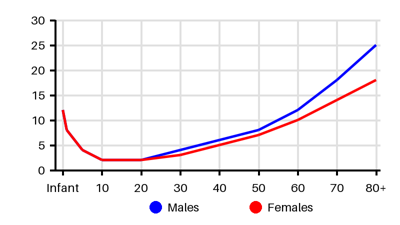
Incidence per 100.000 [w1u][es7][2zw][eb7][iat][swb][ikn][ymi][uih]
Symptoms & findings
Symptoms
Anorexia, Cough, Crepitations, Decreased respiratory sounds, Dyspnea, Fever, Night sweats, Tachypnea, Tracheal deviation, Weight loss
Clinical findings
Anemia, Elevated CRP, Hypoxemia, Leukocytosis
Anamneses
None listed.
Localized findings
Approach
Blood test
Blood gas
Blood culture
Chest X-ray
Cltrasound
CT thorax
Thoracocentesis: culture, Gram stain, PCR, albumin, lactic dehydrogenase, pH
Pleural fluid analysis --> empyema typically characterized by: [idi]
Low pH (<7.2)
Low glucose (<60 mg/dL)
Elevated LDH (>1000 IU/L)
Treatment
Goal of treatment: [idi][iat]
Eradicating infection --> antibiotics
Community-acquired empyema: Staphylococcus and Streptococcus species and anaerobes --> 3rd generation cephalosporins + metronidazole
Hospital-acquired empyema: S aureus, Pseudomonas, and typical organisms and anaerobes --> vancomycin + metronidazole + antipseudomonal cephalosporin
Adequate drainage of the pleural space
Tube thoracostomy (removed when drainage falls below 50 mL in 24 hours)
Video-assisted thoracoscopic surgery (VATS)
Open thoracotomy with decortication
Intrapleural therapies: streptokinase, urokinase, tPA, DNase --> some benefit
Restoring lung function:
Nutritional support
Pulmonary rehabilitation: Breathing exercises and physiotherapy
Treatment of atelectasis
Differential diagnoses
Abdominal abscess, Boerhaave syndrome, Bronchiolitis obliterans, Chylothorax, Heart failure, Hemothorax, Langerhans cell histiocytosis, Lung abscess, Lung cancer, Pleural effusion, Pleuritis, Pneumonia, Pulmonary embolism, Sarcoidosis, Tuberculosis, Wegener's granulomatosis
References
[1] Iguina MM, Sharma S, Danckers M. Thoracic Empyema. Updated 2024 Dec 24: https://www.ncbi.nlm.nih.gov/books/NBK544279/
[2] Moral L, Toral T, Marco N, Clavijo A, Canals F, Forniés MJ, González MC, Moral J, Márquez M, Lucas R, Caballero M, Huertas AM, García-Avilés B, Belda M. Epidemiology of pediatric parapneumonic pleural effusion during 13-valent pneumococcal conjugate vaccine implementation. Enferm Infecc Microbiol Clin (Engl Ed). 2023 Aug-Sep;41(7):414-419.
[3] Hardie W, Bokulic R, Garcia VF, Reising SF, Christie CD. Pneumococcal pleural empyemas in children. Clin Infect Dis. 1996 Jun;22(6):1057-63.
[4] Li ST, Tancredi DJ. Empyema hospitalizations increased in US children despite pneumococcal conjugate vaccine. Pediatrics. 2010 Jan;125(1):26-33.
[5] Arnold DT, Hamilton FW, Morris TT, Suri T, Morley A, Frost V, Vipond IB, Medford AR, Payne RA, Muir P, Maskell NA. Epidemiology of pleural empyema in English hospitals and the impact of influenza. Eur Respir J. 2021 Jun 17;57(6):2003546.
[6] Farjah F, Symons RG, Krishnadasan B, Wood DE, Flum DR. Management of pleural space infections: a population-based analysis. J Thorac Cardiovasc Surg. 2007 Feb;133(2):346-51.
[7] Deceuninck G, Quach C, Panagopoulos M, Thibeault R, Côté-Boileau T, Tapiéro B, Coïc L, De Wals P, Ovetchkine P. Pediatric Pleural Empyema in the Province of Quebec: Analysis of a 10-Fold Increase Between 1990 and 2007. J Pediatric Infect Dis Soc. 2014 Jun;3(2):119-26.
[8] Søgaard M, Nielsen RB, Nørgaard M, Kornum JB, Schønheyder HC, Thomsen RW. Incidence, length of stay, and prognosis of hospitalized patients with pleural empyema: a 15-year Danish nationwide cohort study. Chest. 2014 Jan;145(1):189-192.
[9] Lehtomäki A, Ukkonen M, Toikkanen V, Laurikka J, Khan J. The incidence of pleural infections in Finland. Respir Med Res. 2024 Nov;86:101132.
[10] Grijalva CG, Zhu Y, Nuorti JP, Griffin MR. Emergence of parapneumonic empyema in the USA. Thorax. 2011 Aug;66(8):663-8.
[11] http://emedicine.medscape.com/article/298485 (2014-01-24); [Medscape]
[12] http://emedicine.medscape.com/article/807499 (2014-01-24); [Medscape]