Diagnosis
Lung cancer
Carcinoma originating from lung parenchyma or within the bronchi.
Etiology
Etiology [dhs]
Smoking (90% of lung cancer cases)
Asbestos
Radiation therapy (lymphoma and breast cancer)
Exposure to carcinogens: arsenic, nickel, halogen ether, chromium, vinyl chloride, pollution
Radon gas
Chronic lung disease: chronic interstitial pneumonitis
Pathophysiology [dhs]
Chronic inflammation --> risk of dysplasia of the lung epithelium
Genetic mutations (MYC, BCL2, p53, EGFR, KRAS, p16) --> disrupts the cell cycle and promotes carcinogenesis
Classification [dhs]
Small cell lung cancer (neuroendocrine origin) represents 20% of all lung cancers: characterized by rapid growth and early dissemination
Non-small cell lung cancer (NSCLC): Squamous cell, large cell, and adenocarcinoma
Complications
Horner syndrome
Pancoasts syndrome
Superior vena cava syndrome
Paraneoplastic syndromes (ACTH, SIADH, hypercalcemia, carcinoid syndrome, Hyperaldosteronism, Lambert-Eaton myasthenic syndrome, cerebellar degeneration, Limbic encephalitis, Opsoclonus-Myoclonus, Polymyositis, Acanthosis nigricans, Dermatomyositis and Trousseau sign)
Tumor lysis syndrome (hyperuricemia, hyperphosphatemia, hypocalcemia, and hyperkalemia --> treat with hydration, allopurinol, dialysis)
Epidemiology
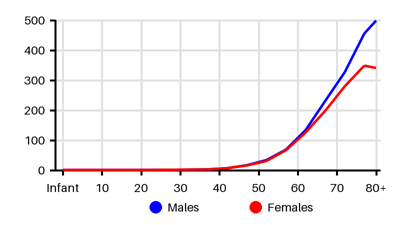
Incidence per 100.000 [dhs][nbk][6fv]
Symptoms & findings
Symptoms
Alopecia, Amenorrhea, Anhidrosis, Anorexia, Ataxia, Bronchorrhea, Cachexia, Coma, Confusion, Cough, Cyanosis, Diarrhea, Diplopia, Dizziness, Dysphagia, Dyspnea, Enophthalmos, Epistaxis, Fatigue, Fever, Flushing, Headache, Hemoptysis, Hirsutism, Hoarseness, Hyperhidrosis, Hyperpigmentation, Jugular vein distention, Lethargy, Loss of appetite, Miosis, Muscle atrophy, Muscle weakness, Myalgia, Nail clubbing, Nausea, Paresthesia, Ptosis, Seizure, Stridor, Syncope, Vomiting, Weight gain, Weight loss, Wheezing
Clinical findings
Anemia, Decreased Blood Urea Nitrogen, Decreased Uric Acid, Elevated ACTH, Elevated ADH, Elevated Jugular Venous Pressure, Elevated NSE, Elevated PTH-related peptide, Hypercalcemia, Hypocalcemia, Hyponatremia, Hyposmolality, Mediastinal lymphadenopathy, Mediastinal widening, Pleural effusion
Anamneses
None listed.
Localized findings
Approach
Blood test: Complete blood count, creatinine, calcium, PTH, electrolytes, serum osmolality, urine osmolality, liver function tests, LD
Blood gas: acidosis, hypercarbia, hypoxia
Chest X-ray: mediastinal widening, atelectasis, hilar enlargement, pleural effusion
CT thorax
Bone Scintigraphy
PET-CT
Sputum cytology
Mediastinoscopy
Bronchoscopy
Thoracoscopy
Transthoracic Needle Biopsy (CT- or fluoroscopy-guided)
Thoracentesis
Genetic testing: EGFR, ALK, BRAF, RET, ROS-1, NTRK 1/2/3, MET, KRAS, PD-L1
Treatment
Non-Small Cell Lung Cancer [kx3]
Stage IA - Surgery only
Lobectomy
Pneumonectomy
Wedge resection
Stage IB-IIIA - Surgery + adjuvant chemotherapy (cisplatin-based)
Stage II-IIIB - If surgically unresectable --> stereotactic radiation plus durvalumab
Stage IV - Chemotherapy (Cisplatin and/or pembrolizumab) and tyrosine kinase inhibitor based on genetic testing
Small Cell Lung Cancer [rto]
Stage Ia (T1N0):
Chemotherapy and radiation therapy + prophylactic cranial irradiation is the standard of care
Consider surgical resection only if true stage I (early stage)
Extensive-stage SCLC (beyond the supraclavicular areas or distant metastases):
Incurable --> palliative chemotherapy (Cisplatin, etoposide, irinotecan, carboplatin)
Immunotherapy: atezolizumab
Brain Metastases and spinal cord compression: corticosteroids
Differential diagnoses
Bronchitis, Carcinoid syndrome, Granuloma, Hamartoma, Horner syndrome, Hyperaldosteronism, Intrapulmonary lymph node, Myasthenia gravis, Pleural effusion, Pneumonia, Pneumothorax, Sarcoidosis, Superior vena cava syndrome, Syndrome of inappropriate antidiuretic hormone secretion, Tuberculosis
References
[1] Siddiqui F, Vaqar S, Siddiqui AH. Lung Cancer. [Updated 2023 May 8]. In: StatPearls [Internet]. Treasure Island (FL): StatPearls Publishing; 2025 Jan-. Available from: https://www.ncbi.nlm.nih.gov/books/NBK482357/
[2] https://www.cancerresearchuk.org/health-professional/cancer-statistics/statistics-by-cancer-type/lung-cancer/incidence#heading-One
[3] Tamási L, Horváth K, Kiss Z, Bogos K, Ostoros G, Müller V, Urbán L, Bittner N, Sárosi V, Vastag A, Polányi Z, Nagy-Erdei Z, Daniel A, Nagy B, Rokszin G, Abonyi-Tóth Z, Moldvay J, Vokó Z, Gálffy G. Age and Gender Specific Lung Cancer Incidence and Mortality in Hungary: Trends from 2011 Through 2016. Pathol Oncol Res. 2021 Apr 30;27:598862.
[4] http://emedicine.medscape.com/article/279960 (2014-01-02); [Medscape]
[5] http://emedicine.medscape.com/article/280104 (2014-01-02); [Medscape]