Diagnosis
Pseudomembranous colitis
An acute colitis characterized by formation of an adherent inflammatory exudate (pseudomembrane) overlying the site of mucosal injury.
Also known as: Clostridioides difficile infection, Clostridium difficile colitis
Etiology
Cause [kht]
Clostridium difficile is a gram-positive, anaerobic, spore-forming bacillus responsible for the development of antibiotic-associated diarrhea and colitis
Pathophysiology [kht]
The gastrointestinal tract microbial community (microbiome) is vital for:
Food fermentation
Barrier against pathogens
Synthesizing vitamins
Regulating metabolism and immunity
Colonization of C difficile in 4% of healthy individuals without causing infections
Antibiotic usage (penicillin, cephalosporin, fluoroquinolone, clindamycin)
A disturbance of the normal bacterial flora of the colon
Overgrowth of C difficile --> dysbiosis ==> colonisation --> infection
Release of toxins that cause:
Mucosal inflammation and damage
Diarrhea: ≥3 loose stools within 24 hours
Risk factors [rts][kht]
Broad-spectrum antibiotic exposure
Hospitalization
Increasing age
Comorbidities
Inflammatory bowel disease
Immunodeficiency
Proton pump inhibitors
Complications [kht]
Pseudomembranous colitis
Toxic megacolon
Colonic perforation
Septic shock
Epidemiology
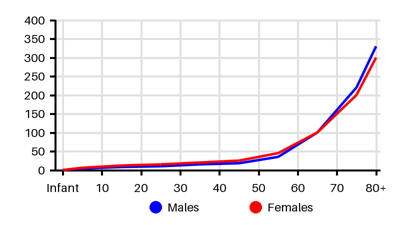
Incidence per 100.000 [e3w][y3w][5oc][rqg][gm9]
Symptoms & findings
Symptoms
Anorexia, Diarrhea, Fever, Malaise
Clinical findings
Decreased Albumin, Elevated Lactate, Leukocytosis
Anamneses
Localized findings
Approach
Blood test: WBC, electrolyte levels, creatinine, albumin, lactate
Hemofec
Feces culture
Clostridium difficile toxin
C difficile antigen: Glutamate dehydrogenase produced by C difficile or NAAT/PCR
Colonoscopy with biopsy
CT abdomen
Treatment
Replacement of fluid and electrolyte losses [1q2][v94][rts]
Avoidance of antiperistaltic agents: opiates, loperamide
Discontinuation of antimicrobial therapy if possible
If severe symptomatic disease --> Metronidazole 500mg x 3 or Vancomycim (oral)
Alternatives: Fidaxomicin, bacitracin, teicoplanin, oral fusidic acid
Fecal microbiota transplantation
Fulminant collitis --> subtotal or total colectomy
Differential diagnoses
Abdominal abscess, Cholera, Coliac disease, Crohn disease, Diverticulitis, Gastroenteritis, Gastrointestinal perforation, Irritable bowel syndrome, Peritonitis, Salmonellosis, Shigellosis, Toxic megacolon, Ulcerative colitis
References
[1] Mada PK, Alam MU. Clostridioides difficile infection. [Updated 2024 Apr 10]. In: StatPearls [Internet]. Treasure Island (FL): StatPearls Publishing; 2025 Jan-. Available from: https://www.ncbi.nlm.nih.gov/books/NBK431054/
[2] Khanna S, Pardi DS. Clostridium difficile infection: new insights into management. Mayo Clin Proc. 2012 Nov;87(11):1106-17.
[3] Khanna S, Pardi DS, Aronson SL, Kammer PP, Orenstein R, St Sauver JL, Harmsen WS, Zinsmeister AR. The epidemiology of community-acquired Clostridium difficile infection: a population-based study. Am J Gastroenterol. 2012 Jan;107(1):89-95.
[4] Health Protection Surveillance Centre (HPSC) Annual Report 2008: 9.5 Clostridium difficile-associated disease in Ireland.
[5] Centers for Disease Control and Prevention. Emerging Infections Program, Healthcare Associated Infections Community interface surveillance report, Clostridioides difficile infection (CDI), 2019. https://www.cdc.gov/hai/eip/pdf/cdiff/2019-CDI-Report-H.pdf
[6] Solanki D, Kichloo A, El-Amir Z, Dahiya DS, Singh J, Wani F, Solanki S. Clostridium difficile Infection Hospitalizations in the United States: Insights From the 2017 National Inpatient Sample. Gastroenterology Res. 2021 Apr;14(2):87-95.
[7] 2019 Annual Report for the Emerging Infections Program for Clostridioides difficile Infection
[8] Simor AE, Bradley SF, Strausbaugh LJ, Crossley K, Nicolle LE; SHEA Long-Term-Care Committee. Clostridium difficile in long-term-care facilities for the elderly. Infect Control Hosp Epidemiol. 2002 Nov;23(11):696-703.
[9] http://emedicine.medscape.com/article/186458 (2014-01-02); [Medscape]