Diagnosis
Gastroenteritis
Inflammation of the stomach, small intestine, or large intestine: [bsg]
Acute gastroenteritis usually lasts fewer than 14 days
Persistent gastroenteritis lasts between 14 and 30 days
Chronic gastroenteritis lasts more than 30 days
Also known as: Infectious diarrhea
Etiology
Cause
Infectious cause [bsg][4ws]
Viral (50-70%): Norovirus, rotavirus, adenovirus, astrovirus, coronavirus, calicivirus and small round-structured viruses (Norwalk, Southhampton and Lonsdale viruses).
Bacterial (15-20%): some pathogens may produce cytotoxin or invade the bowel wall causing inflammatory diarrhea
Salmonella, Campylobacter, Escherichia coli, Listeria monocytogenes, Cholera, Shigella staphylococcus, streptococcus, Vibrio, Yersinia enterocolitica and Clostridium difficile.
Parasite (10-15%): Giardia lamblia, Entamoeba histolytica, Cryptosporidium. Isospora, Cyclospora, Microsporidium.
Medications: Antibiotics, Laxative abuse, Sorbitol, Colchicine, Cardiac antidysrhythmics, NSAIDs, Chemotherapeutics, Antacids
Toxic: Organophosphates, Poisonous mushrooms, Arsenic, Ciguatera or scombroid
Inflammation: Celiac disease, Crohns disease, ulcerative colitis, ischemic colitis, toxin, alcohol, AIDS, radiation
Complications: Reactive arthritis, Guillain-Barre syndrome and Hemolytic uremic syndrome.
Pathophysiology
Exposure typically occurs through the fecal-oral route
Cytotoxins effects on the enterocytes --> damage to the intestinal villi and enterocytes
Malabsorption
Osmotic diarrhea
Transudative fluid loss into the intestine
Risk factors
Contaminated water (well)
Contaminated food
Undercooked food (seafood)
Travel
Immunsuppresion
Poor sanitation
Epidemiology
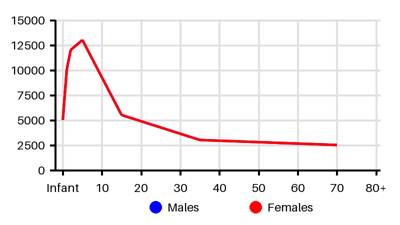
Incidence per 100.000 [mua][zmv][pwi][fiy][wzm]
Symptoms & findings
Symptoms
Arrhythmia, Chills, Dehydration, Diarrhea, Drowsy, Dry mucous membranes, Fatigue, Fecal incontinence, Fever, Flat neck veins, Headache, Hematemesis, Hematochezia, Myalgia, Nausea, Oliguria, Poor skin turgor, Prolonged capillary refill, Sunken fontanel, Tachypnea, Thirst, Vomiting, Weakness, Weight loss
Clinical findings
None listed.
Anamneses
Antibiotics, Contaminated food, Contaminated water
Localized findings
Approach
Blood test: complete blood cell count, electrolytes, renal function, culture
ELISA: Rotavirus, Giardia
Stool:
Culture
Occult blood
Fecal leukocytes --> bacterial cause
Fecal lactoferrin (marker for fecal leukocytes) --> inflammatory process
C difficile assay
Stool ova and parasites
CT abdomen
Treatment
Fluid replacement is the mainstay of symptomatic treatment: [zcd]
Oral rehydration is ideal
Intravenous hydration may be necessary in the setting of dehydration:
1-2 L dextrose 5% in 0.5 isotonic sodium chloride solution with 50 mEq NaHCO3 and 10-20 mEq KCl over 30-45 minutes
Antiemetics: Ondansetron, Promethazine
Antimotility agents: should be avoided in cases of fever or rectal bleeding
Loperamide
Diphenoxylate
Bacterial infection/travellers diarrhea:
Ciprofloxacin (500 mg as a single dose or twice a day for 1–2 days)
Azithromycin (single 1-g dose), in children: 10 mg/kg as a single dose, not to exceed 1 g
Rifaximin (200 mg 3 times a day)
Lactobacillus GG, a specific probiotic
Prevention [bsg]
Vaccines: Rotavirus
Water must be boiled for 3 minutes to kill pathogens. Two drops of bleach or 5 drops of iodine kill pathogens in water within 30 minutes.
Freezing does not kill pathogens. Avoid ice, request bottled beverages, and use a straw versus a glass.
Fruit that must be peeled is safe. Fruit that is not peeled or raw vegetables should be avoided.
Steam table buffets pose a high risk of contracting traveler’s gastroenteritis.
Communal condiments are frequently contaminated and should be avoided.
H2 blockers and proton pump inhibitors, can increase susceptibility to traveler’s diarrhea
Differential diagnoses
Appendicitis, Carcinoid tumor, Celiac disease, Cholecystitis, Clostridium difficile, Crohn disease, Diabetes mellitus, Diabetic ketoacidosis, Diverticulitis, Drug side effects, Gastrointestinal obstruction, Giardiasis, Hemolytic uremic syndrome, Ischemic colitis, Pancreatic failure, Pseudomembranous colitis, Salmonellosis, Sepsis, Shigellosis, Shock, Short bowel syndrome, Toxic megacolon, Ulcerative colitis, Urinary tract infection, Volvulus, Whipple's disease
References
[1] Graves NS. Acute gastroenteritis. Prim Care. 2013 Sep;40(3):727-41.
[2] Stuempfig ND, Tobin EH, Seroy J. Viral Gastroenteritis. [Updated 2025 May 4]. In: StatPearls [Internet]. Treasure Island (FL): StatPearls Publishing; 2025 Jan-. Available from: https://www.ncbi.nlm.nih.gov/books/NBK518995/
[3] Karakusevic A, Devaney P, Enstone A, Kanibir N, Hartwig S, Carias CDS. The burden of rotavirus-associated acute gastroenteritis in the elderly: assessment of the epidemiology in the context of universal childhood vaccination programs. Expert Rev Vaccines. 2022 Jul;21(7):929-940.
[4] Nisavanh A, Horrigue I, Debin M, Turbelin C, Kengne-Kuetche C, Nassany O, Ambert-Balay K, Jourdan-Da Silva N, Pontais I, de Valk H, Jones G. Epidemiology of acute gastroenteritis in France from November 2019-August 2021, in light of reported adherence to COVID-19 barrier measures. Sci Rep. 2022 Oct 19;12(1):17504.
[5] Karsten C, Baumgarte S, Friedrich AW, von Eiff C, Becker K, Wosniok W, Ammon A, Bockemühl J, Karch H, Huppertz HI. Incidence and risk factors for community-acquired acute gastroenteritis in north-west Germany in 2004. Eur J Clin Microbiol Infect Dis. 2009 Aug;28(8):935-43.
[6] de Wit MA, Koopmans MP, Kortbeek LM, van Leeuwen NJ, Bartelds AI, van Duynhoven YT. Gastroenteritis in sentinel general practices,The Netherlands. Emerg Infect Dis. 2001 Jan-Feb;7(1):82-91.
[7] Wheeler JG, Sethi D, Cowden JM, Wall PG, Rodrigues LC, Tompkins DS, Hudson MJ, Roderick PJ. Study of infectious intestinal disease in England: rates in the community, presenting to general practice, and reported to national surveillance. The Infectious Intestinal Disease Study Executive. BMJ. 1999 Apr 17;318(7190):1046-50.
[8] https://emedicine.medscape.com/article/775277
[9] http://emedicine.medscape.com/article/176515 (2014-01-02); [Medscape]
[10] http://emedicine.medscape.com/article/176400 (2014-01-02); [Medscape]