Diagnosis
Irritable bowel syndrome
A condition that involves recurrent abdominal pain, diarrhea and/or constipation due to abnormal bowel motility modified by psychosocial factors for which no anatomic cause can be found.
Etiology
Cause [ggv][wr6]
Abnormal gut-brain interaction
Gastrointestinal dysmotility
Visceral hyperalgesia
Psychopathology
Intestinal dysbiosis
Food intolerances/trigger
Mucosal inflammation
Postinfectious reactivity
Risk factors [osa]
Gastroenteritis
Female
Age (both young and old)
Anxiety
Depression
Stress
Frequent healthcare use
Pain and sleep disorders
Complications [wr6]
Hemorrhoids
Anal fissure
Fecal impaction
Nutritional deficiencies
Mental health issues: depression, anxiety, and mood disorders
Epidemiology
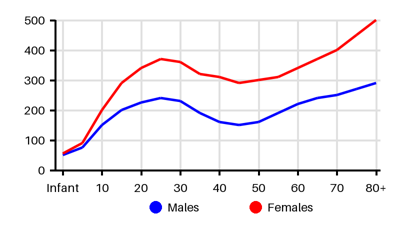
Incidence per 100.000 [sse][osa][sbm][pcg]
Symptoms & findings
Symptoms
Bloating, Constipation, Diarrhea, Dyspepsia, Flatulence, Meteorism, Nausea, Obstipation, Vomiting
Clinical findings
None listed.
Anamneses
None listed.
Localized findings
Approach
Blood test
Gastroscopy / Colonoscopy
Calprotectin
Diagnostic criteria: Manning Criteria, Rome I, Rome II [wb4]
Recurrent abdominal pain/distention (>1 day/week over the past 3 months)
Relieved with defecation
Change in frequency (>3/day or <3/week) and consistency of stool
Other criteria: feeling of incomplete evacuation, passage of mucus
Treatment
Dietary measures: [ggv]
Soluble fiber (oats, psyllium)
Adequate hydration
Limiting known triggers: lactose, oligosaccharides, disaccharides, monosaccharides, polyols (FODMAP-diet), bran, spicy food, fatty food
Behavioral and psychological interventions: [ggv]
Disease self-management, cognitive behavioral therapy, mindfulness, and psychotherapy
Pharmacologic agents: [ggv]
Anticholinergics (eg, dicyclomine, hyoscyamine, trimebutine, peppermint oil)
Antidiarrheals (eg, diphenoxylate, loperamide)
Neuromodulators such as tricyclics (eg, imipramine, amitriptyline)
Prokinetic agents (prucalopride)
Bulk-forming laxatives
PEG laxatives
Serotonin receptor antagonists (eg, alosetron, tegaserod)
Chloride channel activators (eg, lubiprostone)
Guanylate cyclase C (GC-C) agonists (eg, linaclotide, plecanatide)
Altering bacterial flora and gas formation (eg, rifaximin)
Sodium-hydrogen exchange 3 (NHE3) inhibitors (eg, tenapanor)
Peripherally acting mixed opioid receptor agonist/antagonist (eluxadoline)
Differential diagnoses
Acute intermittent porphyria, Acute mesenteric ischemia, Allergy, Anxiety, Bacterial overgrowth syndrome, Bile acid malabsorption, Celiac disease, Cholecystitis, Cholelithiasis, Chronic mesenteric ischemia, Chronic pancreatitis, Colorectal cancer, Crohn disease, Drug side effects, Endometriosis, Gastrinoma, Gastroenteritis, Giardiasis, Hypercalcemia, Hyperthyroidism, Hypothyroidism, Infectious colitis, Lactose intolerance, Lead toxicity, Pancreatic cancer, Pheochromocytoma, Postcholecystectomy syndrome, Small bowel cancer, Somatostatinomas, Ulcerative colitis, VIPoma
References
[1] http://emedicine.medscape.com/article/180389 (2014-01-02); [Medscape]
[2] Nathani RR, Sodhani S, Vadakekut ES. Irritable Bowel Syndrome. [Updated 2025 Sep 15]. In: StatPearls [Internet]. Treasure Island (FL): StatPearls Publishing; 2025 Jan-. Available from: https://www.ncbi.nlm.nih.gov/books/NBK534810/
[3] Creed F. Review article: the incidence and risk factors for irritable bowel syndrome in population-based studies. Aliment Pharmacol Ther. 2019 Sep;50(5):507-516.
[4] Locke GR 3rd, Yawn BP, Wollan PC, Melton LJ 3rd, Lydick E, Talley NJ. Incidence of a clinical diagnosis of the irritable bowel syndrome in a United States population. Aliment Pharmacol Ther. 2004 May 1;19(9):1025-31.
[5] Abdul Rani R, Raja Ali RA, Lee YY. Irritable bowel syndrome and inflammatory bowel disease overlap syndrome: pieces of the puzzle are falling into place. Intest Res. 2016 Oct;14(4):297-304.
[6] Almario, Christopher V. et al. Prevalence and Burden of Illness of Rome IV Irritable Bowel Syndrome in the United States: Results From a Nationwide Cross-Sectional Study. Gastroenterology, Volume 165, Issue 6, 1475 - 1487.
[7] Yale SH, Musana AK, Kieke A, Hayes J, Glurich I, Chyou PH. Applying case definition criteria to irritable bowel syndrome. Clin Med Res. 2008 May;6(1):9-16.