Diagnosis → Ophthalmology
Retinitis pigmentosa
A genetic eye disorder characterized by the progressive degeneration of photoreceptor cells in the retina leading to vision loss.
Also known as: Hereditary retinal dystrophy, Pigmentary retinal dystrophy, Rod-cone dystrophy
Etiology
Causes [ycd]
Multiple genetic mutations are associated with the condition
The genetic diversity contributes to the variation in the severity of the disease
Autosomal recessive: 5-20%
Autosomal dominant: 15-25%
X-linked recessive: 5-15%
Sporadic mutation: 40-50%
Pathophysiology [ycd]
The affected genes are responsible for critical retinal functions:
Phototransduction, the visual cycle, ciliary transport, and photoreceptor structure
Genetic mutation --> Biochemical dysfunction affecting rod photoreceptors
Injury pathways: Apoptosis, light damage, and ciliary transport dysfunction
The result is death of the rod photoreceptors (responsible for low-light vision)
The loss of large numbers of rods --> toxic environment:
Retinal pigment epithelium destruction
Cone photoreceptor cell death
Clinical manifestation:
Visual disturbances
Nyctalopia: Loss of night vision
Gradual narrowing of the visual fields
Tunnel vision
Complete vision loss
Dyschromatopsia: Loss of accurate color discrimination
Loss of visual acuity
Photopsia
Visual hallucinations
Complications [ycd]
Myopia
Astigmatism
Macular edema
Retinal detachment
Vitreous detachment
Cataracts
Glaucoma
Keratoconus
Mild hearing loss (Usher syndrome)
Epidemiology
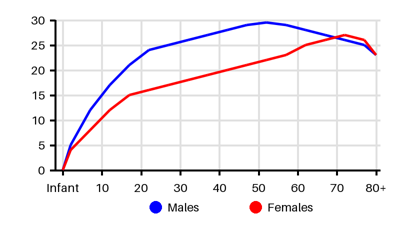
Prevalence per 100.000 [ycd][fbh][ehc][9ur][wmk]
Default
Symptoms & findings
Symptoms
Bilateral hemianopsia, Blindness, Blurred vision, Night blindness, Photopsia, Scotoma, Visual disturbances
Clinical findings
None listed.
Anamneses
None listed.
Approach
Ophthalmologic evaluation
Test visual acuity and contrast sensitivity
Visual field assessment
Dyschromatopsia: Assess color vision
Dust-like particles in the vitreous cavity
Fundoscopic exam:
Bony spicule pigmentation
Vascular narrowing
Abnormal waxy pallor of the optic disc
Fundus autofluorescence
Electroretinogram showing rod dysfunction
Fluorescein angiography
Optical coherence tomography angiography
Adaptive optics scanning laser ophthalmoscopy
Treatment
There is currently no cure for RP [ycd]
Ongoing research shows promising potential:
Gene therapy
Stem cell therapy
Retinal implants show promise in restoring vision
Management involves to help individuals adapt to their changing vision:
Nutritional supplementation, especially with vitamin A
Low-vision aids
Sun glasses
Optimize refraction glasses
Orientation
Mobility training
Macular edema: topical or systemic carbonic anhydrase inhibitors
Cataracts: Intraocular lens
Differential diagnoses
Age-related macular degeneration, Cytomegalovirus, Drug side effects, Lyme disease, Measles, Retinal artery occlusion, Retinal detachment, Retinitis, Retinoblastoma, Retinopathy, Rubella, Sarcoidosis, Systemic lupus erythematosus, Toxoplasmosis, Trauma, Tuberculosis, Vitamin deficiency
References
[1] O'Neal TB, Tripathy K, Luther EE. Retinitis Pigmentosa. [Updated 2024 Feb 12]. In: StatPearls [Internet]. Treasure Island (FL): StatPearls Publishing; 2026 Jan-. Available from: https://www.ncbi.nlm.nih.gov/books/NBK519518/
[2] Haim M. Epidemiology of retinitis pigmentosa in Denmark. Acta Ophthalmol Scand Suppl. 2002;(233):1-34.
[3] Abbass NJ, Yazji I, Allan KC, Kaelber DC, Talcott KE, Singh RP. Trends and Disparities in the Incidence and Prevalence of Inherited Retinal Diseases in the United States. Am J Ophthalmol. 2025 Nov;279:165-173.
[4] Na KH, Kim HJ, Kim KH, Han S, Kim P, Hann HJ, Ahn HS. Prevalence, Age at Diagnosis, Mortality, and Cause of Death in Retinitis Pigmentosa in Korea-A Nationwide Population-based Study. Am J Ophthalmol. 2017 Apr;176:157-165.
[5] Tsujikawa M, Wada Y, Sukegawa M, Sawa M, Gomi F, Nishida K, Tano Y. Age at onset curves of retinitis pigmentosa. Arch Ophthalmol. 2008 Mar;126(3):337-40.
[6] Haim M, Holm NV, Rosenberg T. Prevalence of retinitis pigmentosa and allied disorders in Denmark. I Main results. Acta Ophthalmol (Copenh). 1992 Apr;70(2):178-86.