Diagnosis
Lyme disease
A tickborne zoonosis caused by the spirochete Borrelia burgdorferi.
Also known as: Lyme borreliosis
Etiology
Cause [7k3]
The bacterial spirochete Borrelia burgdorferi (or other Borrelia species) is transmitted by the bite of an Ixodes genus tick
Pathofysiology [e5b][7k3]
Once in the skin, the spirochete can evade the host immune response and undergo hematogenous and lymphatic dissemination
Borrelia burgdorferi shows a distinct tropism for the skin, heart, central nervous system, joints, and eyes
The spirochete itself is not known to be directly toxic
The host inflammatory response is responsible for causing tissue damage in organs
Early localized: >4 weeks after the bite
Asymptomatic but seropositive patient
Erythema migrans.
Early disseminated: weeks to months after the bite
Erythema migrans
Lymphocytoma
Arthritis
Meningitis
Facial nerve paralysis
Cardiac disturbances/Carditis
Chronic disseminated: months to years after infection
Arthritis
Neuroborreliosis
Encephalomyelitis/encephalopathy
Chronic progressive encephalomyelitis
Late axonal neuropathies
Posttreatment Lyme disease syndrome
Complications [7k3]
Arthritis
Carditis
Neurological deficits
Ocular manifestations
Acrodermatitis chronica atrophicans
Lymphocytoma
Epidemiology
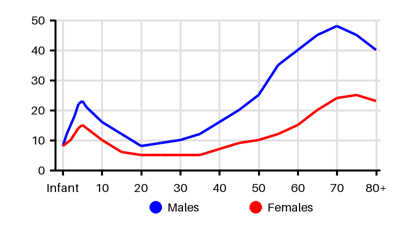
Incidence per 100.000 [3ks][gui][isf]
Symptoms & findings
Symptoms
Arrhythmia, Arthralgia, Arthritis, Ataxia, Chills, Confusion, Depression, Dizziness, Dyspnea, Facial nerve paralysis, Fatigue, Fever, Headache, Hearing loss, Irritability, Mental retardation, Myalgia, Neck stiffness, Palpitations, Paresis, Paresthesia, Photophobia, Pruritus, Seizure, Syncope, Urinary incontinence, Vertigo, Visual disturbances
Clinical findings
AV block, Iritis, Keratitis, Meningitis, Myocarditis, Optic neuritis, Pericarditis
Anamneses
None listed.
Localized findings
Approach
Serology (detect exposure, not infection)
Biopsy
Culture
PCR
Spinal fluid
ECG
MR caput
Treatment
Treatment strategy depends on clinical presentation: [7k3]
Asymptomatic patients with potential exposure: Ixodes, endemic area, tick was attached for ≥36 hours
Doxycycline 200 mg for adults and 4.4 mg/kg (up to a maximum dose of 200 mg) for children
Erythema migrans rash in endemic area:
10-day course of doxycycline or a 14-day course of amoxicillin or cefuroxime axetil
Neurologic manifestations: Intravenous ceftriaxone, cefotaxime, penicillin G, or oral doxycycline for 14 to 21 days
Cardiac manifestations:
heart block --> temporary pacemaker
Oral doxycycline
Lyme carditis --> IV ceftriaxone for 14 to 21 days
Arthritis:
Oral doxycycline for 28 days
If minimal or no response --> IV ceftriaxone for 2 to 4 weeks
If refractory to antibiotics --> intra-articular corticosteroid injections, use of disease-modifying agents or other advanced therapies should be considered
Borrelial lymphocytoma: Oral antibiotic therapy for 14 days
Acrodermatitis chronica atrophicans: Oral antibiotic therapy for 21 to 28 days
Posttreatment Lyme Disease Syndrome:
10-20% will not respond to treatment and can develop PTLDS (no objective manifestations such as active rash, cardiac or neurologic findings, or arthritis, but with persistent or recurring nonspecific symptoms such as fatigue, pain, or cognitive impairment.
Symptomatic management (NSAIDs, acetaminophen, heating pads, and physical therapy)
Antibiotic Refractory Lyme Arthritis:
10% experience persistent inflammatory arthritis that does not respond to antibiotic treatments --> referral to a rheumatologist
Differential diagnoses
Acute rheumatic fever, Ankylosing spondylitis, AV nodal block, Babesiosis, Breast cancer, Cellulitis, Cervical radiculopathy, Chronic venous insufficiency, COVID-19, Depression, Dermatomyositis, Drug eruptions, Eczema, Ehrlichiosis, Encephalitis, Erysipelas, Erythema multiforme, Gout, Granuloma annulare, Hypothyroidism, Insect Bite, Lymphoma, Meningitis, Morphea, Multiple sclerosis, Myocarditis, Paget's disease, Parvovirus B19, Pericarditis, Pityriasis rosea, Psoriatic arthritis, Reactive arthritis, Rheumatoid arthritis, Rocky mountain spotted fever, Sarcoidosis, Scleroderma, Septic arthritis, Syphilis, Systemic lupus erythematosus, Thrombophlebitis, Tinea, Urticaria
References
[1] Skar GL, Blum MA, Simonsen KA. Lyme Disease. [Updated 2024 Oct 1]. In: StatPearls [Internet]. Treasure Island (FL): StatPearls Publishing; 2025 Jan-. Available from: https://www.ncbi.nlm.nih.gov/books/NBK431066/
[2] http://emedicine.medscape.com/article/330178; [Medscape]
[3] Kugeler KJ, Earley A, Mead PS, Hinckley AF. Surveillance for Lyme Disease After Implementation of a Revised Case Definition — United States, 2022. MMWR Morb Mortal Wkly Rep 2024;73:118–123.
[4] Gasmi S, Koffi JK, Nelder MP, Russell C, Graham-Derham S, Lachance L, Adhikari B, Badcock J, Baidoobonso S, Billard BA, Halfyard B, Jodoin S, Singal M, Bourgeois AC. Surveillance for Lyme disease in Canada, 2009-2019. Can Commun Dis Rep. 2022 May 5;48(5):219-227.
[5] Schwartz AM, Nelson CA, Hinckley AF. Epidemiology of Lyme Disease Diagnoses among Older Adults, United States, 2016-20191. Emerg Infect Dis. 2024 Sep;30(9):1926-1929.
[6] Shafquat M, Angulo FJ, Pilz A, Moïsi JC, Stark JH. The Incidence of Lyme Borreliosis Among Children. Pediatr Infect Dis J. 2023 Oct 1;42(10):867-874.
[7] Lohr B, Müller I, Mai M, Norris DE, Schöffski O, Hunfeld KP. Epidemiology and cost of hospital care for Lyme borreliosis in Germany: lessons from a health care utilization database analysis. Ticks Tick Borne Dis. 2015 Feb;6(1):56-62.