Diagnosis
Tension headache
The most common type of primary headache characterized by a constant squeezing pressure on the head.
Also known as: Muscle contraction headache, Psychomyogenic headache, Stress headache, Tension-type headache
Etiology
Cause [opr]
Unknown
Trigger:
Stress
Sleep disturbances
Poor posture (excessive neck flexion)
Muscle tension
Nutritional factors: vitamin B12/D deficiency
Environmental factors
Genetic conditions
Pathophysiology [opr]
Episodic headache: Peripheral sensitization (higher levels of peripheral excitability)
Chronic headache: Central sensitization
Myofascial trigger points: the pericranial musculature is the presumed trigger point
Excessive pericranial muscle contractions
Autonomic dysfunction due to sleep disturbances
Sleep loss --> fatigue --> sympathetic overdrive --> headache
Clinical manifestation according to International Headache Society:
Pain quality: Nonpulsatile, pressing, or tightening pain
Location: Frontal-occipital (band-like) and bilateral
Severity: Mild/moderate intensity
Provoked by: Not aggravated by physical activity
Associated symptoms: Muscle tightness in the head, scalp, or neck
Duration: 30 minutes to 7 days
Classification
Episodic: <15 times per month
Chronic: >15 times per month or on a consistent basis over longer stretches of time
Red flags for secondary disorders [opr]
Sudden onset of headache
Age > 50 years
Severe headache
New onset of headache in the presence of an underlying medical condition
Headache with concomitant systemic illness
Focal neurologic signs or symptoms
Papilledema
History of head trauma
Systemic symptoms, including fever
History of neoplasm
Epidemiology
Incidence per 100.000 [vdk][uic][z8e][sw7][pvm][sus]
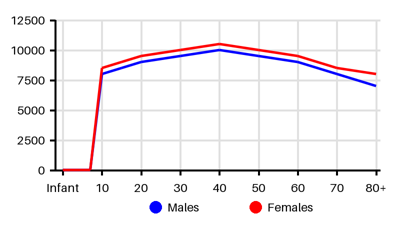
Symptoms & findings
Symptoms
Clinical findings
None listed.
Anamneses
None listed.
Localized findings
Approach
Neurological examination
MRI caput
3rd edition of the International Classification of Headache Disorders [sus][img]
Infrequent episodic tension-type headache
At least 10 episodes of headache occurring on < 1 day/month on average
Lasting from 30 min to 7 days
At least two of the following four characteristics:
Bilateral location
Pressing or tightening (non-pulsating) quality
Mild or moderate intensity
Not aggravated by routine physical activity such as walking or climbing stairs
Both of the following:
No nausea or vomiting
No more than one of photophobia or phonophobia
Frequent episodic tension-type headache
At least 10 episodes of headache occurring on 1–14 days/month on average for > 3 months (≥ 12 and < 180 days/year)
Lasting from 30 min to 7 days
At least two of the following four characteristics:
Bilateral location
Pressing or tightening (non-pulsating) quality
Mild or moderate intensity
Not aggravated by routine physical activity such as walking or climbing stairs
Both of the following:
No nausea or vomiting
No more than one of photophobia or phonophobia
Chronic tension-type headache
Headache occurring on ≥ 15 days/month on average for > 3 months (≥ 180 days/year), fulfilling criteria B-D
Lasting hours to days, or unremitting
At least two of the following four characteristics:
Bilateral location
Pressing or tightening (non-pulsating) quality
Mild or moderate intensity
Not aggravated by routine physical activity such as walking or climbing stairs
Both of the following:
No nausea or vomiting
No more than one of photophobia or phonophobia
Treatment
NSAIDs [sus][opr]
Paracetamol
Antidepressants for chronic cases: Amitriptyline (TCA), mirtazapine and venlafaxine
Non-pharmacologic:
Stress reduction
Acupuncture/trigger point injection
Exercise
Physical therapy
Psychological treatment
Biofeedback / Cognitive-behavioral therapy
Diet
Massage
Manipulation
Differential diagnoses
Brain tumor, COVID-19, Medication-overuse headache, Migraine, Obstructive sleep apnea, Temporal arteritis
References
[1] Shah N, Asuncion RMD, Hameed S. Muscle Contraction Tension Headache. [Updated 2024 Dec 11]. In: StatPearls [Internet]. Treasure Island (FL): StatPearls Publishing; 2025 Jan-. Available from: https://www.ncbi.nlm.nih.gov/books/NBK562274/
[2] Amatniek J, Sorra K, Frey L, Hauser WA. Chapter 10 - Age and Gender-Specific Patterns of Neurologic Illness. Principles of Gender-Specific Medicine (Second Edition) 2010, Pages 113-128.
[3] Lyngberg AC, Rasmussen BK, Jørgensen T, Jensen R. Incidence of primary headache: a Danish epidemiologic follow-up study. Am J Epidemiol. 2005 Jun 1;161(11):1066-73.
[4] Safiri S, Kolahi AA, Noori M, Nejadghaderi SA, Aslani A, Sullman MJM, Farhoudi M, Araj-Khodaei M, Collins GS, Kaufman JS, Gharagozli K. Burden of tension-type headache in the Middle East and North Africa region, 1990-2019. J Headache Pain. 2022 Jul 6;23(1):77. doi: 10.1186/s10194-022-01445-5. Erratum in: J Headache Pain. 2022 Aug 2;23(1):94.
[5] Ge R, Chang J, Cao Y. Headache disorders and relevant sex and socioeconomic patterns in adolescents and young adults across 204 countries and territories: an updated global analysis. J Headache Pain. 2023 Aug 18;24(1):110.
[6] Zhao W, Chen Y, Tang Y, Du S, Lu X. Analysis of headache burden Chinese in the global context from 1990 to 2021. Front Neurol. 2025 Apr 16;16:1559028.
[7] Onan D, Younis S, Wellsgatnik WD, Farham F, Andruškevičius S, Abashidze A, Jusupova A, Romanenko Y, Grosu O, Moldokulova MZ, Mursalova U, Saidkhodjaeva S, Martelletti P, Ashina S. Debate: differences and similarities between tension-type headache and migraine. J Headache Pain. 2023 Jul 21;24(1):92.
[8] Headache Classification Committee of the International Headache Society (IHS) The International Classification of Headache Disorders, 3rd edition. Cephalalgia. 2018 Jan;38(1):1-211.
[9] https://emedicine.medscape.com/article/792384