Diagnosis
Brain tumor
Tumor in the central nervous system (cerebrum, cerebellum, medulla spinalis).
Also known as: Brain cancer, Brain Neoplasm
Etiology
Cause
Primary brain tumors (<50%):
Astrocytoma
Oligodendroglioma
Ependymoma
Meningioma
Pituitary Adenoma
Acoustic Neuroma
Craniopharyngioma
Hemangioblastoma
Glomus Tumors
Metastatic (>50%):
Lung cancer (40%)
Breast cancer (19%)
Melanoma (10%)
Colon adenocarcinoma (7%)
Pathophysiology [k7p]
DNA mutations in cellular growth pathways --> tumor formation
Location and size lays a major role in the pathophysiology:
Epileptogenic regions --> development of seizures
Increased intracranial pressure --> Headache, nausea, vomiting, papilledema,
Obstruction of CSF --> hydrocephalus
Cerebellar dysfunction, and focal neurological deficit
Epidemiology
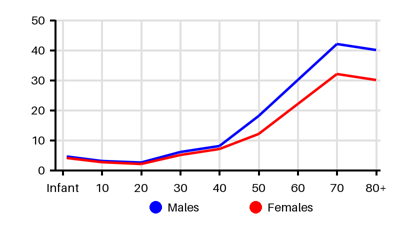
Incidence per 100.000 [e85][q1n][r6a][gfn][s4i][uif][8qk]
Symptoms & findings
Symptoms
Anopsia, Aphasia, Ataxia, Bradycardia, Cheyne-Stokes respiration, Cushing's triad, Diplopia, Headache, Hearing loss, Irregular respiration, Nausea, Nystagmus, Paralysis, Paresis, Scotoma, Seizure, Sunset eye sign, Tinnitus, Vertigo, Vomiting, Wide pulse pressure
Clinical findings
Elevated Intracranial Pressure, Papilledema
Anamneses
None listed.
Localized findings
Approach
CT caput [k7p]
MR caput
MR spectroscopy
CT chest/abdomen/pelvis
EEG
Bone scan
Mammography
Biopsy
Treatment
Treatment depends on acute symptoms, size and tumor type: [8qk][k7p]
Intubation if impending herniation
Corticosteroids --> reduce cerebral edema
Hyperventilation --> vasoconstriction --> reduce ICP
Mannitol --> transiently lower ICP (rebound increases in ICP --> problematic)
Surgical resection
Radiation treatment
Chemotherapy
Differential diagnoses
Arteriovenous malformation, Brain abscess, Cerebral aneurysm, Ependymoma, Epidural hematoma, Hydrocephalus, Intracerebral hemorrhage, Lymphoma, Meningioma, Multiple sclerosis, Stroke, Subarachnoid hemorrhage, Subdural hematoma, Toxoplasmosis
References
[1] Mezzacappa FM, Thorell W. Neuronal Brain Tumors. [Updated 2022 Nov 21]. In: StatPearls [Internet]. Treasure Island (FL): StatPearls Publishing; 2025 Jan-. Available from: https://www.ncbi.nlm.nih.gov/books/NBK576406/
[2] Bondy et al. Brain Tumor Epidemiology Consortium. Brain tumor epidemiology: consensus from the Brain Tumor Epidemiology Consortium. Cancer. 2008 Oct 1;113(7 Suppl):1953-68.
[3] Irena Ilic, Milena Ilic. International patterns and trends in the brain cancer incidence and mortality: An observational study based on the global burden of disease. Heliyon, Volume 9, Issue 7, 2023, e18222. ISSN 2405-8440.
[4] Hiba A Wanis et al. The incidence of major subtypes of primary brain tumors in adults in England 1995-2017, Neuro-Oncology, Volume 23, Issue 8, August 2021, Pages 1371–1382
[5] https://cbtrus.org/cbtrus-fact-sheet/
[6] Arora et al. Age-incidence patterns of primary CNS tumors in children, adolescents, and adults in England. Neuro Oncol. 2009 Aug;11(4):403-13.
[7] Etxeberria et al. Brain and central nervous system cancer incidence in navarre (Spain), 1973-2008 and projections for 2014. J Cancer. 2015 Jan 5;6(2):177-83.
[8] http://emedicine.medscape.com/article/779664 (2014-01-02); [Medscape]