Diagnosis
Obstructive sleep apnea
A sleep-related breathing disorder characterized by repeated partial or complete collapse of the upper airway with episodes of apnea and hypopnea during sleep causing oxygen desaturation.
Etiology
Causes [akv]
Central: ventilatory drive
Adenotonsillar hypertophy
Long uvula
Excessive pharyngeal folds
Neuromuscular factors --> muscle tone decreases --> upper airway collapse
Increase pressure around the upper airway --> pharyngeal collapsibility:
Large neck circumference, excess soft tissue
Pathophysiology [akv]
Negative collapsing pressure during inspiration
Fragmented, nonrestorative sleep
Loud, disruptive snoring
Witnessed apneas
Excessive daytime sleepiness
Suboptimal sleep quality:
Cardiovascular health
Mental well-being
Quality of life
Driving safety
Risk factors [akv]
Anatomical Factors
Micrognathia and retrognathia
Facial elongation
Mandibular hypoplasia
Adenoid and tonsillar hypertrophy
Inferior displacement of the hyoid
Nonanatomical Risk Factors
Central fat distribution
Obesity
Advanced age
Male gender
Supine sleeping position
Pregnancy
Additional Factors
Alcohol use
Smoking
Use of sedatives and hypnotics
Associated Medical Disorders
Endocrine disorders (diabetes mellitus, metabolic syndrome, acromegaly, and hypothyroidism)
Neurological disorders (stroke, spinal cord injury, and myasthenia gravis)
Prader-Willi syndrome
Down Syndrome
Congestive heart failure
Atrial fibrillation
Obesity hypoventilation syndrome
Complications [7ts][akv]
Hypertension
Myocardial infarction
Atrial fibrillation
Congestive heart failure
Pulmonary hypertension
Cor pulmonale
Cerebrovascular accident
Depression
Sleeplessness-related accidents
Sudden death
Epidemiology
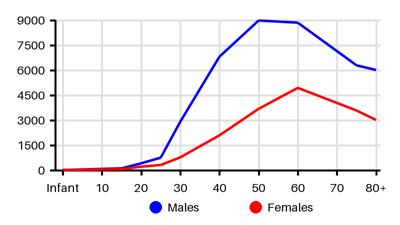
Prevalence per 100.000 [c3k][rri][dei][7ts]
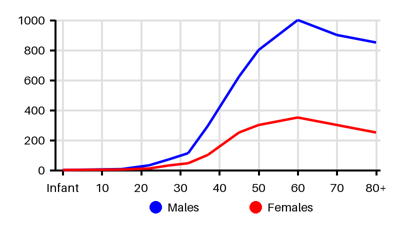
Incidence per 100.000 [c3k][rri][dei][7ts]
Symptoms & findings
Symptoms
Apnea, Enuresis, Growth retardation, Hypersomnia, Snoring
Clinical findings
Anamneses
None listed.
Approach
Pulse oximetry
Oronasal thermal sensor
Nasal air pressure transducer
Lateral neck radiography
Polysomnography
Epworth Sleepiness Scale
Treatment
Continuous positive airway pressure (CPAP) [wws]
Lifestyle Modification:
Weight loss
Avoiding sleeping in a supine position
Regular aerobic exercise
Surgery: if challenging to tolerate CPAP therapy [akv]
Barbed reposition pharyngoplasty
Uvulopalatopharyngoplasty: surgical removal of the uvula and tissue from the soft palate to create more space in the oropharynx
Tonsillectomy and adenoidectomy
Maxillomandibular advancement
Differential diagnoses
Asthma, Central sleep apnea, COPD, Cor pulmonale, Depression, Gastroesophageal reflux disease, Hypothyroidism, Narcolepsy, Obesity-hypoventilation syndrome, Pulmonary edema, Pulmonary hypertension
References
[1] Slowik JM, Sankari A, Collen JF. Obstructive Sleep Apnea. [Updated 2025 Mar 4]. In: StatPearls [Internet]. Treasure Island (FL): StatPearls Publishing; 2025 Jan-. Available from: https://www.ncbi.nlm.nih.gov/books/NBK459252/
[2] Suomi, J., Hess, G., Won, C., Bron, M., & Acquavella, J. (2020). Prevalence of Diagnosed Obstructive Sleep Apnea in the United States 2013-2016: Insured Patients Actively Seeking Care. Journal of Current Medical Research and Opinion, 3(06), 478–486.
[3] Bouchech R, Jmeaa MB, Baklouti M, Nouha G, Yaich S, Sakly G, Cheikh RB. Update on the epidemiology of obstructive sleep apnea syndrome in Central Eastern Tunisia over 11 years. Pan Afr Med J. 2024 Apr 24;47:206.
[4] Nilius G, Kallweit UTrümper D, Vogelmann T, Schubert T. Prevalence, incidence, and characteristics of CPAP treated OSA patients with residual excessive daytime sleepiness, as indicated by health-related data – A population representative study. Sleep Epidemiology, Volume 2, December 2022, 100044.
[5] Amy E. Rogers, Shauna Stahlman, Devin J. Hunt, Gi-Taik Oh, Leslie L. Clark. Obstructive Sleep Apnea and Associated Attrition, Active Component, U.S. Armed Forces, January 2004–May 2016. MSMR Vol. 23 No. 10 October 2016.
[6] Lu Liu, Yi Wang, Liqiong Hong, Nicola Luigi Bragazzi, Haijiang Dai, Huimin Chen. Obstructive Sleep Apnea and Hypertensive Heart Disease: From Pathophysiology to Therapeutics. Rev. Cardiovasc. Med. 2023, 24(12), 342.
[7] http://emedicine.medscape.com/article/295807 (2014-01-02); [Medscape]
[8] Friberg D, Sundquist J, Li X, Hemminki K, Sundquist K. Sibling risk of pediatric obstructive sleep apnea syndrome and adenotonsillar hypertrophy. Sleep. 2009 Aug;32(8):1077-83.