Diagnosis
Testicular torsion
A twisting of the spermatic cord structures and subsequent ischemia of the testis.
Etiology
Cause [wsh]
Spontaneous due to a congenital abnormality of the processus vaginalis
Exercise
Trauma
Pathophysiology [wsh]
The tunica vaginalis is usually adhered to the posterolateral aspect of the testicle
A high attachment of the tunica vaginalis may allow the spermatic cord torsion
In neonates: tunica vaginalis is not adhered to the gubernaculum --> risk of torsion
Testicular malignancy increases risk of torsion
The testicle twists on its spermatic cord
Obstruction of venous return leading to swelling
If obstruction persists, venous thrombosis occurs, followed by arterial occlusion
Infarction ensues quickly in the absence of blood supply
Salvage is possible if the torsion is less than 8 hours
Clinical manifestation:
Acute unilateral scrotal pain
Associated symptoms: nausea, vomiting, lower abdominal pain, inguinal pain
Risk factors [sbl]
Cryptorchid extrascrotal testes
Complications [wsh]
Loss of testis
Infection
Infertility
Cosmetic deformity
Loss or diminished exocrine and endocrine function in men
Epidemiology
Incidence per 100.000 [vsp][ts2][spg][8ri]
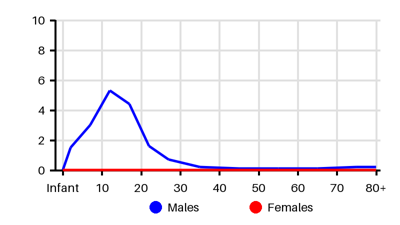
Symptoms & findings
Symptoms
High-riding testis, Nausea, Vomiting
Clinical findings
Absent cremasteric reflex, Hydrocele
Anamneses
Localized findings
Approach
Clinical diagnosis [sbl]
Urine stix
Blood test
Blood gas
Ultrasound is the primary diagnostic modality
MRI
Nuclear scintigraphy
Treatment
Analgesia: intravenous sedation, or a spermatic cord block [qss]
Transscrotal surgical approach: 4-8 hour window before permanent damage [sbl]
Detorsion --> prompt restoration of blood by
Orchiectomy if necrosis
Contralateral orchiopexy
Manual detorsion should be attempted if surgery is not an immediate option
Differential diagnoses
Epididymitis, Fournier gangrene, Hematoma, Hydrocele, Inguinal hernia, Leiomyosarcoma, Leukemia, Lipoma, Lymphoma, Necrotizing fasciitis, Orchitis, Rhabdomyosarcoma, Sarcoma, Testicular tumor, Torsion of the appendix testis, Trauma, Varicocele
References
[1] Schick MA, Sternard BT. Testicular Torsion. [Updated 2023 Jun 12]. In: StatPearls [Internet]. Treasure Island (FL): StatPearls Publishing; 2025 Jan-. Available from: https://www.ncbi.nlm.nih.gov/books/NBK448199/
[2] http://emedicine.medscape.com/article/2036003 (2014-01-02); [Medscape]
[3] Lee SM, Huh JS, Baek M, Yoo KH, Min GE, Lee HL, Lee DG. A nationwide epidemiological study of testicular torsion in Korea. J Korean Med Sci. 2014 Dec;29(12):1684-7.
[4] Mansbach JM, Forbes P, Peters C. Testicular torsion and risk factors for orchiectomy. Arch Pediatr Adolesc Med 2005; 159: 1167-71.
[5] Zhao LC, Lautz TB, Meeks JJ, Maizels M. Pediatric testicular torsion epi- demiology using a national database: incidence, risk of orchiectomy and possible measures toward improving the quality of care. J Urol 2011; 186: 2009-13.
[6] Huang WY, Chen YF, Chang HC, Yang TK, Hsieh JT, Huang KH. e in- cidence rate and characteristics in patients with testicular torsion: a na- tionwide, population-based study. Acta Paediatr 2013; 102: e363-7.
[7] Sharp VJ, Kieran K, Arlen AM. Testicular torsion: diagnosis, evaluation, and management. Am Fam Physician. 2013 Dec 15;88(12):835-40.
[8] Korkes F, Cabral PR, Alves CD, Savioli ML, Pompeo AC. Testicular tor- sion and weather conditions: analysis of 21,289 cases in Brazil. Int Braz J Urol 2012; 38: 222-8; discussion 8-9.