Diagnosis
Epididymitis
Inflammation of the epididymis (a tubular structure located on the posterior and superior aspect of the testis where sperms mature).
Etiology
Cause [sae]
Sexually active (<35 years): Sexually transmitted infection accompanied by urethritis
C. trachomatis
N. gonorrhoeae
E. coli
Pseudomonas
Men aged >35 years: Retrograde flow of urine
Urine retention due to obstructive urinary disease (prostatic hyperplasia)
Urinary tract instrumentation
Surgery
Males prior to sexual maturity:
Trauma
Repetitive movements (running, jumping)
Sexual abuse (bacterial infections)
Chemical (retrograde flow of urine)
Drug-induced (amiodarone)
Viral infections (mumps)
Pathophysiology [sae]
Bacteria are introduced during sexual intercourse --> migrate to the epididymis
UTI + retrograde flow of urine or stagnation of urine along the genitourinary tract
Bacterial epididymitis
Because of its proximity to the testis --> infection may spread to the testis
Complications [sae]
Abscess formation
Infarction/gangrene of the testicle
Subfertility or Infertility
Chronic epididymalgia or epididymitis
Sepsis
Risk factors
Urological infection
Narrowing of the urethra
Urethral catheter
Epidemiology
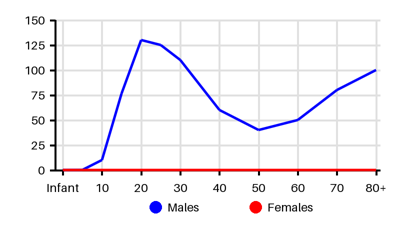
Incidence per 100.000 [dsc][rbr]
Symptoms & findings
Symptoms
Chills, Dysuria, Fever, Hematospermia, Hematuria, Lymphadenopathy, Prehn's sign, Urethral discharge
Clinical findings
Elevated CRP, Hydrocele, Leukocytosis
Anamneses
Localized findings
Approach
Urine stix
Urine microscopy
Urine culture
Blood test
Blood gas
Ultrasonography testis (sensitivity of 70% and a specificity of 88%)
Nuclear scintigraphy
Treatment
Treatment goals:
Microbiologic cure of infection
Improvement of signs and symptoms
Prevention of transmission to others
Decrease in potential complications (e.g., infertility or chronic pain).
Treatment: [ohf]
If caused by repetitive activity:
Bed rest + scrotal elevation + analgesics (NSAIDs)
If likely caused by gonococcal or chlamydial infection:
Ceftriaxone 250 mg single dose + Doxycycline 100 mg x 2 for 10 days
If likely caused by enteric organisms or allergic patients:
Ofloxacin 300 mg x 2 for 10 days OR Levofloxacin 500 mg x 1 for 10 days
Differential diagnoses
Chlamydia, Gonorrhea, Hydrocele, Inguinal hernia, Leiomyosarcoma, Lipoma, Orchitis, Rhabdomyosarcoma, Sarcoma, Spermatocele, Testicular torsion, Testicular tumor, Torsion of the appendix testis, Trauma, Urinary tract infection, Varicocele
References
[1] Rupp TJ, Leslie SW. Epididymitis. [Updated 2023 Jul 17]. In: StatPearls [Internet]. Treasure Island (FL): StatPearls Publishing; 2025 Jan-. Available from: https://www.ncbi.nlm.nih.gov/books/NBK430814/
[2] Goller JL, De Livera AM, Donovan B, Fairley CK, Low N, Hocking JS. Epididymitis rates in Australian hospitals 2009-2018: ecological analysis. Sex Transm Infect. 2021 Aug;97(5):387-390.
[3] Trojian TH, Lishnak TS, Heiman D. Epididymitis and orchitis: an overview. Am Fam Physician. 2009 Apr 1;79(7):583-7.
[4] Centers for Disease Control and Prevention; Workowski KA, Berman SM. Sexually transmitted diseases treatment guidelines, 2006. MMWR Recomm Rep. 2006 Aug 4;55(RR-11):1-94.
[5] http://emedicine.medscape.com/article/436154 (2014-01-02); [Medscape]