Diagnosis
Inguinal hernia
A direct inguinal hernia enters the inguinal canal through its weakened posterior wall. The hernia does not pass through the internal ring and practically never enters the scrotum. An indirect Inguinal hernia is a herniation through the internal inguinal ring traveling to the external ring. If complete, can enter the scrotum while exiting the external ring.
Etiology
Cause [ge9][qum]
Indirect inguinal hernias: A protrution lateral to the epigastric vessels
Congenital: Patent processus vaginalis - an invagination of the parietal peritoneum used in the testicular descent from abdomen to scrotum through the inguinal canal during embryogenesis
Direct acquired: Protrution through Hesselbach’s triangle medial to the epigastric vessels due to weakening of the abdominal wall
Pathophysiology [qum]
Abdominal wall hernias occur in areas where aponeurosis and fascia are devoid of protecting support of striated muscle
Reducible hernia: The protruding viscus can be returned to the abdomen
Irreducible (incarcerated) hernia: Protruding cannot be returned to the abdomen
Strangulated hernia: The tight circumferential pressure applied by the hernia defect may impede the venous outflow resulting in congestion, edema and tissue ischemia. Ultimately, arterial inflow is compromised resulting in tissue necrosis.
Risk factors
Male (congenital)
Age (old)
Smoker (tobacco)
Surgery
Muscle atrophy
Elevated intra-abdominal pressure (hard labor/chronic cough)
Diabetes
Alcoholism
COPD
Ascites
Peritoneal dialysis
Connective tissue disease/collagenopathy
Complications [qum]
Incarceration
Strangulation
Epidemiology
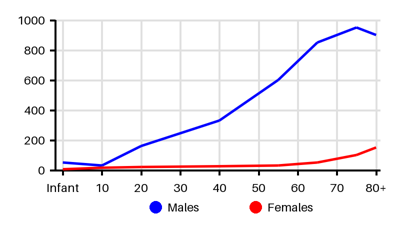
Incidence per 100.000 [iot]
Symptoms & findings
Symptoms
Carnett's sign, Hypotension, Ileus, Nausea, Tachycardia, Tachypnea, Vomiting
Clinical findings
Acidosis, Elevated CRP, Elevated Lactate, Leukocytosis
Anamneses
None listed.
Localized findings
Approach
Clinical diagnosis
Blood test and blood gas: Complete blood count, Electrolytes, blood urea nitrogen, creatinine, Lactate
Abdominal x-ray
Ultrasound abdomen
CT abdomen
Treatment
Nonoperative therapeutic measures include the following: [ge9]
Trusses
Binders or corsets
Hernia reduction
Topical therapy
Compression dressings
Surgery if: bowel necrosis, GI obstruction, symptomatic hernia or increasing size [ge9]
Bassini repair
Shouldice repair
Cooper repair
Simple inguinal hernia repair in children
Differential diagnoses
Cancer, Desmoid, Femoral hernia, Gastrointestinal obstruction, Hydrocele, Lymphadenopathy, Rectus sheath hematoma, Testicular cancer, Testicular torsion, Varicocele
References
[1] http://emedicine.medscape.com/article/189563 (2014-01-02); [Medscape]
[2] Morrison Z, Nirujogi VL. Ureteroinguinal Hernia. [Updated 2023 Aug 28]. In: StatPearls [Internet]. Treasure Island (FL): StatPearls Publishing; 2025 Jan-. Available from: https://www.ncbi.nlm.nih.gov/books/NBK537241/
[3] Zendejas B, Ramirez T, Jones T, Kuchena A, Ali SM, Hernandez-Irizarry R, Lohse CM, Farley DR. Incidence of inguinal hernia repairs in Olmsted County, MN: a population-based study. Ann Surg. 2013 Mar;257(3):520-6.
[4] [Maingots Abdominal Operations, 12.th edition]