Diagnosis
Urinary tract infection
Uncomplicated lower urinary tract infection: inflammation along urethra and bladder wall.
Also known as: Cystitis, Lower urinary tract infection, Uncomplicated urinary tract infection
Etiology
Cause [feo]
Bacteria:
Escherichia coli, Staphylococcus saprophyticus, Klebsiella, Enterococcus faecalis, Staphylococcus aureus, Brucellosis, Citrobacter, Proteus, Pseudomonas, Schistosomiasis
Risk factor [feo]
Trauma
Catheter
Surgery
Urinary retention or bladder diverticulum/fistula
Cystocele
Dehydration
Diabetes
Diarrhea
Sexual intercourse
Pregnancy
Pathophysiology [feo][1sn]
Enteric bacteria, which normally inhabit the periurethral vaginal introitus, ascend the urethra into the bladder and trigger an inflammatory reaction --> cystitis
The shorter female urinary tract is inherently predisposed to bacterial seeding and proximal spread
Urine has natural antimicrobial properties (pH < 5, high urea levels, hyperosmolality, organic acids, proteins, and nitrites)
Frequent urination and high urinary volumes also reduce the risk of UTI
Clinical presentation:
Dysuria
Urinary frequency, hesitancy and urgency
Suprapubic pain (bladder spasms)
Hematuria
Urinary odor
Complicated UTI: fever, chills, nausea, vomiting, back/flank pain, stones, sepsis, urinary obstruction, catheters (biofilm), or involving the kidneys, immunocompromised patients, males, pregnant patients
Complications [feo]
Pyelonephritis
Urosepsis
Urine retention
Prostatitis
Incontinence
Renal abscess
Renal failure
Epidemiology
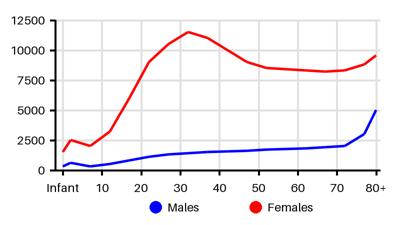
Incidence per 100.000 [p1g][uis]
Symptoms & findings
Symptoms
Chills, Delirium, Dysuria, Fever, Hematuria, Polyuria, Pyuria, Urinary urgency
Clinical findings
Anamneses
None listed.
Localized findings
Approach
Blood test
Urine stix: alkaline urine, bacteria converting nitrates into nitrites, WBC, hematuria
Urine culture: synptomatic patient + ≥1000 CFU/mL = diagnostic for a UTI [feo]
Treatment
Antibiotics: 3-7 days for women and >7 days for men [feo]
1st line: nitrofurantoin, trimethoprim/sulfamethoxazole, trimethoprim alone, fosfomycin, 1st gen cephalosporins, and pivmecillinam
Adjunctive therapies of variable evidence:
Cranberry (juice, pills, or extract)
D-mannose
Estrogen vaginal cream
Increased fluid intake is helpful
Complicated UTI: Antibiotics for 10-14 days
Remove or replace catheter: Most antibiotics cannot effectively penetrate biofilms
Urinary retention/hydronephrosis --> JJ-stent or stone extraction
Perinephric abscess --> drainage
Initial broad-spectrum options: Penicillins, cephalosporins, and carbapenems
Differential diagnoses
Bladder cancer, Chlamydia, Gonorrhea, Herpes simplex, Interstitial cystitis, Overactive bladder, Pelvic inflammatory disease, Prostatitis, Pyelonephritis, Renal infarction, Renal thrombosis, Urolithiasis, Urosepsis, Vaginitis
References
[1] Bono MJ, Leslie SW. Uncomplicated Urinary Tract Infections. Updated 2025 Feb 21: https://www.ncbi.nlm.nih.gov/books/NBK470195/
[2] Sabih A, Leslie SW. Complicated Urinary Tract Infections. Updated 2024 Dec 7: https://www.ncbi.nlm.nih.gov/books/NBK436013/
[3] Yang X, Chen H, Zheng Y, Qu S, Wang H, Yi F. Disease burden and long-term trends of urinary tract infections: A worldwide report. Front Public Health. 2022 Jul 27;10:888205.
[4] He Y, Zhao J, Wang L, Han C, Yan R, Zhu P, Qian T, Yu S, Zhu X, He W. Epidemiological trends and predictions of urinary tract infections in the global burden of disease study 2021. Sci Rep. 2025 Feb 8;15(1):4702.
[5] http://emedicine.medscape.com/article/231574 (2014-01-02); [Medscape]
[6] http://emedicine.medscape.com/article/233101 (2014-01-02); [Medscape]