Diagnosis
Portal hypertension
Portal pressure >10 mm Hg measured indirectly with the hepatic venous pressure gradient of ≥6 mm Hg.
Etiology
Cause [y0v][5kp]
Prehepatic:
Portal atresia, portal vein thrombosis, tumor compression, AV-fistula (increased flow)
Intrahepatic: Changes in hepatic microcirculation --> structural changes --> fibrosis, regenerative nodules, vascular occlusion, angiogenesis, vasoconstriction
Presinusoidal: Schistosomiasis, fibrosis (hemochromatosis, Wilson, congenital), early primary biliary cholangitis, sarcoidosis, chronic active hepatitis, and toxins (vinyl chloride, arsenic, and copper)
Sinusoidal: Cirrhosis, alcohol-related hepatitis, vitamin A intoxication, cytotoxic drugs, and advanced primary biliary cholangitis
Postsinusoidal: sinusoidal obstruction syndrome due to veno-occlusive disease
Posthepatic: Budd-Chiari syndrome, tumor compression of IVC, heart failure (constrictive pericarditis, tricuspid insufficiency, restrictive cardiomyopathy)
Idiopathic portal hypertension
Pathophysiology [5kp][y0v]
The portal vein pressure is normally between 1 and 4 mm Hg (higher than the hepatic vein pressure)
Increased resistance to portal blood flow --> portal hypertension
Portosystemic collaterals: caput medusa, hemorrhoids, esophageal varices
Sustained portal hypertension result in
Decreased systemic blood pressure
Reduced effective arterial blood volume.
Activation of the renin-angiotensin-aldosterone system --> Na and H2O retention
Bacterial translocation from the gut lumen to the systemic circulation
Hepatic venous pressure gradient ≥12 mm Hg --> decompensation:
Ascites
Variceal bleeding
Hepatic encephalopathy
Complications [5kp]
Thrombocytopenia due to hypersplenism
Variceal bleeding (gastroesophageal, anorectal, retroperitoneal)
Anemia
Ascites
Spontaneous bacterial peritonitis
Hepatic hydrothorax
Hepatorenal syndrome
Hepatic encephalopathy
Hepatopulmonary syndrome
Portopulmonary hypertension
Cirrhotic cardiomyopathy
Epidemiology
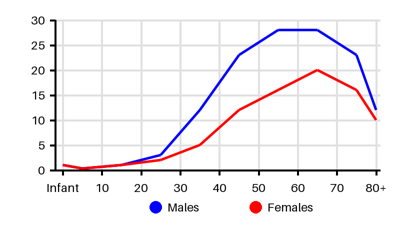
Incidence per 100.000 [vcd][sgc][ids][f5r]
Symptoms & findings
Symptoms
Caput medusa, Coma, Decreased consciousness, Edema, Hematemesis, Hematochezia, Hemorrhoids, Icterus, Lethargy, Obesity, Spider nevus, Splenomegaly
Clinical findings
Ascites, Gynecomastia, Jaundice, Palmar erythema
Anamneses
None listed.
Localized findings
Approach
Blood tests: WBC, liver function tests (ASAT, ALAT, ALT, ALP, PT-INR, APTT, albumin, bilirubin, creatinine, electrolytes, antibodies (ANA, AMA, ASMA), iron, ceruloplasmin, Alpha1-antitrypsin deficiency
Arterial blood gas
Ultrasound abdomen
Liver biopsy
CT abdomen
Visceral angiography
Hepatic venous pressure gradient (HVPG)
Esophagogastroduodenoscopy
Treatment
Identify and address the underlying etiology [5kp]
Thrombosis --> anticoagulation
Hepatitis C infection --> antiviral therapy
Medical treatment: [ccf][y0v]
Splanchnic vasoconstrictors:
Vasopressin (IV)
Somatostatin (IV): Octreotide, Vasopressin, Terlipressin
Nonselective beta-adrenergic blockers: propranolol or nadolol (oral)
β1-blockade (reduction of cardiac output)
β2-blockade (splanchnic vasoconstriction)
Analogues of nitric oxide (NO): nitrates and simvastatin
Block adrenergic activity: prazosin and clonidine
Block angiotensin: captopril, losartan, and irbesartan (induce intrahepatic vasodilatation)
Local therapy: risk of recurrence --> endoscopic surveillance
Esophageal variceal ligation (endoscopic elastic bands)
Variceal sclerotherapy (endoscopic)
Balloon tamponade
Expandable esophageal stents
Percutaneous transhepatic embolization
Transjugular Intrahepatic Portosystemic Shunt (TIPS)
Surgery: severe cirrhosis/esophageal varices and/or liver failure
Portosystemic shunts
Liver transplantation
Differential diagnoses
Acute liver failure, Ascites, Budd-Chiari syndrome, Cirrhosis, Congenital atresia, Congenital fibrosis, Hemochromatosis, Leukemia, Lymphoreticular cancer, Pericarditis, Polycystic kidney disease, Portal vein thrombosis, Sarcoidosis, Schistosomiasis, Splenomegaly, Tricuspid regurgitation, Tuberculosis, Vitamin deficiency, Wilson's disease
References
[1] http://emedicine.medscape.com/article/182098 (2014-01-02); [Medscape]
[2] Oliver TI, Sharma B, John S. Portal Hypertension. [Updated 2025 Jul 7]. In: StatPearls [Internet]. Treasure Island (FL): StatPearls Publishing; 2025 Jan-. Available from: https://www.ncbi.nlm.nih.gov/books/NBK507718/
[3] Fleming KM, Aithal GP, Solaymani-Dodaran M, Card TR, West J. Incidence and prevalence of cirrhosis in the United Kingdom, 1992-2001: a general population-based study. J Hepatol. 2008 Nov;49(5):732-8.
[4] Devarbhavi, Harshad et al. Global burden of liver disease: 2023 update. Journal of Hepatology, Volume 79, Issue 2, 516 - 537.
[5] Mendes FD, Suzuki A, Sanderson SO, Lindor KD, Angulo P. Prevalence and indicators of portal hypertension in patients with nonalcoholic fatty liver disease. Clin Gastroenterol Hepatol. 2012 Sep;10(9):1028-33.e2.
[6] Scaglione S, Kliethermes S, Cao G, Shoham D, Durazo R, Luke A, Volk ML. The Epidemiology of Cirrhosis in the United States: A Population-based Study. J Clin Gastroenterol. 2015 Sep;49(8):690-6.
[7] Garcia-Tsao G, Bosch J. Management of varices and variceal hemorrhage in cirrhosis. N Engl J Med. 2010 Mar 4;362(9):823-32.