Diagnosis
Hirschsprung's Disease
Congenital absence of ganglion cells in the distal GI tract (usually rectum) that results in intestinal obstruction and delayed passage of meconium.
Also known as: Congenital aganglionic megacolon
Etiology
Cause - Genetic association
Genetic disorders (Down syndrome or Waardenburg syndrome)
50% are linked to a specific genetic mutation
20% occur within families
Pathophysiology [p7v][raf]
Three neuronal plexus innervate the intestine:
The submucosal (ie, Meissner) plexus
The intermuscular (ie, Auerbach) plexus
The smaller mucosal plexus
All are involved in bowel function: absorption, secretion, motility, and blood flow.
In patients with Hirschsprung disease, ganglion cells are absent.
The result is an increased smooth muscle tone, imbalance of smooth muscle contractility, uncoordinated peristalsis, and a functional obstruction.
Classification of Hirschsprung disease [raf]
Short-segment (80%): missing nerve cells from the rectum to the sigmoid colon [q6o]
Long-segment: missing nerve cells from the rectum and a longer part of the colon
Total colonic: missing nerve cells from the rectum and the entire colon
Small intestinal: missing nerve cells from the rectum, colon, and the end of the small intestine
Total intestinal: missing nerve cells from the rectum, colon, and (nearly) all of the small intestine
Complications [raf][1wp]
Enterocolitis (HAEC)
Megacolon
Bowel obstruction
Intestinal perforation
Growth failure
Epidemiology
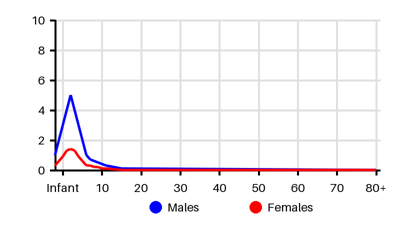
Incidence per 100.000 [q6o][ira][7bn][oop]
Symptoms & findings
Symptoms
Absent feces, Absent flatus, Constipation, Diarrhea, Failure to thrive, Fever, Hematochezia, Vomiting
Clinical findings
Gastrointestinal dilatation, Gastrointestinal obstruction, Peritonitis, Shock
Anamneses
None listed.
Localized findings
Approach
Rectal examination
Abdominal x-ray
Barium enema
Anorectal manometry
Biopsy confirm the diagnosis
Treatment
Constipation: [raf]
Rectal irrigation
Laxatives
High-fiber diet
ACE / Malone procedure (appendicostomy) allowing daily bowel flushing
Incontinence: stoma
Surgical treatment for Hirschsprung’s disease involves a two-step process: [p7v][q6o]
Laparotomy and colostomy
Once the child’s weight, age, and condition are suitable --> pull-through procedure:
Swenson procedure
Duhamel procedure
Soave (endorectal) procedure (transanal endorectal pull-through) [7bn]
Differential diagnoses
Anorectal malformation, Constipation, Enterocolitis, Hypothyroidism, Irritable bowel syndrome, Meconium ileus, Ogilvie syndrome, Toxic megacolon
References
[1] http://emedicine.medscape.com/article/178493 (2014-01-02); [Medscape]
[2] Lotfollahzadeh S, Taherian M, Anand S. Hirschsprung Disease. [Updated 2023 Jun 3]. In: StatPearls [Internet]. Treasure Island (FL): StatPearls Publishing; 2025 Jan-. Available from: https://www.ncbi.nlm.nih.gov/books/NBK562142/
[3] Calkins CM. Hirschsprung Disease beyond Infancy. Clin Colon Rectal Surg. 2018 Mar;31(2):51-60.
[4] Heuckeroth RO. Hirschsprung disease - integrating basic science and clinical medicine to improve outcomes. Nat Rev Gastroenterol Hepatol. 2018 Mar;15(3):152-167.
[5] Ambartsumyan L, Smith C, Kapur RP. Diagnosis of Hirschsprung Disease. Pediatr Dev Pathol. 2020 Jan-Feb;23(1):8-22.
[6] Suita S, Taguchi T, Ieiri S, Nakatsuji T. Hirschsprung's disease in Japan: analysis of 3852 patients based on a nationwide survey in 30 years. J Pediatr Surg. 2005 Jan;40(1):197-201; discussion 201-2.
[7] Best KE, Addor MC, Arriola L, Balku E, Barisic I, Bianchi F, Calzolari E, Curran R, Doray B, Draper E, Garne E, Gatt M, Haeusler M, Bergman J, Khoshnood B, Klungsoyr K, Martos C, Materna-Kiryluk A, Matias Dias C, McDonnell B, Mullaney C, Nelen V, O'Mahony M, Queisser-Luft A, Randrianaivo H, Rissmann A, Rounding C, Sipek A, Thompson R, Tucker D, Wellesley D, Zymak-Zakutnia N, Rankin J. Hirschsprung's disease prevalence in Europe: a register based study. Birth Defects Res A Clin Mol Teratol. 2014 Sep;100(9):695-702.