Diagnosis
Hypothyroidism
Low levels of thyroid hormone with varied etiology and manifestations:
Primary: the thyroid gland cannot produce adequate amounts of thyroid hormone
Secondary: central disease (abnormal pituitary gland or hypothalamus function)
Etiology
Cause [1mf][ucp][rft]
Primary: Most common
Iodine deficiency: most common cause world wide
Chronic autoimmune thyroiditis: Hashimoto thyroiditis
Iatrogenic:
Surgery (for hyperthyroidism, goitre or thyroid cancer)
Neck irradiation (neck neoplasms, breast cancer, or Hodgkin disease)
Genetic (including variations causing congenital hypothyroidism)
Drug-induced: Radioactive iodine, Iodinated contrast, Amiodarone, Interferon alfa, Thalidomide, Lithium, Valproate, Stavudine, Tyrosine kinase inhibitors, Bexarotene, Perchlorate, Interleukin (IL)-2, Ethionamide, Rifampin, Phenytoin, Carbamazepine, Phenobarbital, Aminoglutethimide, Sulfisoxazole, p -Aminosalicylic acid, Monoclonal antibodies, Immune inhibitors (Ipilimumab, pembrolizumab, nivolumab)
Transient thyroiditis: post-partum (92 per 100,000 pregnancies), viral infection (De Quervain syndrome)
Thyroid infiltration: infectious, malignant (primary thyroid or metastatic) and other autoimmune conditions, such as sarcoidosis
Secondary (central): rare
Hypothalamic failure and/or dysfunction
Sheehan syndrome
Pituitary adenoma and/or apoplexy
Tumors impinging on the hypothalamus
Lymphocytic hypophysitis
Brain or pituitary irradiation
Congenital nongoitrous hypothyroidism type 4
TRH resistance/deficiency
Resistance to TSH or thyrotropin releasing hormone
Drug-induced (dopamine, somatostatins, prednisone, opioids)
Extra-thyroidal:
Consumptive hypothyroidism
Tissue-specific secondary to genetic mutations (THRα, THRβ and MCT8)
Pathophysiology [rft]
The hypothalamus --> thyrotropin-releasing hormone (TRH)
The pituitary gland --> thyroid-stimulating hormone (TSH)
Thyroid gland produce:
T4 100 to 125 nmol daily --> converted to T3 peripherally
Smaller quantities of triiodothyronine (T3)
Negative feedback on TRH and TSH is exerted primarily by T3 and T4
Primary hypothyroidism: high TSH and low thyroxine levels
Secondary hypothyroidism: low TSH and low thyroxine levels
Complications [rft]
Myxedema crisis: encephalopathy, hypothermia, seizures, hyponatremia, hypoglycemia, arrhythmias, cardiogenic shock, respiratory failure, and fluid retention
Epidemiology
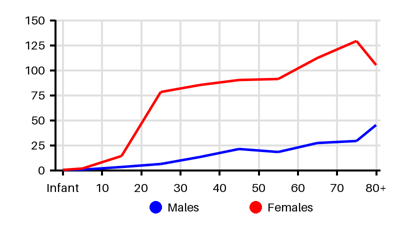
Incidence per 100.000 [kdk][noe][u8b][igq]
Symptoms & findings
Symptoms
Alopecia, Arthralgia, Ataxia, Blurred vision, Bradycardia, Cold intolerance, Coma, Constipation, Decreased libido, Depression, Distant heart sounds, Dysphagia, Dyspnea, Edema, Epicanthal folds, Failure to thrive, Fatigue, Fever, Flat nasal bridge, Globus sensation, Hearing loss, Hoarseness, Hyporeflexia, Hypotension, Hypothermia, Icterus, Infertility, Lethargy, Loss of appetite, Menorrhagia, Mental retardation, Muscle weakness, Myalgia, Myxedema, Oligomenorrhea, Pallor, Palpebral fissures, Paresthesia, Sore throat, Weight gain
Clinical findings
Anemia, Anti-TPO, Ascites, Cardiomegaly, Decreased hematocrit, Decreased T3, Decreased T4, Decreased TSH, Elevated Creatine Kinase, Elevated Creatinine, Elevated TSH, Flat T wave, Hypercapnia, Hyponatremia, Inverted T wave, Jaundice, Low voltage QRS, Macroglossia, Pericardial effusion, Pleural effusion, TSH receptor antibodies
Anamneses
None listed.
Localized findings
Approach
Blood test: TSH, FT4, FT3, anti-thyroid peroxidase (anti-TPO), anti-thyroglobulin antibodies (anti-Tg), TSAb
Ultrasonography of the neck and thyroid
Fine-Needle Aspiration Biopsy
FDG-PET [ucp]
ECG
Treatment
Levothyroxine 1.6 µg/kg/day titrated to optimal TSH levels (0.4–4.0 mIU/L) [ucp]
Pregnant women will require doses about 25% higher
Reduced (1/4th or half) dose in:
Elderly patients
Atrial fibrillation
Ischemic heart disease
If higher dose than expected --> consider gastritis or celiac disease
Malabsorption: [rft]
IV thyroid hormone 50% to 75% of the oral dose
Liquid and gel capsule formulations
Hypothyroidism in pregnancy:
Preeclampsia
Anemia
Postpartum hemorrhage
Cardiac ventricular dysfunction
Increased risk of spontaneous abortion
Low birth weight
Impaired cognitive development in offspring
ADHD, autism, fetal mortality
Myxedema coma:
LT4 4 µg/kg body weight (~200-250 µg) as an IV bolus
24 hours later, give 100 µg IV
Subsequently, give 50 µg/day IV, along with stress doses of IV glucocorticoids
Differential diagnoses
Acute thyroiditis, Adrenal insufficiency, Anemia, Anxiety, Cardiac tamponade, Constipation, Depression, Dysmenorrhea, Eosinophilia, Eosinophilia-myalgia syndrome, Fibromyalgia, Gastrointestinal obstruction, Hashimotos thyroiditis, Hypopituitarism, Hypothermia, Lymphoma, Menopause, Mononucleosis, Obesity, Obstructive sleep apnea, Pituitary adenoma, Postpartum thyroiditis, Riedels fibrosing thyroiditis, Subacute thyroiditis, Syndrome of inappropriate antidiuretic hormone secretion, Thyroid lymphoma, Toxic nodular goiter
References
[1] Taylor PN, Albrecht D, Scholz A, Gutierrez-Buey G, Lazarus JH, Dayan CM, Okosieme OE. Global epidemiology of hyperthyroidism and hypothyroidism. Nat Rev Endocrinol. 2018 May;14(5):301-316.
[2] https://emedicine.medscape.com/article/122393
[3] Patil N, Rehman A, Anastasopoulou C, et al. Hypothyroidism. [Updated 2024 Feb 18]. In: StatPearls [Internet]. Treasure Island (FL): StatPearls Publishing; 2025 Jan-. Available from: https://www.ncbi.nlm.nih.gov/books/NBK519536/
[4] Garmendia Madariaga A, Santos Palacios S, Guillén-Grima F, Galofré JC. The incidence and prevalence of thyroid dysfunction in Europe: a meta-analysis. J Clin Endocrinol Metab. 2014 Mar;99(3):923-31.
[5] Petersen M, Knudsen N, Carlé A, Andersen S, Jørgensen T, Perrild H, Ovesen L, Rasmussen LB, Thuesen BH, Pedersen IB. Increased Incidence Rate of Hypothyroidism After Iodine Fortification in Denmark: A 20-Year Prospective Population-Based Study. J Clin Endocrinol Metab. 2019 May 1;104(5):1833-1840.
[6] Flynn RW, MacDonald TM, Morris AD, Jung RT, Leese GP. The thyroid epidemiology, audit, and research study: thyroid dysfunction in the general population. J Clin Endocrinol Metab. 2004 Aug;89(8):3879-84.
[7] Chiovato L, Magri F, Carlé A. Hypothyroidism in Context: Where We've Been and Where We're Going. Adv Ther. 2019 Sep;36(Suppl 2):47-58.
[8] Leese GP, Flynn RV, Jung RT, Macdonald TM, Murphy MJ, Morris AD. Increasing prevalence and incidence of thyroid disease in Tayside, Scotland: the Thyroid Epidemiology Audit and Research Study (TEARS). Clin Endocrinol (Oxf). 2008 Feb;68(2):311-6.
[9] Åsvold BO, Vatten LJ, Midthjell K, Bjøro T. Serum TSH within the reference range as a predictor of future hypothyroidism and hyperthyroidism: 11-year follow-up of the HUNT Study in Norway. J Clin Endocrinol Metab. 2012 Jan;97(1):93-9.