Diagnosis
Ogilvie syndrome
Massive colonic dilation without mechanical obstruction.
Also known as: Acute colonic pseudo-obstruction, Intestinal pseudo-obstruction
Etiology
Cause [cqv][gfw][czu]
Triggers:
Critical ill patients:
Trauma, infection, Pancreatitis, Cholecystitis, Meningitis, Pneumonia, CMV infection, Sepsis, Lyme disease, Kawasaki disease
Cardiac disease (myocardial infarction, heart failure)
Recent surgery
Neuropathy: Spinal cord injury, neurologic disorders, stroke, Parkinson disease, Alzheimer dementia, Multiple sclerosis, Guillain-Barre syndrome, Meningioma, Diabetic peripheral neuropathy, Neurofibromatosis, Familial visceral neuropathy, Hirschsprung disease, Ehlers-Danlos syndrome, Fabry disease, and Chagas disease
Electrolyte: hyponatremia, hypokalemia, hypocalcemia, hypercalcemia, hypomagnesemia
Other: Hypothyroidism, respiratory disorders, renal failure, cancer (leukemia)
Drug side effects from neuroleptic/opiate --> paralytic ileus
Opioids and narcotics
Calcium channel blockers
Antidepressants
Phenothiazines
Antiparkinsonian medications
Clonidine
Theophylline
Baclofen
Chemotherapy
Corticosteroids
H2 blockers
Epidural analgesics
Voglibose
Chemotherapy
Pathophysiology [cqv]
Inhibition of parasympathetic autonomic nervous system
Dysregulation of stretch receptors
Decreased ganglion cells in the colonic smooth muscle
Imbalance/dysregulation in the autonomic nervous system
Colonic atonia --> reduced colonic motility --> paralytic ileus
Cecal dilatation: diameter, duration and acceleration of the distension
10 cm --> Risk for ischemia and perforation
12 cm --> Impending perforation
Complications [cqv]
Bowel ischemia
Perforation
Peritonitis
Sepsis
Epidemiology
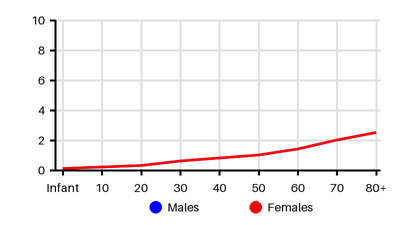
Incidence per 100.000 [cqv][bdk][bor][z2r][igq]
Symptoms & findings
Symptoms
Absent feces, Absent flatus, Constipation, Fever, Ileus, Nausea, Obstipation, Vomiting
Clinical findings
Anamneses
Localized findings
Approach
A diagnosis of exclusion and more common causes of functional or mechanical bowel dilatation must be investigated:
Blood test: complete blood count, electrolytes, thyroid hormone
Feces: Clostridium difficile toxin
Blood gas
Abdominal x-ray + Contrast enema
CT abdomen
Coloscopy + biopsy
Diagnostic criteria: [bdk]
Must include all of the following 4 points:
Onset of 1 or more symptoms of bowel obstruction at least 6 months before a diagnosis
One or both of the following for the previous 12 weeks
a) Abdominal bloating
b) Abdominal pain
Dilatation and/or air-fluid level of the intestine on abdominal X-ray, echo, and/or computed tomography imaging
No evidence of structural disease (on upper and lower gastrointestinal endoscopy, computed tomography, barium enema, and small-bowel follow-through) that could explain the dilatation and/or air-fluid level of the intestine
Important considerations:
Congenital disease and onset before age 15 years must be excluded; only adult onset is included
Surgical history, except surgery for CIPO, within the 6 months before the diagnosis must be excluded to rule out Ogilvie syndrome
CIPO is defined as primary or secondary. Primary CIPO consists of 3 types: myogenic, neurogenic, and idiopathic. Secondary CIPO comprises 2 types: SSc and unclassified
Family occurrence may be present
Neuropathy, such as problems with urination, may be present
Some psychosocial disorder may be present
Treatment
Rule out mechanical obstruction
Supportive care with close observation if uncomplicated [bor][qan]
Bowel rest --> Nothing by mouth
Nasogastric decompression
IV fluid resuscitation
Correct electrolyte abnormalities
Lie prone or in a knee-to-chest position
Frequent turns to promote passage of flatus
Pharmacologic intervention:
Discontinue opiates, anticholinergics, laxative
Neostigmine (acetylcholinesterase inhibitor) 2mg IV over 4 minutes (cardiac monitoring, bradycardia)
Invasive procedures: bowel decompression
Colonoscopy
Surgery (refractory disease, cecal diameter > 12cm, ischemia or perforation)
Differential diagnoses
Acute mesenteric ischemia, Adhesion, Alcoholism, Amyloidosis, Chronic mesenteric ischemia, Colorectal cancer, Constipation, Diverticulitis, Drug side effects, Femoral hernia, Gastrointestinal obstruction, Gastrointestinal perforation, Guillain-Barre syndrome, Hirschsprung's Disease, Incisional hernia, Inguinal hernia, Intestinal hypoperistalsis syndrome, Intussusception, Multiple myeloma, Peritonitis, Pseudomembranous colitis, Toxic megacolon, Umbillical hernia, Volvulus
References
[1] Ahmed S, Sharman T. Intestinal Pseudo-Obstruction. [Updated 2023 Jul 3]. In: StatPearls [Internet]. Treasure Island (FL): StatPearls Publishing; 2025 Jan-. Available from: https://www.ncbi.nlm.nih.gov/books/NBK560669/
[2] DynaMed. Intestinal Pseudo-obstruction. EBSCO Information Services. Accessed 16 January 2025. https://www.dynamed.com/condition/intestinal-pseudo-obstruction
[3] Wells CI, O'Grady G, Bissett IP. Acute colonic pseudo-obstruction: A systematic review of aetiology and mechanisms. World J Gastroenterol. 2017 Aug 14;23(30):5634-5644
[4] Iida H, Ohkubo H, Inamori M, Nakajima A, Sato H. Epidemiology and clinical experience of chronic intestinal pseudo-obstruction in Japan: a nationwide epidemiologic survey. J Epidemiol. 2013;23(4):288-94.
[5] Conner S, Nassereddin A, Mitchell C. Ogilvie Syndrome. Updated 2022 Dec 13: https://www.ncbi.nlm.nih.gov/books/NBK526102/
[6] Ross SW, Oommen B, Wormer BA, Walters AL, Augenstein VA, Heniford BT, Sing RF, Christmas AB. Acute Colonic Pseudo-obstruction: Defining the Epidemiology, Treatment, and Adverse Outcomes of Ogilvie's Syndrome. Am Surg. 2016 Feb;82(2):102-11.
[7] Vanek VW, Al-Salti M. Acute pseudo-obstruction of the colon (Ogilvie's syndrome). An analysis of 400 cases. Dis Colon Rectum. 1986 Mar;29(3):203-10.
[8] Khan Z, Challand CP, Lee MJ. Management of acute colonic pseudo-obstruction: opportunities to improve care? Ann R Coll Surg Engl. 2024 Mar 6.
[9] http://emedicine.medscape.com/article/2162306 (2014-01-02); [Medscape]