Diagnosis
Neuroblastoma
An embryonal neuroendocrine tumor, arising from neural crest progenitor cells of the sympathetic nervous system.
Etiology
Cause [tbf]
Sporadic cases due to acquired mutation
Inherited muttions --> Transmitted mutations in the ALK or PHOX2B genes
Pathophysiology [tbf]
Localisation: Can occur anywhere along the sympathetic nervous system
50% in adrenal medulla
25% in paraspinal sympathetic ganglia
20% in thorax
5% in pelvis
Distant metastases in 50% of infants to lymph node, bone, liver, subcutaneous tissue
Clinical presentation:
Neck, thoracic, or abdominal masses
Horner syndrome (ptosis, miosis, anhydrosis)
Spinal cord compression --> paralysis
Hypertension
Chronic diarrhea
Risk factors
Neurofibromatosis
Beckwith-Wiedemann syndrome
Trisomy 18
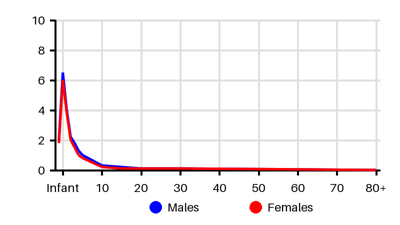
Epidemiology
Incidence per 100.000 [erf][tbf][fgo][7is][scq][p2g]
Symptoms & findings
Symptoms
Anorexia, Ataxia, Blueberry muffin sign, Diarrhea, Dyspnea, Exophthalmos, Failure to thrive, Fatigue, Fever, Hypertension, Irritability, Lethargy, Malaise, Neurofibroma, Opsomyoclonus
Clinical findings
Elevated Alpha-fetoprotein, Elevated Catecholamine, Elevated Homovanillic Acid, Elevated Lactic Dehydrogenase, Elevated Metanephrines, Elevated NSE, Elevated Vanillylmandelic Acid
Anamneses
None listed.
Localized findings
Approach
Blood test: Complete blood cell, erythrocyte sedimentation rate, vanillylmandelic acid–to–homovanillic acid ratio
Urine test: catecholamines
Abdominal x-ray
Abdominal ultrasound
Bone scintigraphy
Pyelography
CT abdomen
MRI
Treatment
Depending on tumor location, grade, and stage: [tbf][orv]
Low-risk neuroblastoma: localized, <5 cm
Observation with imaging every 6-12 weeks
Surgical resection, then observation
Chemotherapy, with or without surgery (if unresectable)
Intermediate-risk neuroblastoma: larger, localized tumor
Multiple-agent chemotherapy (eg, doxorubicin, cyclophosphamide, cisplatin or carboplatin, and etoposide)
Chemotherapy is often given before definitive resection
Surgery and observation
Radiation therapy
High-risk neuroblastoma: Widespread metastatic disease
Chemotherapy
Maximal surgical resection
Stem cell transplantation
Immunotherapy
Radiation therapy
Differential diagnoses
Dermoid Cyst, Ewing sarcoma, Hepatoblastoma, Lymphoma, Neurofibromatosis, Rhabdomyosarcoma, Wilms Tumor
References
[1] Mahapatra S, Challagundla KB. Neuroblastoma. [Updated 2023 Jul 10]: https://www.ncbi.nlm.nih.gov/books/NBK448111
[2] Nong J, Su C, Li C, Wang C, Li W, Li Y, Chen P, Li Y, Li Z, She X, Yuan Z, Liu S, Chen C, Liao Q, Luo Y, Shi B. Global, regional, and national epidemiology of childhood neuroblastoma (1990-2021): a statistical analysis of incidence, mortality, and DALYs. EClinicalMedicine. 2024 Dec 6;79:102964
[3] Schüz J, Kaletsch U, Meinert R, Kaatsch P, Spix C, Michaelis J. Risk factors for neuroblastoma at different stages of disease. Results from a population-based case-control study in Germany. J Clin Epidemiol. 2001 Jul;54(7):702-9
[4] Schilling FH, Spix C, Berthold F, Erttmann R, Fehse N, Hero B, Klein G, Sander J, Schwarz K, Treuner J, Zorn U, Michaelis J. Neuroblastoma screening at one year of age. N Engl J Med. 2002 Apr 4;346(14):1047-53
[5] https://www.kinderkrebsregister.de/fileadmin/kliniken/dkkr/pdf/jb/jb2005/ak2005/kenngr11.pdf
[6] Jaques van Heerden et al., Reporting Incidences of Neuroblastoma in Various Resource Settings. JCO Glob Oncol 7, 947-964(2021)
[7] https://emedicine.medscape.com/article/439263
[8] Kong Y, Ji X, Han X, Zhang B. Pediatric neurological cancer incidence and trends in the United States, 2000-2018. Cancer Causes Control. 2022 May;33(5):687-699
[9] Ajiki, Wakiko, et al. “Effects of Mass Screening for Neuroblastoma on Incidence, Mortality, and Survival Rates in Osaka, Japan.” Cancer Causes & Control, vol. 9, no. 6, 1998, pp. 631–36. JSTOR, http://www.jstor.org/stable/3552911. Accessed 13 Jan. 2025.