Diagnosis
Pericarditis
Inflammation of the pericardial sac surrounding the heart.
Etiology
Causes [zth][ysz][pkg][ynn]
Idiopathic
Virus (developed countries): coxsackievirus B, echovirus, adenoviruses, influenza A and B, parainfluenza virus, enterovirus, mumps virus, EBV, CMV, HSV, VZV, HAV, HBV, HCV, HIV, measles virus, RSV
Bacteria: Tuberculosis (developing countries), Coxiella burneti, Borrelia burgdorferi, Streptococcus, Staphylococcus, Proteus, Escherichia coli, Pseudomonas, Klebsiella, Salmonella, Shigella, Neisseria meningitidis, Haemophilus influenzae, Chlamydia, Mycoplasma, Legionella, Leptospira, Listeria, Providencia stuartii
Purulent pericarditis: complication of intrathoracic infection or hematologic bacterial spread [zth]
Fungus: Histoplasma, Aspergillus, Blastomyces, Candida
Parasite: Echinococcus, Toxoplasma
Inflammatory: RA, SLE, scleroderma, rheumatic fever, Sjogrens syndrome, Churg-Strauss syndrome, Horton disease, Takayasu disease, Behcet syndrome, sarcoidosis, Mediterranean fever, Crohns disease, ulcerative colitis, Still disease, Amyloidosis
Metabolic: renal failure, hypothyroidism, myxoedema, hypercholesterolemia
Cardiovascular: myocardial infarction, Dressler syndrome, aortic dissection, pulmonary arterial hypertension and chronic heart failure
Cancer: breast, lung, leukemia, lymphoma, pericardial mesothelioma
Iatrogenic: Postpericardiotomy, radio frequency ablation
Trauma: direct penetrating injury, indirect radiation, myocardial infarction
Drug side effects:
Lupus-like syndrome: hydralazine, procainamide, methyldopa, isoniazid, anticoagulants, phenytoin
Chemotherapy: doxorubin, daunorubicin, cytosine arabinoside, 5-flourouracil, cyclophosphamide
Penicillins, amiodarone, methysergide, mesalazine, clozapine, minoxidil, dantrolene, practolol, phenylbutazone, thiazides, streptomycin, thiouracils, streptokinase, p-aminosalicylic acid, sulfa-drugs, cyclosporine, bromocriptine, several vaccines, GM-CSF, anti-TNF
Pathophysiology [ynn]
The pericardium is a double-layered, fibroelastic sac separated by 15 to 50 mL of serous fluid
Anchoring the heart within the thoracic cavity
Barrier against extrinsic infections
Reduced friction around the heart
Pericardial inflammation often leads to fluid accumulation within the pericardial sac, resulting in a pericardial effusion (serous, hemorrhagic, or purulent)
Acute and large pericardial effusion can become hemodynamically significant:
External compression the cardiac chambers
Restricted diastolic filling
Cardiac tamponade
Inflammation --> pericardial thickening --> constrictive pericarditis
Complications [eaa][ynn]
Pericardial effusion
Constrictive pericarditis
Cardiac tamponade
Recurrence (30%)
Epidemiology
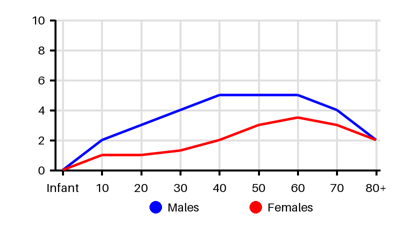
Incidence per 100.000 [1oo][zth][mim][zn9]
Symptoms & findings
Symptoms
Arrhythmia, Cough, Diaphoresis, Distant heart sounds, Dysphagia, Dyspnea, Fever, Kussmaul's sign, Night sweats, Tachypnea, Weight loss
Clinical findings
Elevated CRP, Friction rub, Pericardial effusion, Pleural effusion, PR depression, Pulsus paradoxus, ST elevation
Anamneses
None listed.
Localized findings
Approach
Blood test: troponin, complete blood count, CRP, basic metabolic panel, liver function tests, TSH, viral seromarkers, tuberculosis testing, tumor markers (CEA, CA-19)
Blood gas
Blood culture
ECG
Chest x-ray
Echocardiography
Pericardiocentesis
Pericardial biopsy
Cardiac catheterization
CT/MRI
Diagnostic criteria: at least two of the following criteria [ysz]
Characteristic pleuritic chest pain
Pericardial rub on auscultation
New typical ECG changes (widespread ST-elevation or PR-depression)
Pericardial effusion on imaging
Treatment
Specific therapy appropriate to the underlying disorder is indicated [ysz][aro]
Non-pharmacological recommendation: restrict physical activity until resolution of symptoms and normalization of CRP
High risk case: Tuberculosis, fever > 38C, pericardial effusion, cardiac tamponade, lack of NSAIDs response, immunosuppression, trauma, anticoagulation therapy
Admission and search for etiology: Pericardiocentesis
Anti-tuberculosis antibiotics
Percardiotomy
Low-risk case --> Anti-inflammatory therapy
Aspirin 750-1000 mg every 8h for 1-2 weeks
NSAIDs: Ibuprofen 600 mg every 8h for 1-2 weeks
Colchicine: 0.5 mg x 1 (<70 kg) or 0.5 mg x 2 (>70 kg) for 3 months
Corticosteroids: 20-50mg x 1 (tapering 5-10 mg/day every I-2 weeks)
Differential diagnoses
Angina pectoris, Aortic dissection, Aortic stenosis, Cardiomyopathy, Cholecystitis, Costochondritis, Esophageal perforation, Esophageal rupture, Esophageal spasm, Esophagitis, Gastritis, Gastroesophageal reflux disease, Myocardial infarction, Myocarditis, Pleuritis, Pneumonia, Pneumothorax, Pulmonary embolism, Renal failure, Ruptured aortic aneurysm, Ulcer disease
References
[1] Kytö V, Sipilä J, Rautava P. Clinical profile and influences on outcomes in patients hospitalized for acute pericarditis. Circulation. 2014 Oct 28;130(18):1601-6.
[2] Adler Y, Charron P, Imazio M, Badano L, Barón-Esquivias G, Bogaert J, Brucato A, Gueret P, Klingel K, Lionis C, Maisch B, Mayosi B, Pavie A, Ristic AD, Sabaté Tenas M, Seferovic P, Swedberg K, Tomkowski W; ESC Scientific Document Group. 2015 ESC Guidelines for the diagnosis and management of pericardial diseases: The Task Force for the Diagnosis and Management of Pericardial Diseases of the European Society of Cardiology (ESC)Endorsed by: The European Association for Cardio-Thoracic Surgery (EACTS). Eur Heart J. 2015 Nov 7;36(42):2921-2964.
[3] Zayas R, Anguita M, Torres F, Giménez D, Bergillos F, Ruiz M, Ciudad M, Gallardo A, Vallés F. Incidence of specific etiology and role of methods for specific etiologic diagnosis of primary acute pericarditis. Am J Cardiol. 1995 Feb 15;75(5):378-82.
[4] Dababneh E, Siddique MS. Pericarditis. [Updated 2025 Jul 6]. In: StatPearls [Internet]. Treasure Island (FL): StatPearls Publishing; 2025 Jan-. Available from: https://www.ncbi.nlm.nih.gov/books/NBK431080/
[5] Vecchié A, Chiabrando JG, Dell MS, Bonaventura A, Mauro AG, Wohlford G, Van Tassell BW, Berrocal DH, Montecucco F, Beutler A, Paolini JF, Gal TS, Abbate A. Clinical Presentation and Outcomes of Acute Pericarditis in a Large Urban Hospital in the United States of America. Chest. 2020 Dec;158(6):2556-2567.
[6] Imazio M, Cecchi E, Demichelis B, Chinaglia A, Ierna S, Demarie D, Ghisio A, Pomari F, Belli R, Trinchero R. Myopericarditis versus viral or idiopathic acute pericarditis. Heart. 2008 Apr;94(4):498-501.
[7] Collini V, Siega Vignut L, Angriman F, Braidotti G, De Biasio M, Imazio M. Age-stratified patterns in clinical presentation, treatment and outcomes in acute pericarditis: a retrospective cohort study. Heart. 2024 Aug 26;110(18):1139-1144.
[8] Lazaros G, Antonopoulos AS, Lazarou E, Vlachopoulos C, Vogiatzi G, Vassilopoulos D, Tousoulis D. Age- and sex-based differences in patients with acute pericarditis. Eur J Clin Invest. 2021 Mar;51(3):e13392.
[9] Snyder MJ, Bepko J, White M. Acute pericarditis: diagnosis and management. Am Fam Physician. 2014 Apr 1;89(7):553-60.
[10] http://emedicine.medscape.com/article/157325 (2014-01-21); [Medscape]
[11] http://emedicine.medscape.com/article/156951 (2014-01-02); [Medscape]