Diagnosis
Polycystic kidney disease
Hereditary disease characterized by gradually enlarging benign bilateral cysts of the kidney which lead to reduced renal functioning and renal failure
Also known as: ADPKD, ARPKD, Autosomal dominant polycystic kidney disease, Autosomal recessive polycystic kidney disease
Etiology
Cause [3et]
Autosomal dominant (1 in 800): Mutations to PKD1 (85%) or PKD2 (15%)
Autosomal recessive (1 in 30,000): Mutations in the PKHD1 gene on chromosome 6p12
Also called infantile polycystic kidney disease
Pathophysiology [3et]
Abnormal cell growth that cause ballooning of the tubule in a nephron leading to cyst formation
Cyst formation can occur in proximal and distal tubules but is most common in the distal nephron and collecting duct
The cyst enlarges due to fluid secretion into the cyst and destroying nearby renal tissue and promote renal fibrosis
Clinical presentation:
Pain
Cyst infection
Cyst bleeding
Kidney failure
Increased risk for developing Intracranial aneurysm, liver cysts, heart valve disease and abdominal hernias
Complications [3et]
End-stage kidney disease
Ruptured cerebral aneurysm
Hepatic cysts
Associated with diverticular disease, nephrolithiasis, and abdominal wall or inguinal hernias
Epidemiology
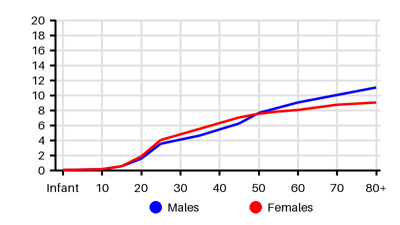
Incidence per 100.000 [gww][etp][esd][bof][ys3]
Symptoms & findings
Symptoms
Fever, Headache, Hematuria, Hypertension, Polyuria
Clinical findings
Elevated Creatinine, Proteinuria, Renal cyst
Anamneses
None listed.
Localized findings
Approach
Blood test: Na, K, Ca, Ph, creatinine, WBC, lipid concentrations, PTH, vitamin D
Urine stix/culture
Urine microsopy
Ultrasound abdomen
CT abdomen
Genetic testing
Diagnostic criteria [esd]
Definite: Ravine-Pei criteria with family history and/or proven genetic mutation
Likely: Bilateral enlarged kidneys with >10 cysts and absence of CKD or other cystic disease
Possible: Normally or mildly enlarged kidneys with cysts > 97.5th percentile and absence of CKD or other cystic disease
Ultrasound Criteria for ADPKD: [3et]
Ages 15 to 29 years: 2 or more cysts, unilateral or bilateral.
Ages 30 to 59 years: 2 or more cysts in each kidney.
Ages 60 years or older: 4 or more cysts in each kidney.
Treatment
Non-operative management: [k3e][3et]
Dietary modifications:
Three liters of PO fluids daily to suppress vasopressin, thereby decreasing cAMP production and inhibiting cyst production
Limit sodium intake to less than 2 grams per day
Control blood pressure: ACEI (enalapril, lisinopril) or ARB (valsartan, telmisartan, losartan, irbesartan, candesartan, olmesartan)
Maintain electrolyte levels: calcium carbonate, calcium acetate, sevelamer, lanthanum carbonate, calcitriol, diuretics
Antibiotics due to kidney cyst infection: ciprofloxacin, ceftriaxone, clindamycin, TMX/SMP
Treat hematuria
Analgesia due to abdominal pain caused by enlarged kidneys
Slow kidney function decline
Hemodialysis/peritoneal dialysis
Surgical intervention:
Surgical drainage of infected cysts: ultrasonography- or CT-guided puncture
Excision/drainage of the outer walls of cysts
Nephrectomy:
Severe pain
Cyst hemorrhage/hematuria
Cyst infection
Renal cell carcinoma
Calculi in nonfunctioning kidneys with persistent urinary tract infections
To increase the abdominal capacity for a future renal transplant
Kidney transplantation
Differential diagnoses
Acute renal failure, Ascites, Bardet-Biedl syndrome, Bladder cancer, Chronic renal failure, Diabetes mellitus, Eclampsia, Heart failure, HIV, Medullary sponge kidney disease, Multiple myeloma, Myocardial infarction, Orofaciodigial syndrome, Ovarian cancer, Preeclampsia, Renal cyst, Renal dysplasia, Rhabdomyolysis, Tuberous sclerosis, Urinary tract infection, Urolithiasis, Von Hippel-Lindau disease
References
[1] Mahboob M, Rout P, Leslie SW, et al. Autosomal Dominant Polycystic Kidney Disease. [Updated 2024 Mar 20]. In: StatPearls [Internet]. Treasure Island (FL): StatPearls Publishing; 2025 Jan-. Available from: https://www.ncbi.nlm.nih.gov/books/NBK532934/
[2] Lanktree MB, Haghighi A, Guiard E, Iliuta IA, Song X, Harris PC, Paterson AD, Pei Y. Prevalence Estimates of Polycystic Kidney and Liver Disease by Population Sequencing. J Am Soc Nephrol. 2018 Oct;29(10):2593-2600.
[3] Willey C, Kamat S, Stellhorn R, Blais J. Analysis of Nationwide Data to Determine the Incidence and Diagnosed Prevalence of Autosomal Dominant Polycystic Kidney Disease in the USA: 2013-2015. Kidney Dis (Basel). 2019 Mar;5(2):107-117.
[4] Suwabe T, Shukoor S, Chamberlain AM, Killian JM, King BF, Edwards M, Senum SR, Madsen CD, Chebib FT, Hogan MC, Cornec-Le Gall E, Harris PC, Torres VE. Epidemiology of Autosomal Dominant Polycystic Kidney Disease in Olmsted County. Clin J Am Soc Nephrol. 2020 Jan 7;15(1):69-79.
[5] Espinosa Cabello M, Ansio Vázquez I, Espejo Portero I, Rodriguez Fuentes D, Rabasco Ruiz C, Espinosa Hernández M. The natural history of autosomal dominant polycystic kidney disease. A strategy for grouping families and mutations. Nefrologia (Engl Ed). 2023 Jan-Feb;43(1):120-125.
[6] Aung TT, Bhandari SK, Chen Q, Malik FT, Willey CJ, Reynolds K, Jacobsen SJ, Sim JJ. Autosomal Dominant Polycystic Kidney Disease Prevalence among a Racially Diverse United States Population, 2002 through 2018. Kidney360. 2021 Sep 22;2(12):2010-2015.
[7] http://emedicine.medscape.com/article/244907 (2014-01-02); [Medscape]